Aerea’s Return from Valyria and Death
Fire & BloodAerea’s Return from Valyria and Death reunited the missing princess with the court only to end in her death within hours. Balerion’s return to King’s Landing revealed that Aerea had endured an ordeal beyond the public explanation of fever; the account Septon Barth later concealed connected her condition and the dragon’s wounds to a perilous journey to Valyria, while leaving its precise cause unknowable.
The Dragon Returns
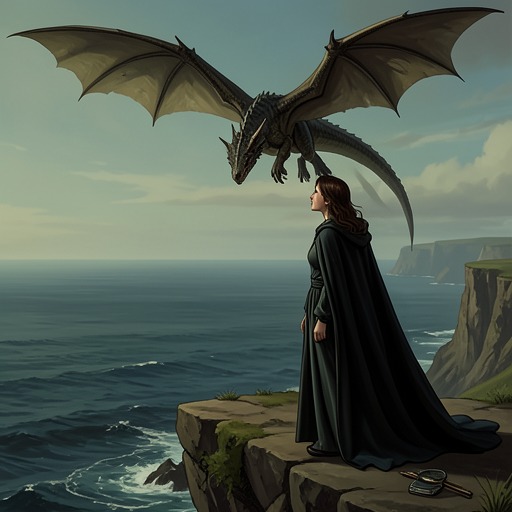
On the thirteenth day of the fourth moon of 56 AC, a guard in a lonely watchtower overlooking Blackwater Bay saw dark wings approaching and sounded the alarm. He sounded it again as the shape grew nearer, then a third time when he recognized a dragon against the clouds. Balerion had returned to King’s Landing after many years away from the city’s skies. His appearance frightened those who remembered the Black Dread and wondered whether Maegor the Cruel had somehow returned to ride him. The rider was instead Aerea, a dying child.
Balerion descended into the inner ward beside Maegor’s Holdfast, his great wings stirring the air across the Red Keep. Aerea slid from his back and collapsed after trying to speak to the people who hurried toward her. The girl who had once been known at court was difficult to recognize: she was gaunt, dressed in little more than rags, and appeared gravely ill. Her arrival did not resolve the mystery of her disappearance; it brought that mystery directly into the royal household.
The alarm had sounded while the court was occupied with ordinary business. Jaehaerys I Targaryen was meeting an envoy of the Iron Bank of Braavos over the Crown’s annual loan payment, and the king questioned the banker about whether the bank had financed Elissa Farman’s ship, Sun Chaser, or knew anything about the stolen dragon eggs. Queen Alysanne was with her children, while Septon Barth and Grand Maester Benifer were elsewhere in the Red Keep. The sudden return of Balerion interrupted these separate routines and drew the court toward the same crisis.
Aerea’s Death and the Public Account
Ser Lucamore Strong carried Aerea across the castle to Grand Maester Benifer. The king and queen were summoned, but Benifer refused them entry to his chambers, saying that seeing the princess in that state would be harmful and that he could not allow them closer. Guards kept other servants away. Septon Barth alone was admitted to perform the rites for the dying.
Benifer tried to reduce Aerea’s fever with milk of the poppy and by placing her in a tub of ice, but neither treatment saved her. As hundreds prayed in the Red Keep’s sept, Jaehaerys and Alysanne kept vigil outside the maester’s door. Aerea died that evening, shortly before the hour of the bat. At sunrise the next day, her body was wrapped in white linen and consigned to the flames. The king announced that his niece had died of a fever and asked the realm to pray for her. King’s Landing mourned for several days, then resumed its ordinary life.
That account was true only in the broadest sense. Barth’s private testimony described a fever unlike any he had seen, one that resisted the maesters’ efforts and caused the princess immense suffering. He recorded that living things moved beneath her skin and eventually emerged after Benifer immersed her in ice. They died in the cold. The public statement omitted these details, as well as Aerea’s whispered pleas for death. Barth and Benifer agreed to conceal what they had witnessed, not only from the wider realm but from the king, the queen, Aerea’s mother, and the archmaesters of the Citadel.
Barth’s Explanation for the Disappearance
Aerea had been missing for more than a year after fleeing Dragonstone. Her mother, Rhaena Targaryen, first suspected that she had gone to King’s Landing, where the princess had openly wished to return to court. Rhaena then looked for her on Fair Isle and in Oldtown. When Aerea was found nowhere in Westeros, Alysanne and Barth considered whether she had flown east to Essos, perhaps believing the Free Cities beyond her mother’s reach. Lord Rego’s agents and informers found no trace of her or Balerion across the narrow sea.
Barth argued that these searches began with the wrong question. Rather than asking where Aerea had taken Balerion, he proposed asking where Balerion had taken Aerea. She was not yet thirteen and had never ridden a dragon. Though she may have intended to reach King’s Landing, visit her twin sister in Oldtown, or seek Elissa Farman, she could not necessarily direct an old and formidable dragon. Barth offered possible reasons for her choice of mount: she may have wanted a creature more fearsome than her mother’s Dreamfyre, or may have wished to master the dragon who had killed her father and his dragon. He acknowledged that her feelings about a father she had never known could not be established.
Barth’s proposed destination was Valyria. Balerion was the oldest and largest of the three dragons ridden by Aegon and his sisters during the Conquest. Unlike Vhagar and Meraxes, who had hatched on Dragonstone, Balerion had come there with Aenar Targaryen and Daenys Targaryen. He had outlived the older dragons, growing larger and more willful, and Barth considered him perhaps the only living creature who had known Valyria before the Doom. From those circumstances Barth inferred that the dragon had carried Aerea there, whether or not she had gone willingly. He could not say what had happened to her during the journey or in Valyria, and presented the destination as an explanation rather than a proven account.
The Dragon’s Wounds and the Account’s Afterlife
Balerion himself returned injured. Barth recorded half-healed scars and a jagged wound nearly nine feet long along the dragon’s left side. Its appearance gave weight to the possibility that Balerion had encountered danger during his absence, but it could not establish what that danger was or confirm Barth’s reconstruction. His testimony suggested that the creatures found inside Aerea might belong to Valyria, where, according to his account, the Valyrians had practiced blood magic and other arts that altered living bodies. Those claims remained conjecture, set against a place already feared and avoided by sailors.
Barth also rejected several rumors that had circulated after Aerea’s return, including stories linking Balerion to strange reports from the Velvet Hills of Andalos, the Disputed Lands, or Astapor. These, he said, were distractions rather than answers. The princess’s disappearance, the dragon’s unexplained absence, and the circumstances of her death remained unresolved even after he offered Valyria as the likeliest destination.
Barth’s account stopped after warning that some doors were best left unopened. He never wrote again about Aerea’s fate, and the testimony remained sealed among his private papers for almost a century. The secrecy protected the royal family and the wider realm from an account its authors could not explain, but it also ensured that the fullest record of the event survived outside the public history. The experience had a lasting effect on Barth: it intensified the hunger for knowledge he called his own abiding sin and preceded his investigations into dragons and related creatures. The Citadel later condemned his book, Dragons, Wyrms, and Wyverns: Their Unnatural History, as provocative but unsound, and Baelor the Blessed ordered it destroyed. Aerea’s return thus ended not with an answer, but with an enduring tension between what witnesses saw, what the court announced, and what Barth believed the evidence implied.