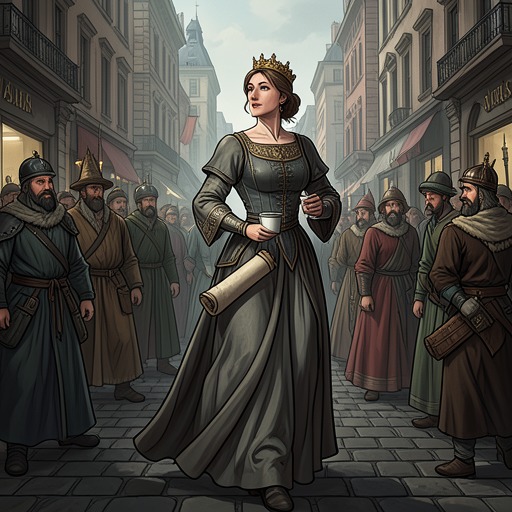
Alaric Stark
Fire & BloodAlaric Stark, Lord of Winterfell, is introduced as a hard and reserved northern ruler whose suspicion of southern customs is matched by a strong sense of duty to his people and the Night’s Watch. Queen Alysanne’s visit exposes the distance between his house and the royal court, but also revises the reputation that precedes him: beneath his flinty manner is a father, widower, and capable ally whose eventual agreement helps enlarge the lands supporting the Watch.
Lord of Winterfell and his household
When Alysanne flew ahead to Winterfell Castle on Silverwing, Alaric and his sons alone came out to greet her. His reputation was severe even among those who knew him: he was described as stern, unforgiving, tight-fisted, humorless, joyless, and cold. Theomore Manderly, his bannerman, said Alaric was respected in the North but not loved; Manderly’s fool made the judgment more crudely, suggesting that the lord had not moved his bowels since he was twelve. The queen arrived expecting a difficult host, and Alaric’s first words did little to soften that expectation.
Alaric had been a widower for three years. When Alysanne expressed regret that she had never met his wife, he described her not as a southern court might have defined a lady, but through her toughness: she was a Mormont of Bear Island who, at twelve, took an axe to a pack of wolves, killed two, and made a cloak from their skins. She had also given him two strong sons and a daughter he considered as lovely as any southern lady. The account places his family within the North’s own measure of courage and worth, rather than the courtly standards Alaric assumes the queen might bring with her.
Alysanne’s reception and the question of marriage
Alaric made his distrust plain before the queen had even dismounted. He looked askance at her clothing and warned, “I hope you brought something warmer than that.” He refused to let Silverwing inside the castle, recalling what had happened at Harrenhal, and made clear that her retinue—and the king, if he found his way north—must not expect an extended stay. Winter, he said, was coming, and the North could not feed a thousand men for long. When Alysanne assured him that only a tenth that number would arrive, he replied, “That’s good. Fewer would be even better.” He was also uncertain how to entertain a queen and warned her that she had come to the wrong place if she expected balls, masques, and dances.
The most consequential early disagreement concerned his sons’ marriages. Alysanne offered to help arrange matches with the daughters of great southern lords. Alaric refused: “We keep the old gods in the North,” he said, insisting that his sons would marry before a heart tree, not in a southern sept. The exchange set a limit on the queen’s attempts to bind the realm through noble marriages. Aegon I’s court had used cross-realm matches as a deliberate means of drawing former enemies into a shared political order, and his queens had arranged marriages ranging from a Stark daughter’s match with Ronnel Arryn to a double wedding meant to reconcile the Blackwoods and Brackens. Alaric’s answer shows that such policy met a distinct religious and cultural boundary in the North; Alysanne did not claim that the boundary was meaningless, but argued that southern houses could also honor the old gods and that some, such as the Blackwoods, had never accepted the Faith of the Seven. He allowed that he would consider her point and raise it with his sons. No marriage agreement for them is established.
A thaw in Winterfell
The longer Alysanne remained at Winterfell Castle, the more Alaric warmed to her. The queen discovered that several parts of his reputation were misleading. He was careful with money but not niggardly, and he did have a sense of humor, though it was sharp-edged. His children and the people of the castle appeared to love him. His change in manner was expressed through practical acts of hospitality rather than a sudden rejection of his reserve: he took Alysanne hunting for elk and wild boar in the wolfswood, showed her the bones of a giant, and let her explore his modest library. He even approached Silverwing, cautiously.
Alysanne also grew close to Alaric’s daughter, Alarra, as the women of Winterfell became more receptive to the queen. When the rest of Alysanne’s party finally reached the castle after struggling through trackless bogs and summer snows, Alaric welcomed them with meat and mead despite the king’s continued absence. His conduct contrasts with his initial insistence that the royal party should not linger: once the first frost between host and guest had passed, he did not withhold hospitality from those who had made the arduous journey north.
Walton Stark and the New Gift
Jaehaerys’s arrival brought a more painful dispute. Alaric led the king into the crypts beneath Winterfell Castle to show him the tomb of his brother Walton. He blamed the deaths of men like Walton on the king’s decision to send large numbers of convicted oathbreakers to the Wall, where the Night’s Watch had struggled to feed them and ultimately had to put down those who rebelled. Jaehaerys acknowledged the grievous price and offered regret and gratitude, but Alaric answered, “I would sooner have my brother.” The exchange makes clear why the two men never became friends: royal regret could not undo the loss, and Walton’s death remained between them to the end.
Alysanne nevertheless created room for practical accord. After visiting Brandon’s Gift, she argued that its thin, stony soil and sparsely populated hills could not adequately sustain the Night’s Watch, particularly when winter brought hunger and the Watch lacked coin. She proposed granting it an additional strip of land to form a New Gift. Alaric supported the Watch but recognized that the lords holding the proposed lands would object to losing them without consent. Alysanne pressed him to persuade them. Charmed by her, he agreed that he could, and the Gift was doubled. His contribution was therefore not simply assent to the queen’s proposal: the plan depended on his willingness to persuade the northern lords whose lands were at stake.
Character and significance
Alaric’s encounters with Alysanne reveal a ruler who does not readily translate royal intentions into northern obligations. He guards his household’s customs, resists southern marriage arrangements, and judges the king through the concrete cost of a policy that brought oathbreakers to the Wall and left his brother dead. Yet he is not fixed in opposition. He listens to the queen’s case, revises his first impression of her, and accepts a demanding role in securing more land for the Night’s Watch. The contrast between his first welcome and his later hospitality, and between his grief in the crypts and his cooperation over the New Gift, gives his brief appearance its defining shape: trust is neither assumed nor complete, but a workable settlement becomes possible through Alysanne’s persistent mediation.