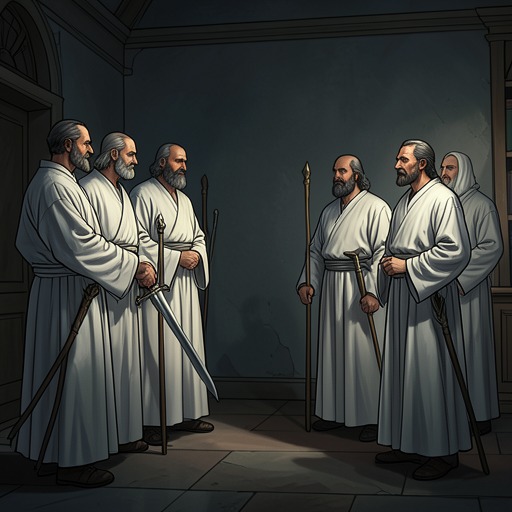
Arryk Cargyll
Fire & BloodArryk Cargyll was one of the Kingsguard whose loyalty to Aegon brought him into direct conflict with his identical twin, Erryk, who served Rhaenyra. Their final encounter on Dragonstone ended with both brothers dead, making Arryk’s story a stark instance of the civil war’s power to turn sworn service into a conflict between kin.
Identity and service
The Kingsguard was a brotherhood of seven knights sworn to defend the king and his family. When Viserys died, only five of its white cloaks were in King’s Landing: Arryk, Lord Commander Criston Cole, Rickard Thorne, Steffon Darklyn, and Willis Fell. Erryk and Lorent Marbrand were with Rhaenyra on Dragonstone, unaware of the events unfolding in the capital. The brothers thus began the crisis on opposite sides of the bay, each serving a different claimant.
Arryk’s existing familiarity with Dragonstone later made him useful to Aegon’s cause. He had visited the ancient Targaryen seat often during Viserys’s reign, and his resemblance to Erryk was so complete that even fellow Kingsguard could not distinguish them. In the plan Criston devised, those two facts—Arryk’s knowledge of the island and his twin’s presence there—made disguise a weapon.
The peace mission and the brothers’ separation
After news reached the Red Keep that Rhaenyra had been crowned, Aegon refused to accept her claim. The two queens, Alicent and Helaena, nevertheless supported Grand Maester Orwyle’s proposal to seek terms rather than proceed immediately to open war. Orwyle crossed Blackwater Bay under a peace banner, accompanied by Arryk, Gwayne Hightower, and a party that included scribes and septons.
Rhaenyra rejected the offered settlement. She challenged Orwyle over whom Viserys had named as his heir and, after he acknowledged her claim, had his chain of office removed and given to Maester Gerardys. As the envoys departed, Arryk was therefore returning to a court where the proposed peace had failed and the king’s anger had hardened into a demand for action.
A later song, Farewell, My Brother, claims that Arryk and Erryk met as the party prepared to leave Dragonstone. In the ballad, each tries to persuade the other to change allegiance before they part with declarations of love, knowing their next meeting will be as enemies. The account may preserve a real farewell, but the surviving sources do not confirm that such a meeting took place. The song’s emotional symmetry is therefore not secure historical testimony; it is a later version of the divide that the brothers’ service made unavoidable.
The mission to Dragonstone
Criston persuaded Aegon’s council against an overt attack on Dragonstone and proposed a covert strike instead. Arryk was chosen to carry it out. He was to travel to the island in the clothes of a fisherman, then put on his armor and white cloak and enter the castle while passing as Erryk. The sources disagree about the precise target: Grand Maester Munkun says Arryk was ordered to kill Rhaenyra, while Mushroom says the intended victims were her sons, Jacaerys and Joffrey. The evidence establishes the mission’s lethal purpose but not a settled account of whom Arryk was meant to kill.
Arryk did not undertake the assignment gladly. Septon Eustace reports that he went to the Red Keep’s sept to pray to the Mother Above for forgiveness on the night he was to sail. Yet his vows as a Kingsguard, and his obligation to obey his king and commander, left him with no honorable choice as he understood it. He reached Dragonstone without hindrance, changed into his white cloak, and gained entry under his brother’s identity.
The twins’ final encounter
As Arryk made his way toward the royal apartments, he came face-to-face with Erryk, who recognized what his brother’s arrival meant. Their encounter transformed a calculated act of disguise into a confrontation between two men who knew one another intimately and had sworn themselves to rival rulers. The singers give them declarations of love before they draw their swords, but those words belong to the reported, romanticized version of the scene rather than to an uncontested account.
Munkun describes a fight lasting nearly an hour, heard by much of the queen’s court. The onlookers could not intervene, since they could not tell which of the identical white-cloaked men was which. In his account, each brother dealt the other a mortal wound, and they died in one another’s arms. Mushroom gives a shorter and harsher version: the fight lasts only moments, the twins condemn each other as traitors, and their deaths do not occur together. Septon Eustace offers only the conclusion that the brothers slew one another. The accounts agree on the essential outcome—Arryk and Erryk killed each other—but leave the manner and emotional character of their last moments uncertain.
Narrative significance
Arryk’s defining action is also the end of his recorded story. He enters Dragonstone intending to exploit the very resemblance that binds him to Erryk; instead, that resemblance makes the encounter impossible for the court to interpret or stop. The failed disguise does not simply frustrate the mission: it brings the war’s competing loyalties into a private, irreversible collision.
The differing accounts show how quickly that collision became a story reshaped by its tellers. Munkun’s extended duel and the singers’ affectionate farewell turn the brothers’ deaths into a tragedy of mutual love; Mushroom rejects the tenderness and stresses accusation, while Eustace leaves the details unadorned. Arryk remains important less for any lasting political result than for the human cost embodied in his final act: a Kingsguard’s obedience sends him against the brother who has taken the other side, and neither survives their meeting.