Bartimos Celtigar
Fire & BloodBartimos Celtigar was a lord who served as master of coin under Queen Rhaenyra. He pressed the queen to distrust two of her dragonriders because they were born outside marriage, and later proposed taxing every child born out of wedlock. As Rhaenyra’s authority weakened, the policy-minded official became a target of the unrest: rioters seized him at his manse, and Wat the Tanner later displayed his severed head while proclaiming an end to taxes.
Office and Place in Rhaenyra’s Council
Bartimos appears in the account as Rhaenyra’s master of coin and a participant in the discussions of her council. His office gave him a direct interest in the Crown’s finances, but the evidence also shows him intervening in questions of loyalty and security. When the council considered whether Addam Velaryon and Nettles might defect, Bartimos argued for their immediate seizure. His contribution was not a report of discovered disloyalty: it was a demand for preventive action based on his belief that their birth made them untrustworthy.
The argument placed him among the councillors who treated the dragonseeds’ origins as grounds for suspicion. Ser Luthor Largent, commander of the City Watch, and Ser Lorent Marbrand, Lord Commander of the Queensguard, supported taking the riders into custody; Ser Medrick Manderly and Ser Torrhen Manderly also urged caution. Against them, Lord Corlys Velaryon defended Addam and Nettles, while Grand Maester Gerardys said there was no proof that either had betrayed the queen. The dispute was therefore about whether the possibility of another defection justified acting against people for whom the council had no evidence of treason.
Suspicion of the Dragonseeds
Bartimos framed bastardy as an inherited disposition toward treachery, contrasting it with the loyalty he associated with trueborn men. His reasoning turned status into presumed character: because Addam and Nettles were baseborn, he believed they might join the enemy with their dragons. The danger he emphasized was practical as well as political. In the view of Ser Torrhen Manderly, losing two more dragons could leave the queen’s side unable to prevail.
Corlys offered a different account of the evidence. He called Addam and his brother Alyn true Velaryons and worthy heirs to Driftmark; he also pointed to Nettles’s courage in the Battle of the Gullet. Bartimos answered that the two dragonseeds who had already defected had fought valiantly too. The disagreement thus showed the limits of using battlefield service as proof of loyalty: for Bartimos, past courage could not dispel the risk he attached to their birth. Rhaenyra did not order an immediate arrest after this debate, but her suspicions had been stirred. She sought Mysaria’s judgment, and Mysaria alleged that Nettles had betrayed her by sharing Daemon Targaryen’s bed. The account presents Bartimos’s warning as part of the atmosphere in which suspicion grew, not as proof that Nettles or Addam had plotted against the queen.
Tax Proposal and Political Consequences
After Addam fled before he could be questioned, Mysaria treated the flight as confirmation of guilt, and Bartimos agreed. He then proposed a punitive tax on every child born out of wedlock. The measure had two stated purposes: replenishing the Crown’s coffers and, as he put it in policy terms, reducing the number of bastards in the realm. His proposal carried the council’s suspicion beyond the two disputed dragonriders and into a levy aimed at thousands of people on the basis of their birth.
The proposal joined a financial problem to a broader assertion of royal power. Bartimos’s office concerned the treasury, and he presented the levy as a source of revenue; yet it was also designed to punish an entire class of people. The evidence does not establish how far the tax was implemented or what revenue it produced. It does show that, amid repeated defections, Bartimos supported an expansive response that treated suspicion of individuals as grounds for a general penalty. His policy position made him especially exposed when a city already in revolt turned against taxes and the officials associated with them.
The Riot and His Death
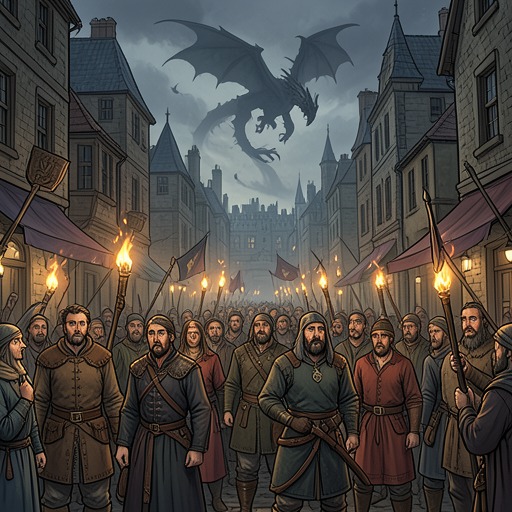
The rioting in King’s Landing began in Flea Bottom and spread through the city amid calls for justice for the dead princes and their murdered mother. When the mob reached Bartimos’s walled manse, only six guardsmen and a few hastily armed servants defended it. The defenders either abandoned their weapons and fled or joined the attackers. Arthor Celtigar, fifteen years old, briefly held a doorway against the crowd, but a serving girl let the rioters in by another entrance, and Arthor was killed.
Bartimos tried to reach the stables, only to find that his horses had been killed or stolen. The rioters captured him and forced him to reveal where his wealth was hidden. Wat the Tanner then accused him of failing to pay the so-called cock tax, turning the allegation into a public humiliation. Later, Wat rode through the streets carrying Bartimos’s severed head and declaring that taxes had ended. Bartimos’s death therefore became part of the riot’s spectacle and its attack on royal extraction: the master of coin was made into a symbol of the levies that the mob rejected.
Significance
Bartimos’s brief but consequential role connects the council’s response to the dragonseeds with the popular revolt in King’s Landing. He urged the queen to treat contested birth as evidence of disloyalty, then supported extending punishment for illegitimacy into taxation. In the later riot, the same city politics turned violently against the officials and fiscal demands associated with Rhaenyra’s government. His fate does not demonstrate that his suspicions about the dragonseeds were correct; it shows instead how fear of betrayal and the search for revenue could produce policies whose consequences reached far beyond their immediate targets. The contrast between his demand for pre-emptive control and his own household’s collapse under attack gives his story a pointed ending: a royal official who sought to make suspicion the basis for action could not secure even his own manse when the queen’s authority failed.