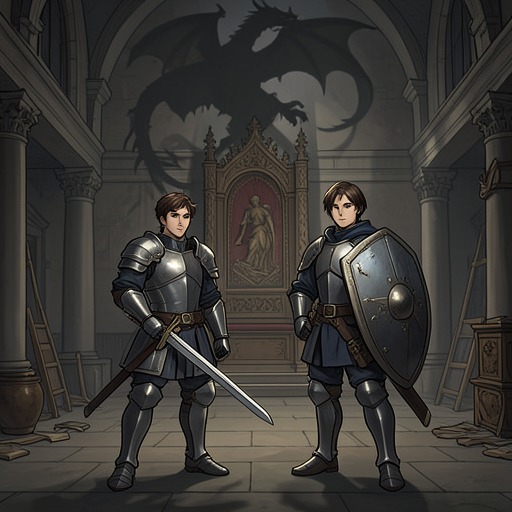
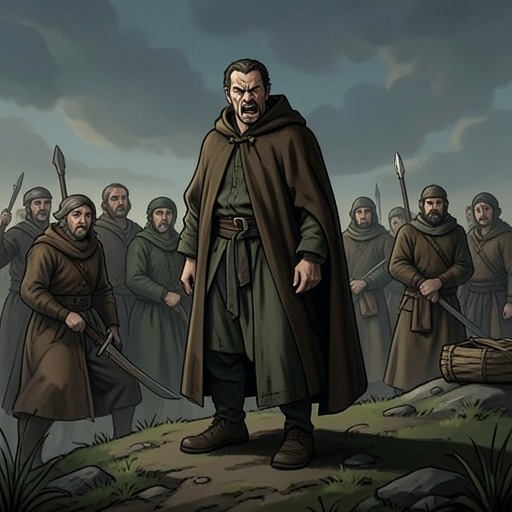
Blackfyre wielded by Aegon the Conqueror and Maegor
Fire & BloodBlackfyre wielded by Aegon the Conqueror and Maegor is the ancestral Valyrian steel sword carried by Aegon Targaryen and later given to his son Maegor. Its history joins the Conqueror’s martial reputation to the succession crisis after his death: Aegon’s sword was burned with him, restored to the living by Maegor, and then used to execute the Grand Maester who challenged Maegor’s claim to the Iron Throne.
The Conqueror’s sword
Aegon carried Blackfyre as a warrior counted among the greatest of his age. That reputation did not mean he sought combat for its own sake: he took no pleasure in feats of arms and never rode in a tourney or melee. The sword thus belonged to a public image built around the capacity to command and fight, even as Aegon’s actual rule relied on trust in his council and sisters, and on his own intervention when he judged it necessary.
Blackfyre remained with Aegon until his death on Dragonstone in the thirty-seventh year After the Conquest. His grandsons Aegon and Viserys were present in the Chamber of the Painted Table, where the king had been showing them the details of his conquests. For his funeral, Aegon was dressed in battle armor, his mailed hands folded over the sword’s hilt. The arrangement placed the blade beside the king who had carried it through the making of his realm, before Valyrian funerary custom consigned both to fire.
The funeral and recovery
House Targaryen’s custom since Old Valyria was to burn its dead rather than bury them. Vhagar supplied the flames for Aegon’s funeral pyre in the castle yard, and Blackfyre was burned with him. The sword did not remain lost: Maegor retrieved it afterward. Its blade had grown darker, but was otherwise unharmed, an outcome the account explains through the resistance of Valyrian steel to ordinary fire.
The scene makes the sword’s survival a material link between the dead king and the political struggle that followed. Aegon’s body was consumed according to the family rite, but the blade endured and passed into the hands of the son who would soon contest the succession. Its return from the pyre was not, by itself, a declaration of Maegor’s right to rule; it did, however, leave him in possession of a weapon closely associated with his father’s kingship.
A bequest with consequences
Aenys returned from Highgarden on Quicksilver for his father’s funeral. After the rites, he put on Aegon’s iron-and-ruby crown and was proclaimed king. When Maegor’s turn came to kneel, Aenys drew him upright, kissed his cheek, and told him that he need never kneel again because the brothers would rule together. He then gave Maegor Blackfyre, saying, “You are more fit to bear this blade than me. Wield it in my service, and I shall be content.”
The gesture expressed brotherly confidence, but the later account judges the bequest unwise. Visenya had already given her son Dark Sister; with Blackfyre, Maegor now held both ancestral Valyrian steel swords of House Targaryen. From then on he wielded Blackfyre, while Dark Sister hung on the walls of his chambers on Dragonstone. The contrast is specific: one sword became the weapon Maegor carried, while the other remained displayed, and Aenys’s attempt to entrust his brother with a place in his reign left the new king armed with both family blades.
Blackfyre and Maegor’s claim
After Aenys died, Maegor came to Dragonstone and claimed the crown. He chose their father’s iron crown set with blood-red rubies, rather than the ornate golden crown Aenys had favored. Grand Maester Gawen objected that the laws of inheritance, affirmed by the Conqueror after the Conquest, entitled Aenys’s son Aegon to the Iron Throne. Maegor answered, “The Iron Throne will go to the man who has the strength to seize it,” and immediately executed Gawen, taking off the old man’s head with a single swing of Blackfyre.
Here the sword’s role becomes explicit and terrible. It is no longer only the weapon recovered from the Conqueror’s pyre or a gift entrusted to a brother’s service: Maegor uses it to kill the official who voices the hereditary claim of Aenys’s son. The act gives physical force to Maegor’s rejection of lawful inheritance, converting the blade associated with Aegon’s rule into an instrument of the usurpation that follows.
Blackfyre’s record in these episodes therefore depends on more than its exceptional material. The account emphasizes its survival in ordinary fire, its inheritance from Aegon to Maegor, and its use in a decisive political killing. At Aegon’s funeral, the blade lay folded beneath the dead king’s hands; in Maegor’s seizure of power, it struck down the voice of succession law. Its passage preserves continuity of dynastic possession while exposing how little that continuity guarantees continuity of rule.