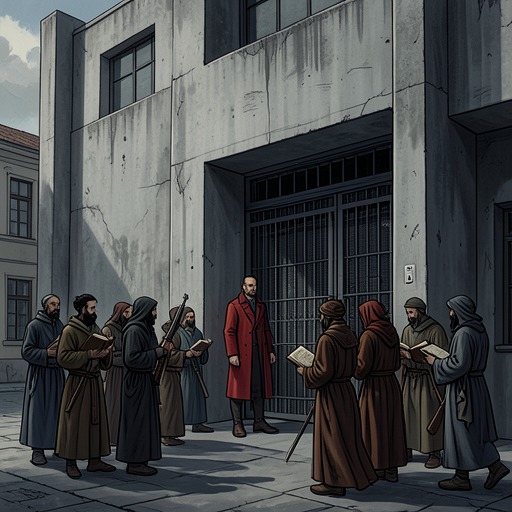
Burning of the Sept of Remembrance
Fire & BloodThe Burning of the Sept of Remembrance was Maegor’s attack on a fortified sept on the Hill of Rhaenys, where seven hundred Warrior’s Sons had gathered for morning prayers. Its destruction struck at the Faith Militant’s strongest fighters and began a conflict that would continue throughout Maegor’s reign. The episode turns public celebration into a weapon of rule: Maegor appeared restored before the city, then used Balerion to destroy a religious stronghold within it.
Return of Alys Harroway and Tyanna
On the twenty-eighth day after the Trial of Seven, a ship from Pentos arrived carrying Alys Harroway, Maegor’s second wife, Tyanna of the Tower, and six hundred sellswords. Tyanna, the daughter of a Pentoshi magister, had risen from tavern dancing to courtesanship. Rumors attributed poisoning and sorcery to her, while accounts differed over whether she was Maegor’s concubine or Alys’s paramour. The record establishes her sudden arrival and uncertain standing, not the truth of those rumors.
Queen Visenya dismissed Maegor’s maesters and septons and entrusted him to Tyanna’s care as soon as she arrived. The next morning Maegor rose with the sun and appeared on the Red Keep’s walls between Alys and Tyanna. The city’s cheering at his return preceded the attack by only a short interval, setting the public image of a king recovered against the violence that followed.
The Attack on the Sept
After appearing before the crowd, Maegor mounted Balerion and descended on the Hill of Rhaenys. Seven hundred Warrior’s Sons were praying inside the fortified sept. Dragonfire set the building alight, while archers and spearmen waited outside for those who tried to flee. The assault killed the gathered fighters; its smoke remained over King’s Landing for days.
The attack was not the end of the Faith Militant’s resistance. Other chapters remained at Oldtown, Lannisport, Gulltown, and Stoney Sept. Yet the destruction of the Warrior’s Sons at the sept removed the order’s foremost force, and it never again approached its former strength. Maegor’s war against the Faith Militant had only begun.
Crowns, Sanctuaries, and Rule
The attack gives sacred space a stark place in the history of Targaryen kingship. Aegon the Conqueror’s first crowning was marked by a red three-headed dragon standard and the acclamation of lords and smallfolk; at Oldtown, the High Septon later anointed him with the seven oils in the Starry Sept. Those ceremonies joined royal authority to public recognition and religious ritual. Maegor’s assault, by contrast, brought a dragon into a city and turned a fortified place of prayer into a target.
Coronations continued to make authority visible during the later succession crisis. At Aegon II’s coronation, Criston Cole placed the Conqueror’s iron-and-ruby crown on his head, while Septon Eustace anointed him. On Dragonstone, Daemon Targaryen placed Jaehaerys the Conciliator’s crown on Rhaenyra’s head as she claimed the throne. These ceremonies differ sharply from Maegor’s attack, but all show how rule was asserted through public acts and charged symbols. The sept’s destruction is the violent counterpoint: rather than seeking religious sanction, Maegor made force against the Faith Militant unmistakable.
The later assault on the Dragonpit offers another contrast in which religious fervor and royal dragons meet in the streets of King’s Landing. A crowd of dragon-slayers marched toward the pit, growing as it moved; Rhaenyra ordered the city’s remaining defenders to disperse the crowd and protect the royal dragons. The events are distinct, but together they show how the dragons that signified Targaryen power could also draw resistance into the city’s sacred and public spaces.