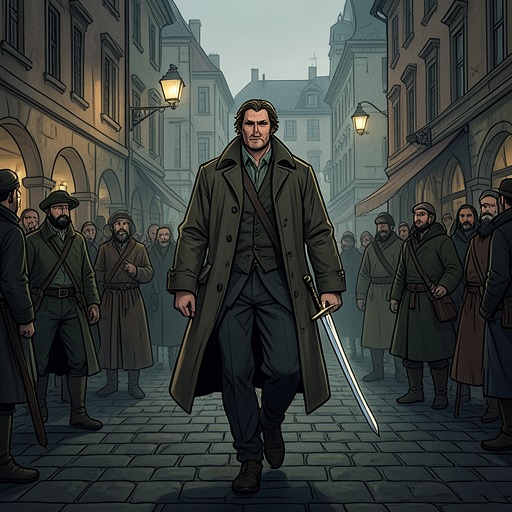
Cregan Stark and Alysanne Blackwood's Marriage
Fire & BloodCregan Stark and Alysanne Blackwood’s marriage joined a personal attachment to a consequential bargain in the unsettled aftermath of the civil war. Alysanne appealed to Cregan to let Aegon III’s order sparing Corlys Velaryon stand, although Cregan had the authority to disregard it and proceed with Corlys’s execution. The account attributes his decision to a bargain with Alysanne: he granted her request and asked her to marry him. Their wedding followed in 132 AC at Winterfell.
Background and Connection
Alysanne met Cregan while she was at court in King’s Landing accompanying her young nephew, Benjicot Blackwood. Cregan had been a widower for three years. The account presents their interest as mutual: Alysanne developed a liking for the stern Lord of Winterfell, and Cregan began seeking her company in the hall and yard. Their courtship thus preceded the plea that would make their relationship politically consequential; the marriage was not introduced solely as an arrangement between houses.
The narrative also gives Alysanne an identity beyond her kinship to Benjicot or her later place beside Cregan. She was a huntress, a horse-breaker, and an accomplished archer, described as physically strong and fearless. Her stubbornness and direct manner are presented as qualities that appealed to Cregan. This characterization matters to the account of their relationship: she enters the political scene as someone able to approach a formidable lord and make a request, not merely as a bride selected by others.
The Plea and the Bargain
The marriage took shape during the dispute over Corlys Velaryon’s fate. Aegon III, then ten and not yet crowned, had asked that Corlys be spared and restored to his offices and honors. Cregan Stark could have ignored the boy’s decree: the young prince’s command had no legal force, and Cregan would still have been within his rights to carry out the execution. His choice not to do so therefore required an explanation beyond the prince’s formal authority.
The accounts offer competing possibilities. Septon Eustace suggests a religious prompting, and also proposes that Cregan feared the strength of the Velaryon fleet. The narrative questions the latter explanation as inconsistent with Cregan’s character. Mushroom instead identifies Alysanne as decisive: she asked Cregan to let the prince’s order stand. When Cregan questioned whether sparing a traitor could serve the realm, Alysanne appealed to the realm’s interests. The disagreement reveals the stakes of her intervention. This was not simply a private favor; Corlys’s execution could have frustrated the attempt to preserve the young king’s settlement and risked renewed conflict.
Cregan granted the boon and named marriage as what he wanted in return. Alysanne accepted. The exchange links her political appeal directly to their union, without erasing the prior attraction between them. She had already sought his company and he hers; the bargain gave that attachment a public and consequential form. Alysanne’s role was therefore both personal and political: her request helped determine whether Cregan would honor the prince’s decision, while the marriage bound her future to the lord whose choice she had influenced.
Wedding at Winterfell
The marriage took place later in 132 AC, after a difficult journey north. Benjicot Blackwood, Alysanne’s nephew and Lord of Raventree, led a party to Winterfell to witness the wedding. With winter already gripping the North, the journey took three times as long as expected. Riders lost half their horses amid severe snowstorms, and outlaws attacked Benjicot’s carts three times, taking much of the party’s food and all the wedding gifts.
Despite those losses, the wedding itself was said to be splendid. Alysanne and Cregan pledged their troth before Winterfell’s heart tree, in the icy godswood. The ceremony placed their union within the Stark seat and its northern traditions, while Benjicot’s presence connected the bride’s House Blackwood family to the occasion. At the feast, four-year-old Rickon, Cregan’s son by his first wife, sang for his new stepmother. The detail marks Alysanne’s entry not only into a marriage but into the household of a widower with a young child.
Significance of the Marriage
The account makes the marriage the personal resolution of a political exchange. Alysanne’s appeal helped secure Corlys’s reprieve and restoration, while Cregan’s proposal turned the granted favor into a lasting bond. Their relationship consequently stands at the meeting point of private attachment, household formation, and the fragile postwar settlement. The evidence does not describe their married life beyond the wedding and Rickon’s welcome, but it establishes the circumstances in which their union began.
The episode also gives Alysanne unusual agency within the political aftermath. She did not command Cregan’s forces or hold his office; she influenced the outcome by making a direct appeal to him, grounded in the welfare of the realm. Cregan’s answer made that intervention consequential, and his request for marriage made the bargain personal as well as political. The journey’s losses and the ceremony at Winterfell then carry the agreement out of the court and into the Stark household, where Alysanne became Rickon’s stepmother.