Dance of the Dragons Civil War
Fire & BloodThe Dance of the Dragons Civil War was fought from 129 to 131 AC over the Iron Throne, pitting Rhaenyra Targaryen’s claim against that of her half-brother Aegon II Targaryen. Its roots lay decades earlier in the succession choices and expanding royal family of Jaehaerys I Targaryen and Alysanne Targaryen; its opening political crisis produced rival coronations, and the conflict eventually drew the people of King’s Landing toward the Dragonpit in a mass uprising against the dragons.
Origins in a Crowded Succession
The war’s origins reached back to the long and peaceful reign of Jaehaerys I Targaryen. He and Alysanne ruled together until her death in 100 AC and had thirteen children. Four—two sons and two daughters—lived to adulthood, married, and had children of their own. The resulting abundance of Targaryen princes and princesses multiplied the number of potential claims to the throne; historians later regarded the family’s tangled succession as a seedbed for the civil war, or for a similar struggle.
For a time, the succession appeared secure. Jaehaerys’s eldest son, Aemon, was named heir, while his younger brother Baelon was regarded as a capable reserve. Aemon’s death on Tarth in 92 AC broke that arrangement. Jaehaerys named Baelon heir, bypassing Aemon’s daughter Rhaenys. After Baelon’s death, the question of succession returned, and the Great Council of 101 AC chose Viserys Targaryen over Rhaenys’s son, Laenor Velaryon, by a margin said to exceed twenty to one. Many took the decision to establish that a woman could not inherit the Iron Throne, nor pass a claim to her male descendants.
That precedent formed a powerful background to the later contest, but it did not settle the succession that divided the realm. Viserys I Targaryen continued to intend that his daughter Rhaenyra should succeed him, and that her sons should follow her. Meanwhile, hostility between Rhaenyra and Queen Alicent Hightower passed into the next generation: Alicent’s sons grew into bitter rivals of Rhaenyra’s Velaryon nephews, whom they regarded as having taken their birthright. Shared feasts, lessons, and training brought the boys together in proximity without reconciling their claims.
Family, Marriage, and Rival Claims
The scale of the dynasty was shaped by marriage and childbirth as well as formal succession. Aegon I Targaryen had married both his sisters, Rhaenys Targaryen and Visenya Targaryen, and each queen bore him a son. In a later generation, Aenys Targaryen married Alyssa Velaryon, a marriage between members of two families of Valyrian descent. Their children included Jaehaerys and Alysanne, whose many descendants would enlarge the field of possible heirs.
The family’s marital customs also crossed the lines of political rivalry. In 122 AC, Viserys married his elder son, Aegon, to his daughter Helaena, joining the future claimant to his sister. Helaena soon bore twins, Jaehaerys and Jaehaera, and later a second son, Maelor. Aegon’s marriage and children gave the faction around him direct dynastic stakes of its own, while Rhaenyra’s children were central to the succession Viserys intended to preserve. The conflict therefore involved not only the king’s immediate heirs, but rival branches of a large royal family.
The precedent of 101 AC and Viserys’s designation of Rhaenyra did not yield a shared understanding of who should inherit. Each claim could be linked to royal descent, yet the two claims could not be exercised together. The political struggle was consequently both a contest over succession and a rupture among close kin, with the princes’ inherited antagonism reinforcing the divisions among their elders.
Rival Coronations
The competing claims became public acts of kingship after Viserys’s death. At King’s Landing, Aegon II was crowned in the Dragonpit. Criston Cole placed the iron-and-ruby crown of Aegon I Targaryen upon his brow, while Queen Alicent placed her own crown on Helaena, Aegon’s wife and sister. The High Septon was absent from Oldtown, so Septon Eustace anointed Aegon. The number of spectators is disputed: one account describes more than a hundred thousand people, while another says the stone benches were only half full.
The ceremony’s visible splendor did not mean that the new king’s position went unchallenged. Ser Steffon Darklyn had left King’s Landing the night before with a stolen crown once worn by Viserys and Jaehaerys. He carried it to Dragonstone, where Daemon Targaryen placed it on Rhaenyra’s head before three hundred witnesses. Rhaenyra named her eldest son, Jacaerys, heir to the Iron Throne, while Daemon claimed the title of Protector of the Realm. Her first act as queen was to declare Alicent and Otto Hightower traitors, but she offered to spare her half-brothers and Helaena if they came to Dragonstone, bent the knee, and sought forgiveness. Aegon, in turn, called Rhaenyra and Daemon traitors and demanded their arrest and deaths.
The pair of ceremonies made the conflict’s central contradiction unmistakable: each side presented a crowned ruler, a royal lineage, and a claim to govern the same realm. The crowns gave material form to competing traditions of rule, while the ceremonies drew religious and political witnesses into each faction’s account of legitimate succession. The Great Council’s earlier verdict remained a precedent, but the rival coronations showed that precedent alone could not end the dispute.
The Realm and the Dragons
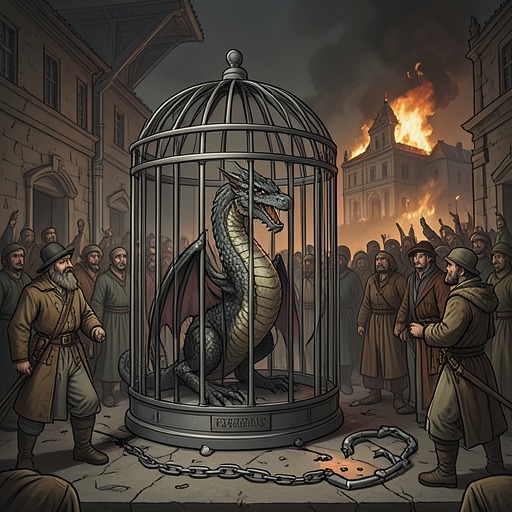
The war’s consequences reached beyond the royal family. During the uprising against the dragons, a prophet’s call for their destruction helped set a vast crowd moving through the streets toward the Dragonpit. Ten thousand voices joined the cry to kill them; as the crowd advanced, its numbers grew, and by the time it reached Rhaenys’s Hill they had doubled. The episode turned the dragons, emblems of Targaryen power, into the targets of the people of the capital.
Rhaenyra sent riders to the Old Gate and Dragon Gate with orders to disperse the crowd, seize the Shepherd, and defend the royal dragons. The city’s disorder made it uncertain whether her orders could be carried out, and the remaining loyal Gold Cloaks were too few to be confident of success. When Joffrey asked to ride out with knights, Rhaenyra refused: she believed the castle itself would be threatened if the crowd took the hill, and kept the available swords to defend it. The episode exposed how precarious royal control had become: a struggle begun over dynastic legitimacy had reached the streets, where the defense of the dragons competed with the defense of the queen’s seat of power.