Dragonpit
Fire & BloodThe Dragonpit was King’s Landing’s great domed enclosure for housing the Targaryen dragons, built into the Hill of Rhaenys. Its scale was intended to make the dragons a visible, guarded presence in the capital, and custom placed at least one dragonrider there to defend the city if necessary. During the civil war, however, the enclosure’s containment became a fatal weakness: a mass assault trapped dragons inside, killed four of them, and left the building largely in ruins. Its history therefore links royal display and urban defense with the danger of holding powerful creatures within the city itself.
Design and Construction
The Dragonpit was conceived as a monumental public structure, not simply a stable. In one early plan for a royal wedding, its rising stone tiers were to accommodate tens of thousands of spectators. At that point the building was only half complete and remained open to the sky; the ceremony was to be followed by a tourney, seven days of feasting, and a mock sea battle in Blackwater Bay. The proposed use of the site made its scale part of the political spectacle: the royal family’s marriage would be staged before an immense audience inside a structure built to house dragons.
That ambition depended on a treasury already strained by war. The Crown’s earlier taxes had failed to replenish its coffers as hoped, while the coronation and Golden Wedding of the young King Jaehaerys had added further expense. Lord Rogar intended to finish the Dragonpit before handing the government over to the king, but the funds were not available. Construction slowed, trade was diverted from King’s Landing to ports where merchants could avoid new levies, and work on the dome stopped when the Crown could no longer pay the builders.
The halt ended after Rego Draz, the new master of coin, secured three substantial loans from rival banks in Braavos, Tyrosh, and Myr. The financing allowed work to resume, bringing builders and stonemasons back to the Hill of Rhaenys. This episode established the Dragonpit as a conspicuous test of royal policy: taxation had helped drive commerce elsewhere, while borrowing from competing lenders made completion possible.
Dragons and the Dragonkeepers
Beneath the great dome, forty large vaulted chambers had been carved into the hill and arranged in a ring. These artificial caves had thick iron doors at both ends: one opened onto the sands of the pit, and the other onto the hillside. The arrangement gave the dragons separate lairs within a shared, enclosed complex, while the doors and dome sharply limited their ability to leave in an emergency.
The Dragonpit housed dragons belonging to several generations of the royal family. Prince Aemon’s mount, the blood-red Caraxes, had once been kept there; the Dragonkeepers called him the Blood Wyrm. In the later civil war, Caraxes, Vermithor, Silverwing, and Sheepstealer had also made their lairs there before departing for battle. At a later accounting, five dragons remained: Prince Joffrey’s Tyraxes, Addam Velaryon’s Seasmoke, the young dragons Morghul and Shrykos, and Queen Helaena’s Dreamfyre. Morghul and Shrykos were associated with Princess Jaehaera and her twin, Prince Jaehaerys, though Jaehaerys was dead and Jaehaera had fled.
The Dragonkeepers guarded the dragons and their enclosure. Their numbers were limited: the order counted seventy-seven, but fewer than fifty were on watch on the night of the assault. The established custom that at least one dragonrider reside at the Dragonpit was meant to ensure that the capital could call on a rider in a crisis. Because Rhaenyra preferred to keep her sons close, Addam Velaryon was assigned that duty. The custom made the Dragonpit part of the city’s defensive arrangements, but it could not compensate for the vulnerability of its guards when the attackers vastly outnumbered them.
Royal Use and Access
The Dragonpit also figured in the lives of princes and princesses as a place associated with dragons and the possibility of claiming one. When Princess Saera disobeyed instructions to remain in her rooms, she disguised herself in a washerwoman’s clothes, took a horse, and crossed the city toward the Dragonpit. She was intercepted by the Dragonkeepers as she tried to enter and returned to the Red Keep. The episode shows that the enclosure was not an open public attraction: access was controlled by its guardians, even for a member of the royal family.
The Dragonpit’s importance to the capital was also expressed through royal building projects. After it had been damaged, the Hand halted work on commissioned statues of Prince Aemond and Prince Daeron and put hundreds of stonemasons, carpenters, and builders to work repairing and restoring the structure. At the same time, the gates of King’s Landing were strengthened against attacks from inside and outside the city walls. Repairing the Dragonpit was thus presented alongside other measures to defend the city and restore its infrastructure.
The Storming and Destruction
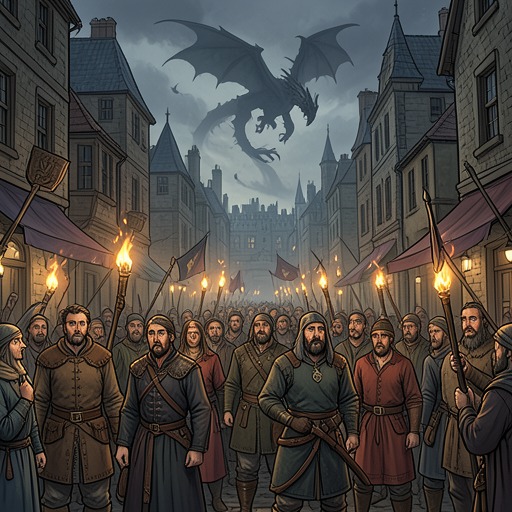
During the uprising known as the Storming of the Dragonpit, a crowd gathered and moved through the streets toward the building, growing to twice its size by the time it reached the Hill of Rhaenys. Gold cloaks from the Dragon Gate attempted to defend the hill but could not force a path through the mob. A messenger sent to the Old Gate never arrived. The Dragonkeepers fought at the Dragonpit, but the attackers forced their way through lesser entrances and windows; the great main gates, sheathed in bronze and iron, were too strong to be the point of entry.
The dragons could not escape the enclosure. Its dome, walls, and heavy chains confined them, preventing them from flying clear of the attack. The chronicles disagree over the human death toll, giving figures from two hundred to two thousand, while reporting that many more survived with burns. The episode turned the Dragonpit’s protective design against both its inhabitants and its defenders: the same barriers intended to secure the dragons left them trapped within reach of the attackers.
Dreamfyre was the last of the four dragons to resist. After breaking some of her chains, she attacked the crowd and took wing within the cavernous interior. A crossbow bolt struck one of her eyes; wounded and unable to flee, she flew upward against the dome in an attempt to break through. The weakened structure cracked and half of it collapsed, killing Dreamfyre and people beneath the falling stone. By the end of the assault, Tyraxes, Shrykos, Morghul, and Dreamfyre lay dead. The Dragonpit itself remained largely in ruins, although Syrax was still alive and descended upon survivors as they emerged from the wreckage.
Ruins and Restoration
The ruined state of the Dragonpit changed how the royal family used the surrounding heights. In 131 AC, the wedding of Prince Aegon and Princess Jaehaera was held outdoors atop Visenya’s Hill, with grandstands erected for the nobility, rather than inside the damaged building. After the ceremony, the couple were carried in an open litter to the Red Keep, where Aegon was crowned. The choice of an outdoor venue made the Dragonpit’s destruction visible in the arrangements for a dynastic celebration, even as the public ceremony presented the royal succession to the city.
Later, the Crown undertook the work of repair, assigning a large labor force to the Dragonpit while also strengthening the city gates and funding new war galleys. The effort could restore the building, but the catastrophe had exposed the limits of treating the dragons as a resource that could simply be secured behind iron doors and a dome. In a later period, Rhaena brought Morning to the Red Keep only once; she then flew with the dragon across Blackwater Bay to Dragonstone, saying that dragons and their riders were more welcome there. The Dragonpit remained a landmark of royal presence, but its ruined history had made the promise of a safe home for dragons—and of safety for the city around them—impossible to take for granted.