Dragonpit on Rhaenys’s Hill
Fire & BloodThe Dragonpit on Rhaenys’s Hill was King’s Landing’s principal dragon enclosure: a vast, domed structure whose underground lairs could shelter several dragons at once. Built to keep powerful creatures within the city and available to defend it, it became a trap during the Storming of the Dragonpit, when its barriers confined both the dragons and the people who attacked them.
Structure and Purpose
Beneath the great dome, forty immense undervaults were carved from the bones of the Hill of Rhaenys and arranged in a ring. Each man-made cave had thick iron doors at both ends: an inner door opened onto the sands of the pit, while an outer one faced the hillside. The arrangement provided separate lairs connected to a central arena, but also made the complex a series of enclosed spaces with limited ways in and out.
The pit housed dragons belonging to several members of the royal family. Among those kept there were Tyraxes, Prince Joffrey Velaryon’s dragon; Seasmoke, Addam Velaryon’s pale-grey dragon; the young dragons Morghul and Shrykos; and Dreamfyre, beloved of Queen Helaena Targaryen. Other dragons, including Caraxes, Vermithor, Silverwing, and Sheepstealer, had laired there before flying to battle. The distinction between the dragons that had once lived in the pit and those still there later is important: the complex’s occupants changed as the war drew its riders and dragons away.
It was customary for at least one dragonrider to reside at the pit, ready to defend the city if needed. Rhaenyra Targaryen preferred to keep her sons near her, so the duty fell to Addam Velaryon. The arrangement made the Dragonpit more than a stable: it was also part of King’s Landing’s defenses, dependent on a rider being present to respond to danger.
The Storming
When the Shepherd’s followers attacked, the Dragonkeepers defending the complex were badly outnumbered. The order had seventy-seven members, but fewer than fifty were on watch that night. Gold Cloaks sent from the Dragon Gate could not force their way through the crowd, and the messenger dispatched to the Old Gate never arrived. The main gates, sheathed in bronze and iron, resisted assault, but the building had twenty lesser entrances; attackers broke through these and climbed in through windows. The complex’s many access points, intended to serve its large structure, gave the mob other ways inside when the principal gates held.
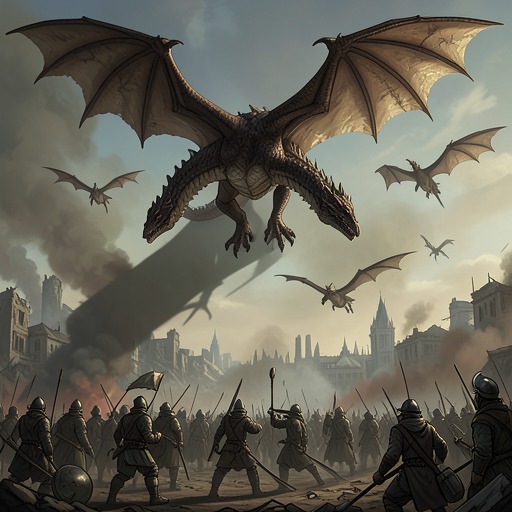
The attack’s noise roused the dragons before the first attackers reached the sands. In the account of the battle, four dragons were housed in the pit. Chained within the domed enclosure, they could not escape into the open sky, and the walls limited their ability to use their wings to evade assaults. The structure that kept them close to the city thus became a confining arena in which neither side could readily withdraw.
Dreamfyre was the last of the four to fall. After Queen Helaena’s death, she had broken two chains; during the assault she broke the remaining bonds and attacked the mob, at times taking wing within the cavernous interior. When a crossbow bolt struck one of her eyes, she flew upward in an attempt to break through the dome. The already weakened roof gave way under the impact, and half of it collapsed, killing Dreamfyre and people beneath the falling stone.
Destruction and Significance
The collapse ended the Storming of the Dragonpit. Four of the Targaryen dragons kept there lay dead, but the attack did not destroy every dragon in King’s Landing. Syrax, Rhaenyra’s own dragon, remained alive and free; as survivors emerged from the ruins, she descended upon them. The distinction between the dragons trapped in the pit and the one still at liberty made the aftermath a continuation of the city’s danger, not a simple end to it.
The Dragonpit’s fate gives its design a double significance. Its ring of lairs, iron doors, and dome were means of housing and controlling dragons, while those same enclosed spaces and barriers became obstacles to escape once the attack began. In the battle’s conclusion, the building itself failed under the force of a dragon’s attempted flight: the roof that had enclosed the creatures became rubble over both dragons and attackers. The pit’s destruction therefore marked not only a costly assault but a decisive loss of the dragons it held.