Dragons of House Targaryen
Fire & BloodDragons of House Targaryen are at once a military force, a visible sign of Targaryen distinction, and a source of political authority. Their power is not confined to the battlefield: a dragon’s presence can alter the terms of allegiance, while the claim that only Targaryens can master dragons becomes part of an argument for the dynasty’s exceptional status. The accounts move between these roles, showing dragons as mounts in war and travel, as presences in royal display, and as the formidable beings around whom arguments about blood and rule are made.
Dragons and Targaryen power
Aegon Targaryen’s dragon was Balerion the Black Dread. Although Aegon was counted among the greatest warriors of his age, he did not ride Balerion for tournaments or displays of arms. He flew on the dragon to battle or to travel swiftly across land and sea. This selective use places the dragon within the practical reach of the king’s campaigns and journeys, rather than treating it as a constant feature of courtly spectacle.
The difference between a dragon’s presence and its actual use is also visible in the First Dornish War. Aegon entered Dorne with a large army, while Orys Baratheon led picked knights through the Boneway and Rhaenys Targaryen rode Meraxes to attack the Planky Town. The invasion’s strength did not make the landscape yield: Dornish forces avoided open battle, destroyed or poisoned supplies, and used mountain terrain against the invaders. Aegon’s force took Skyreach and won Yronwood after a brief siege, but the campaign also records how heat, scarce water, and difficult passes could frustrate the progress of armies moving through dragon country. The dragon was a formidable advantage, not a substitute for the demands of an expedition.
Mounts and royal display
Dragons also made dynastic authority visible in public ceremonies. At Aegon’s coronation in Oldtown, after the High Septon anointed him and crowned him in the Starry Sept, the king rode through the city on Balerion’s back. The crowd that witnessed this second coronation was far larger than the group present at his first crowning at the mouth of the Blackwater. The scene joined religious recognition and public spectacle to the image of a king mounted on a dragon; the Oldtown coronation, attended by maesters and archmaesters, later became the accepted beginning of Aegon’s reign.
In the next generation, dragons likewise accompanied rival claims to the throne. At Storm’s End, fourteen-year-old Jaehaerys Targaryen proclaimed himself the true king and was supported by his mother, Queen Alyssa, and his sister Alysanne Targaryen. He rode Vermithor, while Alysanne commanded Silverwing. Their dragons gave the challenge a forceful visible dimension as a hundred banner lords and stormland knights cheered. Rhaena Targaryen soon joined them on Dreamfyre, leaving the uncle she had been forced to marry and bringing her daughter Aerea and the stolen sword Blackfyre. The shift from two dragons to three marked a corresponding change in the strength of Jaehaerys’s cause.
Dragons could also shape negotiation without being ridden into combat. When Jaehaerys sought peace with his former Hand, Rogar Baratheon asked whether the king would require hostages to guarantee Rogar’s loyalty. Jaehaerys instead led him to Vermithor while the dragon was being fed. He declined the offer of hostages and accepted Rogar’s word. Grand Maester Benifer understood the unspoken implication: while the king rode Vermithor, the people of the stormlands were already within his reach. The episode makes a dragon a political guarantee as well as a weapon, turning its presence into leverage in a settlement.
Blood, doctrine, and distinction
The exceptional status of dragons also figures in the doctrine promoted by Jaehaerys and his allies. The Seven Speakers explained that the Targaryens’ ancestry and customs came from Valyria rather than Andalos, and that their capacity to tame dragons distinguished them from other peoples. The argument did not reject the Faith of the Seven’s general prohibitions on incest; it asserted that Targaryens were different and should not be judged by the same rule. Dragons thus supported not only royal power but a political and religious defense of Targaryen exceptionalism.
That claim was put into memorable form by Septon Alfyn: the gods, he argued, had made different creatures with different gifts, just as the lion and the aurochs were not alike. His comparison framed dragon-riding as a distinctive gift belonging to the blood of the dragon, and therefore as a reason the Targaryens’ customs should be treated differently. Septon Baldrick’s reported reply to a hedge knight who challenged the argument made the same point more sharply: the knight would have to go to Dragonstone and claim a dragon before expecting the same exception. In this reasoning, access to dragons marks the boundary between ordinary people and the ruling dynasty.
Dragons in war and revolt
The later struggle between Rhaenyra Targaryen and Aegon II shows how dragons remained bound to contested sovereignty. After Aegon II’s coronation in the Dragonpit, Rhaenyra was crowned on Dragonstone with the stolen crown of Jaehaerys the Conciliator. Daemon Targaryen placed the crown on her head, and her eldest son, Jacaerys Velaryon, was named heir. The two rival coronations presented competing claims in parallel, each framed by royal titles and the allegiance of supporters; dragons were central to the power each side could bring to the conflict.
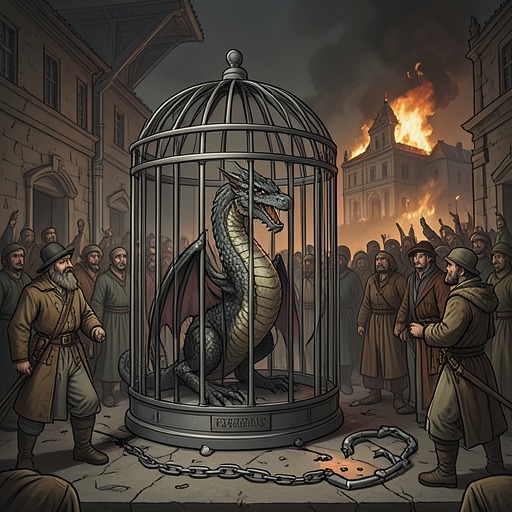
That centrality carried risk. When the Shepherd’s followers advanced on the Dragonpit, Rhaenyra’s orders called for the crowd to be dispersed and the royal dragons defended. But the remaining loyal gold cloaks were too few to make success likely, and the queen refused Joffrey Velaryon’s request to ride out with knights. She kept the swords she had at hand to defend the castle. The episode places the dragons within the vulnerability of the city: they were potent royal assets, yet their presence did not guarantee that the people or the defenses surrounding them could be controlled.
Across these accounts, dragons do not function as a single, unchanging symbol. Balerion carries a conquering king; Vermithor and Silverwing strengthen a child’s rebellion; Dreamfyre brings Rhaena into that cause; and the threatened dragons at the Dragonpit become a focus of popular violence. Their significance comes from this double character: they are living military power, but also public evidence around which claims to rule, religious arguments, loyalty, and resistance are organized.