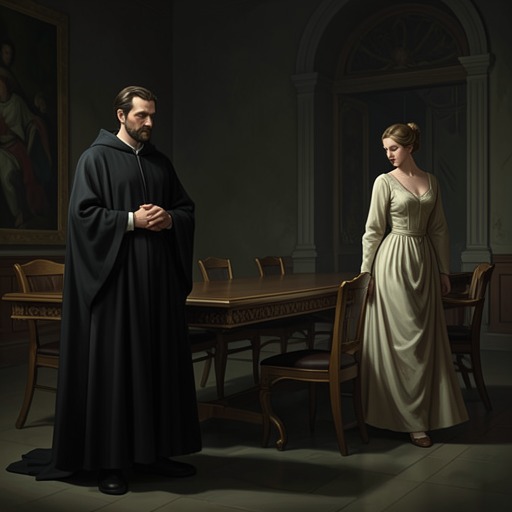
Exceptionalism as an Established Doctrine
Fire & BloodExceptionalism as an Established Doctrine was the Faith’s formal recognition that the Targaryens’ Valyrian tradition of sibling marriage should not be judged by the rules governing other people. King Jaehaerys Targaryen sought to make that recognition official, turning a dynastic custom into a matter of religious doctrine. The arrangement secured institutional support for the practice, but the death of his daughter Daenerys from the Shivers struck at another belief bound up with Targaryen exceptionalism: that the royal family was protected from disease.
Purpose and religious stakes
Jaehaerys’s concern was not which family supplied the next High Septon, nor whether the candidate was noble or lowborn. He wanted the new head of the Faith to be an Exceptionalist and to ensure that the Starry Sept would not again question the Targaryen tradition of sibling marriage. The doctrine thus addressed a specific conflict between the royal house’s inherited Valyrian customs and the Faith’s authority to define acceptable conduct.
This aim was pursued through an institution whose approval mattered to the crown. The High Septon had anointed Aegon in the Starry Sept, where the Conqueror’s second coronation drew hundreds of lords and tens of thousands of cheering townspeople. That earlier ceremony shows the religious standing the monarchy could gain from the Faith; Jaehaerys’s negotiations sought to secure that institution’s acceptance not just for a coronation, but for a contested dynastic custom.
The agreement at Oldtown
During Jaehaerys’s stay in Oldtown, he and Lord Donnel Hightower held private discussions in the Hightower’s own apartments. Septon Barth later recorded a summary from what the king told him. Lord Donnel hoped a member of his extensive family, several of whom served the Faith, would become High Septon. Jaehaerys did not object to Donnel’s brother or other Hightower kin, but none had yet spoken in favor of Exceptionalism.
After hours of discussion, the king and Lord Donnel reached an understanding. At the Starry Sept, the Most Devout then chose a new High Septon through four ballots. Septon Mattheus led the first ballot but did not secure the required votes; his support declined as other candidates gained ground. On the fourth ballot, the electors broke with tradition and selected Septon Alfyn, who was not one of their own number. Alfyn had crossed the Reach a dozen times in his litter on behalf of Jaehaerys and the queen, and was known as a forceful champion of Exceptionalism.
The bargain looked beyond Alfyn’s tenure. He was the oldest of the Seven Speakers and legless, so Jaehaerys considered it likely that he would not serve long. The king assured Lord Donnel that a Hightower would succeed Alfyn if Donnel’s kin firmly aligned themselves with the Exceptionalists during Alfyn’s reign. The doctrine’s official standing was therefore tied to a political understanding about both the incumbent High Septon and the succession after him.
Appointment, judgment, and limits
Septon Barth’s account presents the election as a bargain between king and lord, mediated through the Most Devout. Barth did not dispute the account, but lamented how readily the electors could be influenced. He nevertheless judged Alfyn, and the Hightower who succeeded him, more worthy of the crystal crown than Septon Mattheus. The episode therefore depicts the doctrine’s advance as both a religious settlement and a product of courtly power: the result was welcomed for the candidates’ merits, while the means raised questions about the independence of the Faith’s leadership.
The doctrine should not be confused with rules of royal succession. At the Great Council of 101 AC, the assembled lords chose Viserys over Laenor by a reported margin of more than twenty to one. Many thereafter treated that decision as a precedent against a woman inheriting the Iron Throne or transmitting the claim to her male descendants. That was a separate succession principle, not the religious accommodation Jaehaerys sought for sibling marriage; the two illustrate different kinds of limits and permissions within Targaryen rule.
The Shivers and the claim of difference
The doctrine belonged to a wider belief that the Targaryens were unlike other people. Princess Daenerys, daughter of Jaehaerys and Alysanne and Targaryen on both sides, was believed to possess the pure blood of Old Valyria. The rationale held that the Faith’s prohibitions against incest did not apply to the dynasty and that the fire in dragon blood protected Targaryens from disease. The death of Daenerys from the Shivers shattered that confidence: the illness that killed her also claimed thousands of children, highborn and low, during the same winter.
Her death did not erase the institutional settlement concerning marriage, but it revealed the vulnerability of the broader claims used to describe Targaryen difference. A doctrine could be negotiated with the Faith and secured through appointments; a princess’s mortality could not be negotiated away. In that contrast, Exceptionalism appears as both a defense of dynastic custom and a belief whose limits became painfully visible within the royal family itself.