Faith Militant
Fire & BloodThe Faith Militant was the armed expression of the Faith, a religious institution whose authority reached across the Seven Kingdoms. Its two principal bodies, the Warrior’s Sons and the Poor Fellows, gave religious opposition a military presence on the roads and in the cities. Their rebellion against Targaryen rule made them central adversaries of the crown, until King Maegor’s campaign broke their strength and a new High Septon formally dissolved both orders.
Nature and religious standing
The Faith’s authority was centered in Oldtown, where the High Septon resided and the Starry Sept stood. The High Septon commanded the obedience of millions of the devout throughout the realms, apart from the North, where the old gods held sway. The Faith Militant supplied that institution with an armed force: the Warrior’s Sons were a fighting order, while the Poor Fellows were a poorer, more irregular body. Smallfolk called the armed order the Stars and Swords. These groups brought religious allegiance into direct conflict with royal power when opposition to the Targaryens took the form of a holy war.
The order’s later strength had limits. Even after its principal forces were defeated, chapters remained in Oldtown, Lannisport, Gulltown, and Stoney Sept. Their survival did not restore the organization’s former reach, but it shows that Maegor’s victory over its main forces and the Faith’s eventual formal dissolution were distinct stages in its defeat.
Rebellion against the crown
By the end of 41 AC, rebellion against Targaryen rule had spread across much of the realm. The insurgents understood themselves as defenders of the Seven against a godless tyranny. Dozens of pious lords abandoned the king’s banners and declared for the Starry Sept. The Warrior’s Sons took control of the gates of King’s Landing, controlling who could enter or leave, and drove workmen from the unfinished Red Keep. Meanwhile, thousands of Poor Fellows travelled the roads, demanding that people declare where their allegiance lay and pressing lords to denounce the Targaryen king.
The uprising disrupted royal authority well beyond the capital. Prince Aegon and Princess Rhaena had to abandon their progress through the westerlands and take shelter at Crakehall Castle. The rebels’ claim to religious legitimacy also found a striking expression in a letter from an envoy of the Iron Bank of Braavos, who described the High Septon as the true king of Westeros in all but name. The crisis therefore involved more than armed encounters: control of the capital, the public allegiance of lords, and the question of whose authority the faithful should recognize were all at stake.
Maegor’s campaign
After taking the Iron Throne, Maegor ordered the Poor Fellows moving toward King’s Landing to surrender their weapons, threatening proscription and death for refusal. The decree did not stop them. He then called on loyal lords to take the field against the Faith’s forces, while the High Septon in Oldtown urged the faithful to defend their religion against the Targaryen regime. The result was a campaign in which religious allegiance and military command were openly opposed.
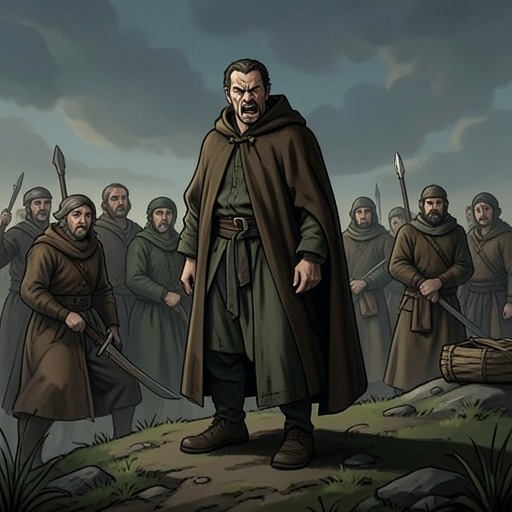
One of the first major clashes came at Stonebridge in the Reach. Nine thousand Poor Fellows under Wat the Hewer attempted to cross the Mander and found themselves caught between six lordly hosts. With their force split between the two banks, they were routed. Their makeshift equipment and lack of discipline could not withstand the charge of armored knights, though Wat himself was captured alive after fighting fiercely. The severity of the battle gave the town and castle a new name: Bitterbridge.
Maegor’s attack on the Warrior’s Sons’ stronghold in King’s Landing was more decisive still. The order had fortified the Hill of Rhaenys and occupied the Sept of Remembrance. After Maegor appeared publicly on the Red Keep’s walls, he mounted Balerion and attacked the fortified sept while seven hundred Warrior’s Sons were at morning prayers. Archers and spearmen waited outside for those who escaped the burning building. The order’s leading force was destroyed, and its surviving chapters never again approached their former strength.
Dissolution and consequences
The defeat of the Warrior’s Sons did not end Maegor’s war against the Faith Militant. Captured members were offered a choice: renounce the order and take the black with the Night’s Watch, or remain loyal and die as martyrs. Three-quarters of the captives chose the Wall. Maegor personally executed seven condemned men, prominent knights and sons of lords, with Blackfyre; their former comrades carried out the other executions. Ser Morgan Hightower alone received a full royal pardon.
A new High Septon formally dissolved both the Warrior’s Sons and the Poor Fellows, declaring that the Seven no longer needed armed defenders because the Iron Throne would protect the Faith. Maegor allowed the remaining members until the end of the year to surrender their weapons and abandon rebellion. After that deadline, rewards were offered for the heads of those who continued to resist. The High Septon and the Most Devout did not oppose the decree. Religious authority had thus helped summon the rebellion, but the Faith’s leadership ultimately accepted the crown’s claim to provide its protection.
Political significance
The Faith Militant’s rise exposed the danger of an armed religious institution whose loyalties could rival those of the king. Its control of the King’s Landing gates, its appeal to lords across the realm, and its mobilization of Poor Fellows on the roads turned a dispute over royal legitimacy into a widespread revolt. Maegor’s response broke the organization through battlefield defeat, the destruction of its principal stronghold, executions, and a final institutional ban. The contrast is central to its history: an order that claimed to defend the Faith was first defeated by royal force and then formally disarmed with the Faith’s leadership’s consent.