Faith Militant Uprising
Fire & BloodThe Faith Militant Uprising was a revolt against Targaryen rule in which religious authority became the rallying point for armed resistance. It began under Aenys Targaryen after he persisted in arranging the marriage of his children, Rhaena and Aegon, despite the Faith’s condemnation. The crisis spread from denunciation to rebellion: the Warrior’s Sons seized control of King’s Landing’s gates, the Poor Fellows mobilized across the roads, and Aenys died while the rising threatened his family and his rule. Under Maegor, the conflict became a war of suppression that ended with the dissolution of both orders and the Crown’s declaration that it would protect the Faith.
Origins in a Disputed Marriage
The immediate crisis followed Aenys’s announcement that his eldest children would marry. The Faith had tolerated, or at least disregarded, the Conqueror’s marriage to his sisters, but the High Septon condemned the proposed union between their grandchildren as an offense against the gods. Aenys did not abandon the match or use force against the Starry Sept. His persistence instead made the marriage a test of whether royal custom could prevail over religious judgment.
The conflict became public at the wedding. Warrior’s Sons watched the guests arriving at the Sept of Remembrance, while many lords stayed away. On their subsequent progress through the realm, Aegon and Rhaena met open hostility: no septon at Maidenpool would bless them, Lord Lucas Harroway refused them entry to his castle unless they accepted his daughter Alys as Aegon’s lawful wife, and Poor Fellows threw dirt at the couple in a village in the riverlands. The incidents showed that the dispute was no longer confined to the court or the clergy; it had become visible in the reception given to the royal family throughout the country.
Aenys’s effort to defend his Hand, Septon Murmison, intensified the breach. After the Faith expelled Murmison for performing the forbidden marriage, Aenys wrote to the High Septon asking for his reinstatement and explaining the old Valyrian precedent for brother-sister marriage. The High Septon rejected the appeal and challenged Aenys’s right to rule, describing him as a pretender and tyrant. The religious dispute had thereby become a direct contest over royal legitimacy.
Rebellion and the Death of Aenys
The consequences followed swiftly. Less than a fortnight after the High Septon’s reply, Poor Fellows killed Murmison while he crossed the city. The Warrior’s Sons fortified the Sept of Remembrance on the Hill of Rhaenys, turning it into their citadel. With the Red Keep still unfinished, Aenys judged his residence on Visenya’s Hill too vulnerable and planned to move with Queen Alyssa and their younger children to Dragonstone. Two Poor Fellows broke into his bedchamber before the departure; the Kingsguard prevented them from killing him.
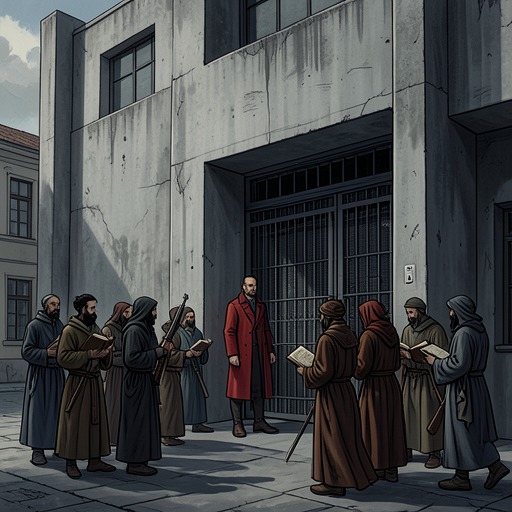
By the end of 41 AC, rebellion had spread widely. Pious lords throughout the Seven Kingdoms abandoned the king’s banners and declared for the Starry Sept. The Warrior’s Sons held King’s Landing’s gates, controlling entry to and exit from the city, and drove workmen from the unfinished Red Keep. Thousands of Poor Fellows traveled the roads, demanding that people declare whether they stood with the gods or the king, and pressing lords to denounce Aenys. In the west, Aegon and Rhaena had to abandon their progress and shelter at Crakehall. The movement’s claim to speak for the Faith had become a means of organizing resistance among both lords and common people.
Aenys remained on Dragonstone, increasingly incapacitated by fear and illness. He appeared to improve while Queen Alyssa took charge of his care, but news that Poor Fellows had surrounded Crakehall, where his children were reluctant guests, was followed by his sudden collapse. He died three days later. The uprising had thus helped produce a succession crisis at the very moment it was threatening the dynasty’s hold across the realm.
Maegor’s Counteroffensive
Maegor’s return to power did not end the revolt; it changed its character. After appearing in King’s Landing with Alys Harroway and Tyanna of the Tower, he mounted Balerion and attacked the fortified Sept of Remembrance while seven hundred Warrior’s Sons were at prayer. The building was destroyed by dragonfire, ending the order’s strongest concentration in the capital. Other chapters survived in Oldtown, Lannisport, Gulltown, and Stoney Sept, but the Warrior’s Sons never regained their former strength.
Maegor then ordered the Poor Fellows approaching the city to surrender their weapons. When they refused, he called on loyal lords to disperse them by force. The High Septon at Oldtown answered by urging the Faith’s supporters to take up arms against the Targaryens. The first major battle came at Stonebridge, where nine thousand Poor Fellows under Wat the Hewer were caught while crossing the Mander. With his force divided between the two banks, they were overwhelmed by six lordly hosts. Wat was captured alive and taken to King’s Landing.
The war continued through Maegor’s reign, but its close was shaped by both coercion and formal religious action. At Oldtown, Maegor held court and presided over the fate of the captured Warrior’s Sons. They could renounce the order and take the black, joining the Night’s Watch, or refuse and die. Three-quarters chose the Wall. Seven captives, including famous knights and sons of lords, were beheaded by Maegor with Blackfyre; other condemned men were executed by former brothers-in-arms. Ser Morgan Hightower alone received a full royal pardon.
Dissolution and Political Legacy
A new High Septon formally dissolved the Warrior’s Sons and the Poor Fellows, ordering their remaining members to lay down their arms. The proclamation declared that the Seven no longer needed warriors because the Iron Throne would defend the Faith. Maegor allowed the surviving members until the end of the year to surrender; after that, rewards were offered for the heads of those who remained defiant. Religious authority had been incorporated into a settlement enforced by royal power, rather than permitted to sustain an independent armed force.
The uprising also exposes a tension in the Conqueror’s policy of reconciliation. Aegon had used coronation and public recognition to present himself as king of a united realm: at Oldtown, the High Septon anointed him in the Starry Sept before a vast audience. His successors nevertheless encountered a Faith capable of challenging the Crown’s right to govern when dynastic practice crossed its boundaries. Aegon’s later policy of bringing children of former enemies into court and arranging marriages between distant noble houses sought to bind the realm through service and kinship; the revolt showed how quickly those bonds could be strained when royal conduct was opposed by a widely shared religious judgment.
The conflict remained a political precedent as well as a military defeat. Much later, Otto Hightower feared that Daemon might become a second Maegor, invoking the memory of a king whose rule had been marked by violence against religious opposition. That comparison reflects the uprising’s lasting double meaning: Maegor suppressed the Faith Militant, but the means by which he did so made his name a warning within subsequent disputes over power and succession. A later attack on the Dragonpit by a vast crowd inspired by the Shepherd likewise showed that religiously framed popular violence could reappear, though it was a distinct episode, not a continuation of the dissolved orders.