Grand Maester Orwyle
Fire & BloodGrand Maester Orwyle is a court official whose career during the Dance of the Dragons shows how the same man could serve as royal adviser, diplomatic envoy, captive, and witness to the destruction of the regime he had served. Appointed by the Citadel rather than the Crown, he was regarded as politically uncommitted; yet his presence at decisive meetings and his eventual confession made him both a recorder of events and one of their condemned participants.
Appointment and position at court
Orwyle entered the royal council after Grand Maester Mellos died. Princess Rhaenyra proposed Maester Gerardys, whose healing had helped King Viserys Targaryen after his injury on the Iron Throne. Queen Alicent opposed that choice and recommended Maester Alfador, then serving at the Hightower. Viserys declined to decide between them, reminding both women that the selection belonged to the Citadel. The Conclave ultimately chose Orwyle, an archmaester from its own ranks.
His arrival coincided with a brief improvement in the king’s vigor, though accounts disagreed about its cause: Septon Eustace credited prayer, while many attributed the change to Orwyle’s potions and tinctures. The improvement did not last. As gout, chest pains, and breathlessness continued to weaken Viserys, the king left more of the realm’s government to his Hand and council. By the opening of 129 AC, Orwyle was the newest councillor and was thought to favor neither the Blacks nor the Greens. His institutional authority came from the Citadel, but his daily work placed him amid a court increasingly divided by succession.
The king’s death and the Green Council
When Viserys died, Queen Alicent ordered the room sealed and the serving man who found the body detained. Ser Criston Cole summoned the council to the queen’s apartments in Maegor’s Holdfast. Orwyle was there with Alicent, Ser Otto Hightower, Cole, Lord Lyman Beesbury, Ser Tyland Lannister, Larys Strong, and Lord Jasper Wylde. The meeting took place while the dead king remained above them, and Grand Maester Munkun later called it the Green Council.
Orwyle began by setting out the customary actions following a king’s death: summon Septon Eustace for the last rites, send word to Rhaenyra on Dragonstone, ring the bells, and begin preparations for her coronation. His proposed sequence treated the king’s death as a matter of established procedure and recognized Rhaenyra as the expected successor. Ser Otto interrupted, insisting that these measures wait until the succession had been settled. The meeting instead turned toward installing Aegon II. The contrast between Orwyle’s initial agenda and Otto’s intervention marks the point at which ordinary royal procedure was subordinated to the council’s political decision.
The council’s later conduct also departed from the routine Orwyle had outlined. The bells did not ring, the silent sisters were not summoned to the king’s chamber, and ravens were sent to lords considered sympathetic to Aegon rather than to Dragonstone. When the coronation took place in the Dragonpit, Ser Criston placed the Conqueror’s iron-and-ruby crown on Aegon’s head, while Alicent crowned her daughter Helaena. Orwyle’s proposed preparations for Rhaenyra had been displaced by a rival public ceremony and a concealed transfer of power.
Envoy, captive, and witness
After Rhaenyra was crowned on Dragonstone, Aegon’s council reluctantly permitted Orwyle to carry a peace proposal across Blackwater Bay. He traveled under a peace banner with Ser Arryk Cargyll, Ser Gwayne Hightower, scribes, and septons. The terms offered by Aegon would have allowed Rhaenyra to keep Dragonstone, promised Driftmark to Lucerys, placed her younger sons at court, and pardoned lords who had supported her, provided she acknowledged Aegon as king. Rhaenyra rejected the premise of the offer: she asked Orwyle whom Viserys had named as heir, and he acknowledged that the king had named her. His mission therefore brought him face to face with the central contradiction of the war: he was sent by a king whose claim his own answer implicitly undermined.
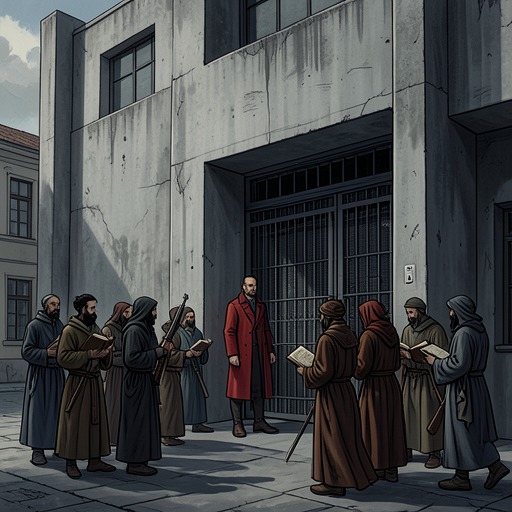
Orwyle later found himself imprisoned when the balance of power in King’s Landing shifted. As Alicent tried to summon loyal lords to defend Aegon, she ordered ravens sent out through the Grand Maester. When Orwyle hurried back to his chambers, gold cloaks seized him, bound him, and took him to the black cells. The City Watch’s allegiance had changed with the return of Daemon Targaryen, and the queen’s orders could no longer be safely carried out through the city’s gates.
Ser Perkin the Flea eventually freed the prisoners in the castle dungeons, including Orwyle and Corlys Velaryon. The next day Orwyle was present when Perkin’s squire Trystane mounted the Iron Throne. With Aegon II’s former court gathered in the hall, Orwyle spoke for them and hailed the riverlords as deliverers. His public role had shifted once more: the official who had served the king and carried his peace offer now welcomed the force that had overturned the court.
The record of Larys Strong and the king’s death
After his release, Orwyle resumed his place on the restored Green Council. The surviving account presents the council as divided at a moment when Aegon II most needed unity. Later, Orwyle’s testimony supplied Grand Maester Munkun with important details about the king’s escape from King’s Landing. According to that account, Larys Strong led Aegon and his children through a secret passage, separated the fugitives, and concealed Aegon in a fisherman’s skiff among codfish. Munkun attributed this information to Larys’s own words to Orwyle. The account thus preserves a remarkable secret, but reaches the reader through a chain of testimony rather than an impartial, immediate record.
Munkun’s history relied heavily on Orwyle’s confession, made before his execution. The book acknowledges that Orwyle had reason to present himself favorably and to lessen his responsibility for what followed. His testimony is therefore valuable and compromised at once: he had attended the court’s deliberations and knew its inner workings, but he was also defending himself after the regime’s collapse.
When the riverlords entered King’s Landing and found Aegon II dead beneath the Iron Throne, Cregan Stark insisted that the king’s killers be punished. Orwyle had confessed under torture to giving poison to Larys Strong. He protested that he had not known what the substance was for; Stark answered that Orwyle had not asked because he did not wish to know. Stark judged him complicit and sentenced him to death. The judgment made the boundary between ignorance and willful blindness central to Orwyle’s ending: his own defense was recorded, but it did not spare him from the consequence of having supplied the poison.
Historical significance
Orwyle’s trajectory is shaped less by independent command than by the institutions and factions that alternately used, confined, and judged him. He deferred to the Citadel on the appointment of a Grand Maester, tried to follow the customary rites after Viserys’s death, carried Aegon’s terms to Rhaenyra, and later served as a source for the history of Larys Strong’s secret escape plan. At each stage, procedure and testimony offered him a role in events without insulating him from their political stakes.
His legacy is consequently double-edged. The historical account depends on his access to the court and on what he revealed, while warning that his self-exculpatory interests shaped his testimony. He survives in the narrative not simply as a neutral chronicler or a passive functionary, but as a participant whose knowledge helped explain the war and whose failure to question a dangerous commission became grounds for his death.