Great Council of 101 succession precedent
Fire & BloodThe Great Council of 101 succession precedent was the principle drawn from the Great Council’s choice of Viserys Targaryen as heir to the Iron Throne over Laenor Velaryon. It made the male line, rather than seniority alone, the decisive consideration in the succession dispute and was understood to bar both a woman’s accession and the passage of the claim through a woman to her descendants. Its force came from a lords’ decision made amid competing claims, and the precedent would shadow later arguments over who could inherit.
Background and competing claims
The council followed the death of Prince Baelon Targaryen, whom King Jaehaerys Targaryen had named Prince of Dragonstone and heir after Baelon’s elder brother, Prince Aemon Targaryen, died. Aemon’s daughter, Rhaenys Targaryen, was already a capable adult, married to Corlys Velaryon, and pregnant when her father died. By choosing Baelon over Rhaenys, the king had passed over the daughter of his eldest son and potentially the child she carried. Baelon, however, was an experienced knight who had already fathered two healthy sons, Viserys and Daemon.
The dispute had precedents of its own. Aegon the Conqueror had ruled before his elder sister, Visenya Targaryen, and Jaehaerys had succeeded his uncle Maegor even though Jaehaerys’s sister, Rhaena Targaryen, was older. These examples supported preference for men, but did not by themselves settle the question of whether a woman’s son could inherit through her.
Fourteen claims were examined at Harrenhal. Among those excluded were Archmaester Vaegon, because of his vows, and Rhaenys and her daughter, because they were women. The two leading remaining claimants were Viserys, Baelon’s twenty-four-year-old son and grandson of the king, and Laenor, Rhaenys’s seven-year-old son and great-grandson of the king. Primogeniture favored Laenor; proximity to the king favored Viserys. The distinction between a claim descending through a father and one descending through a mother became central to the decision.
Deliberation and decision
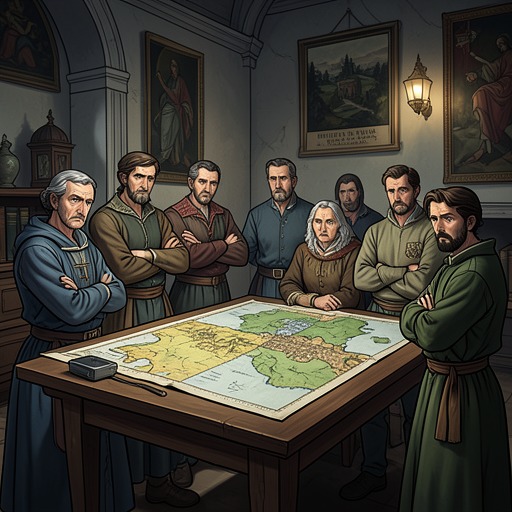
The assembled lords deliberated for thirteen days. They weighed Viserys’s descent from Baelon against Laenor’s descent from Aemon, as well as the claimants’ ages and circumstances. Viserys was an adult; Laenor was a child who had not yet flown on his young dragon, Seasmoke. More decisively, many lords held that the male line should take precedence over the female. In their view, Viserys’s claim came through his father, whereas Laenor’s came through his mother.
The lords chose Viserys by a lopsided margin. The maesters who counted the votes did not publish the figures, though it was later said that the result exceeded twenty to one. When the verdict reached King Jaehaerys, he thanked the lords and formally granted Viserys the style Prince of Dragonstone. The decision was accepted, albeit grudgingly, by Driftmark and Storm’s End; even Laenor’s parents recognized that the scale of the vote left them little prospect of prevailing.
Scope and significance
The council’s decision was understood by many as an iron precedent: the Iron Throne could not pass to a woman, regardless of seniority, or through a woman to her male descendants. It resolved the immediate contest in favor of Viserys while giving political weight to male-line descent over the competing logic of primogeniture. The principle was not merely an abstract rule about women’s succession; it also narrowed the claims of male heirs whose connection to the royal line ran through a woman.
The precedent arose from a particular contest and a judgment by the assembled lords, rather than from a succession settled by birth order alone. Its overwhelming vote and the king’s confirmation strengthened its authority, but the competing principles were visible even in the council’s own case: Laenor had the stronger claim by primogeniture, while Viserys was nearer in the male line. The outcome favored the latter and gave later claimants a powerful basis for arguing that descent through women could not carry the throne.
Later succession conflicts
The later struggle between Aegon II and Rhaenyra Targaryen shows the continuing stakes of rival claims to the Iron Throne. Aegon II was crowned in King’s Landing, while Rhaenyra was also crowned and named her own heir. These competing ceremonies do not, by themselves, state how either side interpreted the Great Council’s decision; they do show that a precedent favoring male succession did not prevent a later woman from being proclaimed queen or end the contest over royal legitimacy. The council’s legacy therefore lay both in the rule many believed it had established and in the disputes that remained possible around it.