Great Council of Harrenhal of 101 AC
Fire & BloodThe Great Council of Harrenhal of 101 AC was a kingdom-wide assembly called to settle a crisis of royal succession. Faced with competing claims after the deaths of Prince Aemon and Prince Baelon, King Jaehaerys I placed the choice before the realm’s assembled lords. Their decisive preference for Viserys Targaryen did more than name an heir: it strengthened the expectation that the Iron Throne would pass through the male line, a precedent whose force would be felt in later disputes.
Causes and competing claims
Prince Baelon, Prince of Dragonstone and the king’s heir, fell ill in 101 AC after hunting in the kingswood. His condition worsened over five days, and he died in his bedchamber in the Tower of the Hand with Jaehaerys beside him. His death followed that of his elder brother, Prince Aemon, leaving the succession without either of the two heirs who had seemed to secure it. The realm mourned Baelon, but the king also faced a political dilemma: several relatives could now make claims to the throne, and supporters of different claimants had begun to gather around them.
Baelon’s surviving sons, Viserys and Daemon, could claim through their father. Aemon’s daughter, Princess Rhaenys, and her daughter Laena Velaryon were also advanced as possible successors. Rhaenys’s son, Laenor Velaryon, presented a further claim: he was male and descended from Jaehaerys’s elder son, while Viserys descended from the younger. At the same time, Corlys Velaryon was gathering ships and men on Driftmark to defend Laenor’s rights, and Daemon had assembled sworn swords in support of Viserys. A violent contest seemed possible whichever claimant the king selected.
Jaehaerys summoned his last surviving son, Archmaester Vaegon, to King’s Landing. Accounts disagree about whether the king offered him the throne or sought his advice, but the council that followed answered the central problem by transferring the decision from the king’s immediate choice to an assembly. Jaehaerys declared that great and lesser lords, together with maesters and representatives of the Faith, would hear the claims. He pledged to accept their decision.
Assembly at Harrenhal
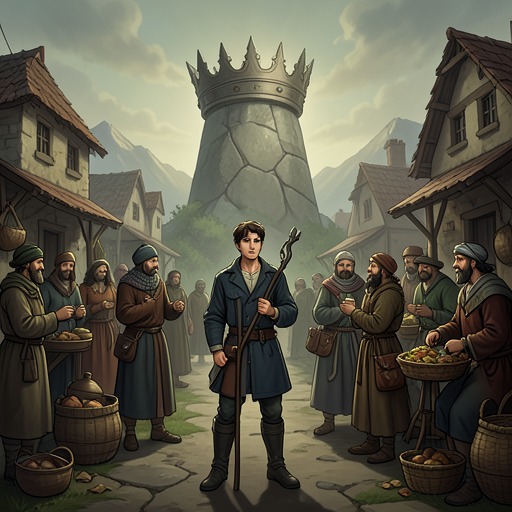
The council was held at Harrenhal, chosen as the largest castle in the realm. Its scale exceeded expectations: more than a thousand lords attended, although preparations had allowed for at least five hundred, and their entourages included knights, squires, grooms, cooks, and servants. The gathering took half a year to assemble; some lords arrived only as it was breaking up. The castle could not contain the crowds. A sprawling encampment grew outside its walls and along the lakeshore, and Harrenton became, for a time, the realm’s fourth-largest city.
The breadth of attendance gave the decision a public and collective character beyond a private royal appointment. Lords came from across Westeros, from the Dornish Marches and the lands near the Wall to the Three Sisters and the Iron Islands. The Prince of Dorne sent his daughter and twenty knights as observers, and the High Septon came from Oldtown to bless the assembly. Merchants, tradespeople, hedge knights, and many others also converged on Harrenhal, drawn by the crowd and the opportunities it offered.
Fourteen claims were examined. The field included distant and disputed lines of descent as well as the principal royal claimants. Three competing men from Essos claimed descent from Jaehaerys through his daughter Saera; one distributed gifts to poorer lords and brought a dwarf elephant. Another claimant presented a long genealogy tracing descent from Gaemon the Glorious. A man who claimed to be a bastard son of Maegor the Cruel also appeared with his mother, but the lords did not accept that her account established his paternity. These claims were among the cases considered before the council narrowed its choice.
Deliberation and decision
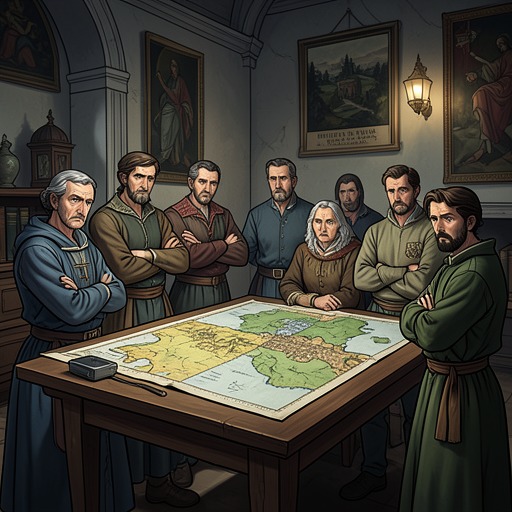
The lords deliberated for thirteen days. Nine lesser claims were rejected, including that of a hedge knight whom Jaehaerys exposed as an impostor and had imprisoned. Vaegon was excluded because of his maester’s vows. Rhaenys and Laena were set aside on account of their sex. The leading choice therefore came down to Viserys, aged twenty-four, and Laenor, aged seven.
The arguments for the two men drew on different principles of succession. Primogeniture favored Laenor, whose descent ran through Aemon, the elder son. Proximity to the king favored Viserys, Jaehaerys’s grandson, over his great-grandson. But the comparison also turned on the gender of the line through which each claim descended: Viserys’s claim came through his father, while Laenor’s came through his mother. Most lords held that the male line should take precedence. Viserys’s adulthood, against Laenor’s youth, further favored him; yet Laenor could not be dismissed as a candidate because his parents, Corlys and Rhaenys, were powerful and influential.
Corlys and Rhaenys arrived in state and used the wealth and influence of House Velaryon to advocate for their son. Their supporters included Boremund Baratheon, Lord of Storm’s End, as well as lords from the North, the Riverlands, and the Crownlands. Their campaign was eloquent and generous, but it did not overcome the wider preference for Viserys. The vote was overwhelmingly in his favor. Although the maesters who counted it did not publish the totals, the reported margin was more than twenty to one.
Result and legacy
Jaehaerys was not present at Harrenhal. When the verdict reached him, he thanked the lords and named Viserys Prince of Dragonstone, formally confirming him as heir. The houses of Storm’s End and Driftmark accepted the result reluctantly; the scale of the vote made continued resistance difficult to sustain.
The council’s enduring significance lay in the rule many later observers drew from its decision: the Iron Throne could not pass to a woman, nor through a woman to her male descendants, regardless of seniority. That conclusion rested not simply on one claimant’s bloodline, but on the assembly’s choice among competing principles of descent and its capacity to give that choice realm-wide recognition. When the succession was contested again during Viserys’s reign, the Great Council of 101 was invoked as precedent for preferring a male claimant over a daughter. The council thus settled an immediate dispute while leaving behind a rule that would shape the next generation’s claims.