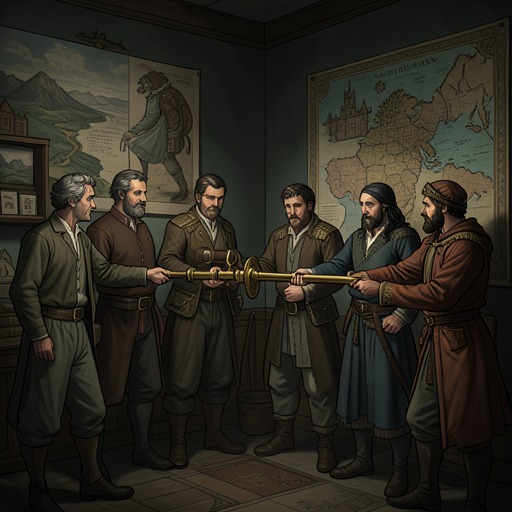
Iron Bank of Braavos
Fire & BloodThe Iron Bank of Braavos is presented as a major foreign financial institution whose dealings with the Targaryen crown involved both lending and the safekeeping of royal funds. Its appearances connect the monarchy’s immediate need for money to a wider network of rival lenders and, later, to the struggle over who controlled the late King Viserys Targaryen’s treasury.
Royal credit under Jaehaerys
The crown’s financial need was acute when Jaehaerys Targaryen began to rule in his own right. The wars of Maegor the Cruel had drained the royal treasury, and the expensive coronation and Golden Wedding of Jaehaerys’s mother had added to the strain. The crown also lacked the money to complete the Dragonpit on Rhaenys’s Hill, a project Lord Rogar Baratheon was determined to finish before relinquishing power.
After Jaehaerys appointed Rego Draz as master of coin, Draz approached the Iron Bank of Braavos and its competitors in Tyrosh and Myr. He arranged three substantial loans, negotiating among the institutions to obtain favorable terms. The credit immediately allowed work on the Dragonpit to resume, bringing builders and stonemasons back to the site. The loans were understood as temporary relief rather than a lasting solution: they eased the crown’s shortage of coin but did not remove its underlying need for revenue.
Custodian of the royal treasury
The Iron Bank’s role shifted from creditor to custodian during the succession crisis after King Viserys’s death. Ser Tyland Lannister, appointed master of coin by the faction supporting Aegon II, divided the royal treasury into four parts. One portion was entrusted to the Iron Bank of Braavos for safekeeping; other portions went under guard to Casterly Rock and Oldtown, while the remaining share was reserved for gifts, bribes, and the possible hiring of sellswords.
This division meant the crown’s wealth was distributed beyond the capital before Rhaenyra Targaryen took King’s Landing. Aegon II had spent the portion left in the city, leaving empty vaults for his half-sister. The remainder, including the portion entrusted to the Iron Bank, was held beyond her grasp alongside the funds sent to the Lannisters of Casterly Rock and the Hightowers of Oldtown. The account establishes the bank as one of several repositories used in the transfer, not as the sole holder of the missing royal fortune.
Financial power and political consequence
Across these episodes, the Iron Bank mattered because royal power depended on money that the crown could not readily raise at home. Under Jaehaerys, its lending helped restore a major royal building project when the treasury could not pay its workers. In the later conflict, its custody of part of the treasury helped leave Rhaenyra facing an empty royal storehouse when she seized the city.
The bank’s recorded dealings therefore span two different pressures on the monarchy: the costs of rebuilding and governing, and the financial preparations made for a contested succession. In both cases, the movement of royal funds through foreign institutions shaped what the ruling faction could actually afford to do.