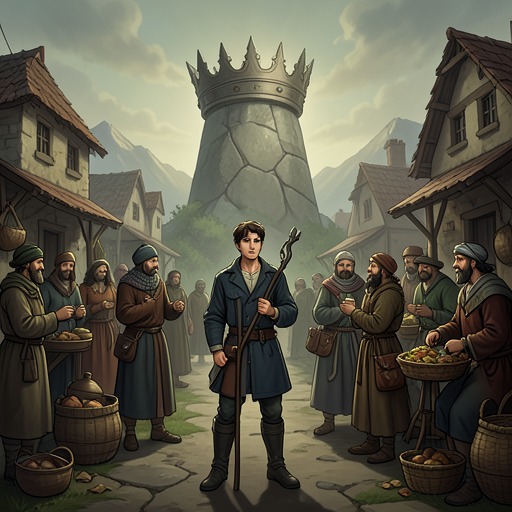
Jaehaerys Pardons Maegor's Supporters
Fire & BloodJaehaerys Pardons Maegor's Supporters was the new king’s first major test of government after King Maegor’s death. Faced with a crowded prison and pressure from his regent, Queen Alyssa, to punish the former king’s adherents, Jaehaerys rejected collective retribution. Most prisoners were released after renouncing Maegor and doing homage to his nephew; their pardon was conditional, secured by hostages, surrendered lands, or payments. The decision offered former enemies a route back into the king’s peace while establishing that Jaehaerys would not begin his reign by repeating his uncle’s violence.
The question of punishment
Maegor’s death did not leave the realm without supporters of his rule. Many great houses and lesser lords had already abandoned him, but a number of lords near King’s Landing and the crownlands remained loyal until the end. Among them were Lords Rosby and Towers, described as the last men to see Maegor alive, as well as Lords Stokeworth, Massey, Harte, Bywater, Darklyn, Rollingford, Mallery, Bar Emmon, Byrch, Staunton, and Buckwell. The immediate aftermath was unsettled: Lord Rosby drank hemlock, while Buckwell and Rollingford fled by ship to Pentos and most of the others withdrew to their castles.
When Jaehaerys and his sisters Rhaena and Alysanne arrived at the Red Keep on dragons, Lords Darklyn and Staunton remained with Lord Towers to yield the castle. The three men knelt before the prince and laid their swords at his feet. Jaehaerys pointed out that they had come late to his cause and that their blades had helped bring about his brother Aegon’s death beneath the Gods Eye. He nevertheless ordered them imprisoned rather than executed on the spot. A fortnight later, when Lord Rogar Baratheon and Queen Alyssa arrived with their host, hundreds more people were seized. Those held included knights, squires, stewards, septons, serving men, and noblewomen who had attended Maegor’s Black Brides.
The arrests raised a consequential legal and political question: if Maegor’s reign was treated as unlawful, were all who had supported him therefore traitors liable to death? Queen Alyssa argued for severe punishment. She had lost two sons to Maegor’s cruelty and believed those who had served him should not be granted even the dignity of a trial. Rogar, Jaehaerys’s Hand and Protector of the Realm, agreed that the prisoners deserved punishment but warned that executions could drive remaining loyalists to resist. The crown would then have to take their strongholds one by one by force, a costly campaign likely to deepen opposition. Rogar urged trials, death for those guilty of the worst crimes, and hostages or territorial concessions from the rest.
Jaehaerys’s intervention
Rogar’s proposal had support among the young king’s other adherents, but Jaehaerys made the decision his own. Though only fourteen, he would not remain a passive figure while others governed in his name. Accompanied by his maester, his sister Alysanne, and several young knights, he climbed the Iron Throne and summoned his lords. He declared, “There will be no trials, no torture, and no executions,” explaining that the realm must see he was not his uncle and that he would not begin his reign in blood.
The declaration was striking because it was not yet legally binding. Jaehaerys had not been crowned or anointed and had not reached his majority; formally, he could not overrule the regent and council. Yet the force of his position on the Iron Throne, and the resolve of his words, shifted the room. Rogar and Lord Velaryon gave him their support, followed by the others. Rhaena alone objected, warning that people might cheer Jaehaerys’s coronation as they had once cheered Maegor and their father. Her response underscored the uncertainty that still surrounded popular acclaim and royal legitimacy.
The final choice rested with Queen Alyssa. Although she wanted vengeance, she did not wish to oppose her son or make him appear weak, a danger she associated with his father’s downfall. She accepted his decision, and most of Maegor’s imprisoned supporters were spared. The settlement thus emerged not from a simple agreement among the king’s advisers, but from a confrontation in which the young monarch asserted his will and the regent chose to uphold it.
Public submission and conditional pardon
In the following days, the dungeons of King’s Landing were emptied in an orderly public process. The prisoners received food, drink, and clean clothes, then were brought into the throne room in groups of seven. Before witnesses, each renounced allegiance to Maegor and did homage to Jaehaerys on his knees. The king then pardoned him, restored his lands and titles, and bade him rise. The sequence transformed release into a visible act of submission: the former adherent returned to his place only after acknowledging the new king.
The pardon did not mean that the former supporters escaped consequence. Lords and knights had to send a son to court as a hostage; where there was no son, a daughter was required. The wealthiest of Maegor’s lords also surrendered lands, including Towers, Darklyn, and Staunton, while others bought their pardons with gold. These measures addressed Rogar’s concern that an indiscriminate purge would provoke resistance, while giving the crown leverage over men whose loyalty had recently belonged to Maegor.
Nor did clemency extend to everyone. Maegor’s headsman, gaolers, and confessors were judged culpable for assisting Tyanna of the Tower in the torture and death of Prince Viserys, and were executed. Ser Maladon Moore, a Kingsguard knight, also lost his head after being accused of holding Ceryse Hightower while Ser Owen Bush removed her tongue, an act that resulted in her death. Maladon denied that account, but admitted delivering Tyanna to Maegor and witnessing her killing; the chronicler therefore records a separate ground for his guilt. These cases drew a boundary around the pardon: broad reconciliation for political adherence, but punishment for individuals held responsible for grave crimes.
The meaning of the settlement
Jaehaerys’s decision joined clemency to control rather than treating them as opposites. Restoring titles and lands invited defeated lords back into the political order; hostages, forfeitures, and payments made their renewed allegiance conditional and enforceable. The public ceremony in the throne room gave that arrangement a form the assembled court could witness, with the king personally receiving submission and granting pardon.
The event also established a contrast between the new reign and Maegor’s. Jaehaerys refused the mass executions urged by his mother, but did not declare all conduct forgiven: men implicated in Prince Viserys’s death and the killing of Ceryse Hightower were still punished. His first act of rule was therefore neither unconditional mercy nor vengeance. It was a deliberate effort to bring most former opponents under his authority without beginning his kingship with a wider war.