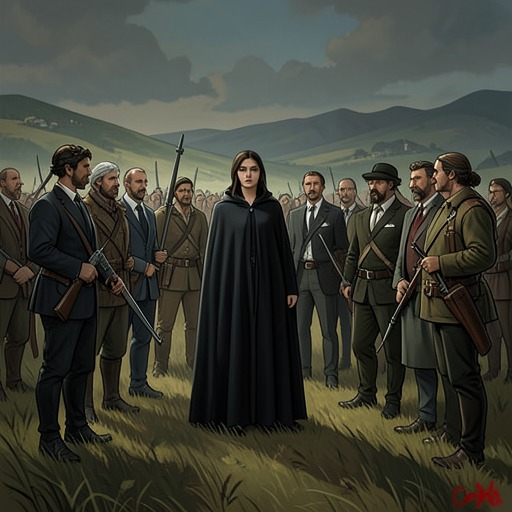
Joffrey Arryn
Fire & BloodJoffrey Arryn was the chosen heir of Jeyne Arryn, the Maiden of the Vale, and was declared the rightful Lord of the Eyrie after her death. Though he had served her loyally as Knight of the Bloody Gate for ten years, his claim was challenged by relatives closer by blood, and the decision to uphold Jeyne’s will helped ignite a renewed struggle across the Vale.
Jeyne Arryn’s Chosen Heir
Jeyne died at forty in the Motherhouse of Maris, on the stony island in Gulltown’s harbor, after a cold settled in her chest. At her deathbed, with her dear companion Jessamyn Redfort beside her, she dictated a final testament naming Joffrey her heir. His service as Knight of the Bloody Gate had been a decade-long defense of the Vale against wildlings from the hills, giving the choice a record of loyal service behind it as well as the authority of Jeyne’s will.
The succession was disputed from the outset. Joffrey was only Jeyne’s fourth cousin by degree; Ser Arnold Arryn, her first cousin, was much closer by blood. Arnold had twice tried to depose her and had been imprisoned after his second rebellion. By the time Jeyne died, years in the Eyrie’s sky cells and the dungeons beneath the Gates of the Moon had left him mad. His son, Ser Eldric Arryn, was sane, shrewd, and ambitious, and advanced his father’s claim. Supporters of Eldric argued that established inheritance laws could not be set aside by the whim of a dying woman.
A third claimant, Isembard Arryn, came from the wealthy Gulltown branch of House Arryn, which had separated from its noble kin during Jaehaerys’s reign and prospered through trade. Known as the Gilded Falcon, Isembard used his fortune to bribe lesser lords and bring sellswords across the Narrow Sea. Joffrey’s claim therefore faced not a single rival but competing appeals to blood, inheritance custom, and wealth.
Judgment and Renewed War
Ser Corwyn Corbray ruled that Jeyne’s will must prevail and declared Joffrey the rightful Lord of the Eyrie. The other claimants would not accept the judgment. Corwyn imprisoned Isembard and his sons and executed Eldric, while Arnold escaped and fled to Runestone, where he had served as a squire in his youth.
The crisis sharpened at Runestone. When Corwyn arrived to draw Arnold from his sanctuary, Gunthor Royce confronted him in ancient bronze armor. Their words escalated from argument to threats. Corwyn drew Lady Forlorn, though the account leaves uncertain whether he meant to strike Royce or merely threaten him; a crossbowman on Runestone’s battlements then killed Corwyn with a bolt to the breast. The death of the king’s regent was treated as an act of treason, and the Vale’s fighting flared anew.
The Factions Around His Claim
The conflict divided the Vale’s houses. The Corbrays, Hunters, Craynes, and Redforts rallied for Joffrey, the heir selected by Jeyne and upheld by Corwyn. The Royces of Runestone sided with Arnold, joined by the Templetons, Tolletts, Coldwaters, and Duttons, as well as lords of the Fingers and the Three Sisters. Gulltown and House Grafton continued to support Isembard despite his captivity.
From King’s Landing, Lord Rowan sent ravens ordering the lords behind Arnold and Isembard to lay down their arms. When no answer came, he consulted Oakenfist and prepared to suppress the rebellion by force. The evidence establishes Joffrey as the testamentary heir and the beneficiary of Corwyn’s ruling, but does not relate the eventual outcome of the succession war.
Significance
Joffrey’s part in the conflict is chiefly defined by decisions made in his favor: Jeyne’s deathbed designation and Corwyn’s judgment. His decade of service at the Bloody Gate supplied a basis for confidence in him, yet could not settle the competing claims of blood and inheritance custom. The resulting war shows how a lawful designation could become a contested political settlement when rival claimants and regional alliances refused to recognize it.