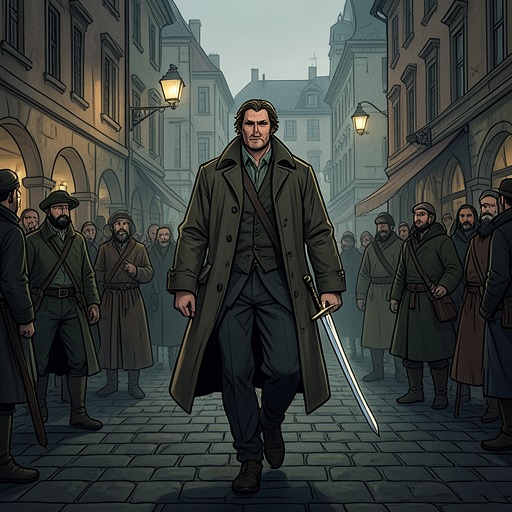
Judgment of the Wolf
Fire & BloodThe Judgment of the Wolf was Cregan Stark’s investigation and sentencing of those implicated in the murder of Aegon II. Appointed Hand to the young Aegon III so that he could lawfully judge another lord, Stark turned a threatened mass execution into a narrower reckoning: only Ser Gyles Belgrave and Larys Strong were put to death, while many others were sent to the Night’s Watch. The proceedings closed the account of Aegon II’s reign and revealed the tension between justice, royal authority, and the practical mercy of preserving men for the Wall.
A disputed crown and a king’s death
The judgment followed a war in which public ceremonies had made rival claims to rule visible. Aegon II had been crowned in the Dragonpit, where Ser Criston Cole placed Aegon the Conqueror’s iron-and-ruby crown on his head. On Dragonstone, Rhaenyra was crowned with the crown of Jaehaerys the Conciliator, and named her son Jacaerys heir. The two ceremonies presented competing Targaryen claims in the language of inherited crowns and royal titles; the struggle that followed left Aegon II dead and the realm in need of a settlement.
Aegon II’s murder brought accusations against people across the court and household. Grand Maester Orwyle had confessed under torture to giving the poison to Larys Strong, though he maintained that he had not known what it was for. Evidence also implicated Ser Perkin the Flea and a wider circle of servants, guards, and armed men. The inquiry was not confined to the great lords: the king’s litter-bearers, herald, wine-cellar keeper, and the serving man responsible for keeping his flagon full were among those accused of playing a part.
Cregan Stark’s authority and inquiry
A lord could not lawfully put another lord to death. Prince Aegon therefore made Cregan Stark the King’s Hand, granting him authority to act in the king’s name. Stark conducted the proceedings without claiming the Iron Throne for himself; he sat on a plain wooden bench beneath it while the accused were brought before him. That choice placed the judgment in service of the young king’s authority, even as Stark exercised power on his behalf.
The inquiry distinguished between suspicion and proof, while also judging failures of responsibility. Septon Eustace was released because there was no evidence against him. Orwyle was judged complicit: Stark treated his claim of ignorance as no answer when the Grand Maester had not asked what the poison was for. Ser Gyles Belgrave was condemned because he had either put poison in the king’s wine or allowed the act through carelessness or willful blindness. Three Kingsguard who had been present when Aegon died were likewise sentenced, although their participation in the plot could not be proved; those who had not been in the city were found innocent.
Stark also condemned twenty-two lesser figures connected to the murder. The accused included the household servants who had access to the king’s food and drink, as well as men involved in the deaths of his food taster Ummet and Tom Tangletongue and the drowning of Tom’s father. Many were gutter knights, sellswords, or men-at-arms who had received questionable knighthoods during the upheaval. They blamed their actions on Ser Perkin’s orders, but Stark found Perkin himself guilty of changing allegiance, helping drive Rhaenyra from the city, raising up his own squire, and then abandoning him.
The last major defendants were Larys Strong and Corlys Velaryon. Corlys did not deny involvement in the plot, maintaining that he had acted for the realm and that the killing had to end. Orwyle’s testimony and Perkin’s accusation pointed to Larys, who neither confirmed nor denied the charges. Stark found both lords guilty of murder, regicide, and high treason. Their cases, however, did not bring the same response from those around them: Larys stood friendless, while Corlys had admirers and supporters, including Baela and Rhaena, who appealed to Aegon on his behalf.
Sentences, appeals, and the taking of the black
The condemned were brought in chains to the Red Keep’s outer ward for execution. Stark followed the northern custom that the person who passed sentence should wield the sword, so that responsibility for the deaths rested on the judge himself. The scene’s course changed when Perkin, selected by lot to die first, asked to take the black. Stark accepted the request, respecting the Night’s Watch’s need for men. The other prisoners seized on the same possibility, and one after another called for the Wall.
The change in sentence spared men from across the ranks of the accused. Household servants and armed followers, the three condemned Kingsguard, and Orwyle all joined the appeal. Orwyle’s service as a man of learning counted in his favor: the Night’s Watch needed men able to use a quill as well as a sword. Stark sent the would-be penitents to the Wall rather than carrying out the original death sentences. The proceedings therefore ended not in the execution of every condemned participant, but in a commutation that transferred most of them into the service of the Watch.
Not every prisoner accepted that alternative. Belgrave refused the black and maintained that a Kingsguard should not outlive a king who had died violently. Stark executed him with Ice in a single stroke. Larys also declined to join the Night’s Watch. He requested that Stark remove his clubfoot after his death, asking to be free of it in death as he had dragged it through life. Stark granted the request and executed him.
The ending of the proceedings
Only Belgrave and Larys died at the executions. Their heads were displayed on either side of the Red Keep’s gates; the remaining condemned were returned to their cells pending arrangements to send them to the Wall. Larys’s death ended House Strong. His remains were given to the silent sisters and his bones later came to rest at Harrenhal, but the foot Stark had ordered buried separately disappeared before burial. The history’s report of its supposed later use by a sorcerer is presented as a dubious tale, not a certain outcome.
Corlys, though sentenced to death, was not among the two men executed that day. His supporters’ appeals had brought his case before Aegon, and the account of the executions leaves him alive. The contrast with Larys is stark: the Clubfoot faced the sentence without anyone speaking in his defense, while the Sea Snake’s allies pressed the king to intervene.
Stark’s service as Hand ended the next day. He returned the chain of office to Prince Aegon and went north rather than remain to govern or claim a regency. The Judgment of the Wolf thus ended both the immediate proceedings and Stark’s brief tenure at court. Its outcome joined punishment to restraint: two prominent men were executed, while the threatened sweep of death sentences was largely redirected toward the Night’s Watch.