King's Landing City Watch
Fire & BloodThe King's Landing City Watch was the capital’s largest armed force, and its command could influence whether a royal order or political challenge had force behind it. Across successive struggles for the Iron Throne, the Watch appears not as a single, unchanging instrument of the crown, but as a body whose commanders, gate captains, and available numbers shaped what rulers could attempt in the city.
Command and Force
During the regency of Jaehaerys Targaryen, the king entrusted command of the Watch to Qarl Corbray, Lord of Heart’s Home, who had fought beside Aegon the Uncrowned beneath the Gods Eye. The appointment placed a supporter of the young king in charge of the capital’s largest armed force. When Rogar Baratheon proposed setting Jaehaerys aside, Qarl made clear that the men under his command would not support the plan. His response helped show that a proposed change of sovereign could not be treated as a private decision among councillors: the stance of the city’s armed force mattered.
The command later became a source of power for Daemon Targaryen. After King Viserys removed him first as master of coin and then as master of laws, Daemon held the Watch’s command and two thousand men. The account presents this post as making him more powerful than before, a measure of the force’s importance in the capital’s political balance. Otto Hightower feared Daemon’s possible accession to the throne, while Daemon’s authority over the Watch strengthened his position even outside the council offices he had lost.
Gate Captains and Political Allegiance
At the beginning of the succession crisis in 129 AC, the Watch’s commander and its seven captains, each responsible for one of the city gates, were summoned to the Red Keep and questioned about their sympathies. Five captains were judged to favor Aegon’s cause. The other two and the unnamed commander were deemed unreliable and imprisoned. The episode shows how control of the Watch was handled as an immediate political concern: the incoming regime assessed its officers and removed those it distrusted before relying on the force.
Ser Luthor Largent, one of the five captains considered loyal to Aegon, was appointed the new commander. Otto Hightower also named his own son, Ser Gwayne Hightower, as Largent’s second, instructing him to watch for signs of disloyalty. The arrangement joined a change in command to an effort at oversight: Largent received authority, but the regime placed a trusted member of the queen’s family beside him.
Authority and Its Limits
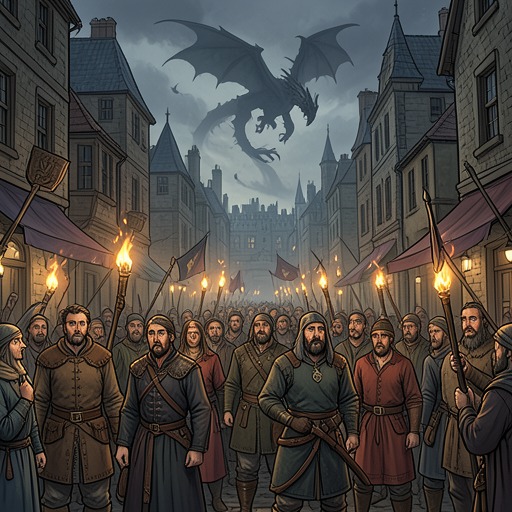
The Watch’s presence did not guarantee control of the streets. During the unrest that followed the Shepherd’s call to attack the Dragonpit, Rhaenyra Targaryen ordered riders to reach the Old Gate and Dragon Gate, disperse the advancing crowd, seize the Shepherd, and protect the royal dragons. The account leaves uncertain whether the messengers succeeded in getting through the turmoil. It also notes that too few loyal gold cloaks remained to offer a realistic prospect of stopping the attackers. The Watch’s formal responsibilities and the crown’s commands were not enough to overcome a city in revolt.
The contrast between Qarl Corbray’s refusal to support a proposed coup and the later shortage of loyal watchmen captures the institution’s changing political significance. At one moment, the commander’s allegiance could obstruct a plan against the king; in another, the remaining force could not reliably defend the regime’s priorities. The Watch mattered because it concentrated armed authority in the capital, but that authority depended on who commanded it, which officers could be trusted, and how many men were still available when the city’s loyalty broke down.