King’s Landing
Fire & BloodKing’s Landing is the seat of royal power and a city whose inhabitants repeatedly become part of the political story. Its Red Keep houses kings and queens, but authority there is never only a matter of crowns and councils: news carried through the streets, the response of the smallfolk, and the security of the gates can strengthen or imperil a ruler. During the Dance of the Dragons, the capital changes hands, erupts in revolt, and becomes a place of refuge and contagion; afterward, its crowds also witness the public settlement of a fractured dynasty.
The capital and its royal households
King’s Landing appears as a working center of court and government. The Red Keep is where King Viserys I Targaryen dies in 129 AC, after a long decline that has left him bedridden. A serving man discovers that the king has died when he fails to wake from a nap. The death takes place within the royal household, but its consequences extend immediately beyond it: the queen is informed, the court must decide what happens next, and the city will soon be asked to recognize a new king.
The city also contains the ordinary spaces in which royal lives become public or vulnerable. Saera Targaryen’s pranks reach beyond the family apartments: she enters White Sword Tower as a child and takes the white cloaks she finds there, dyeing them pink. Years later, one of her japes at the Blue Pearl brothel exposes her companions’ conduct to two members of the City Watch. The episode shows that the capital’s court and its streets are not separate worlds. The Watch can encounter the consequences of a princess’s actions in a commercial district, while the princess’s name travels through other people’s accounts of the affair.
The city’s proximity to royal power makes it the setting for private grief as well as public rule. At the darkest hour of the night, Ser Ryam Redwyne wakes the king and queen to tell them their daughter has been found dead in an alley at the foot of Aegon’s High Hill. The report brings a death in the city directly into the royal household. Elsewhere in the narrative, King Jaehaerys I Targaryen returns to King’s Landing alone on Vermithor, while Queen Alysanne remains on Dragonstone amid uncertainty surrounding their marriage and the king’s relations with his mother and council. The capital is thus not merely a fixed home for the court: returning to it, or remaining away from it, carries political significance.
Succession made public
King’s Landing’s political importance is especially visible when a royal death creates competing claims. After Viserys I dies in the Red Keep, the new king’s accession is announced through a coordinated display of authority. On the tenth day of the third moon of 129 AC, bells toll, Grand Maester Orwyle sends ravens across the realm, and riders carry the news through the streets. They proclaim that Viserys is dead and Aegon is king. The Silent Sisters are summoned to prepare the body for burning, while the city hears the announcement before it can know how the succession will be contested.
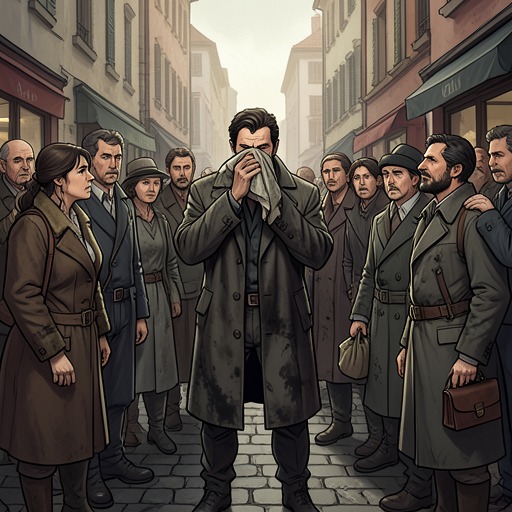
The people’s response is not unanimous recognition. Some weep, others cheer, and most of the smallfolk remain silent, confused and wary. A voice calling for the queen interrupts the proclamation. That uncertain reception contrasts with the formal ceremony that follows: Ser Criston Cole places Aegon II Targaryen’s iron-and-ruby crown on his head and proclaims him king, while Queen Alicent Hightower crowns her daughter Helaena. Alicent then kneels before Helaena and addresses her as queen. The ceremony uses inherited regalia, titles, and public gestures to assert a settled order, but the mixed reaction in the streets makes clear that royal proclamation and popular certainty are not the same thing.
A rival coronation takes place elsewhere, on Dragonstone, where Daemon Targaryen crowns his wife Rhaenyra with the crown of Jaehaerys. The contrast matters to King’s Landing because the city becomes the prize in the conflict between competing royal governments. When Rhaenyra’s forces approach, the capital has been left poorly defended: Aemond Targaryen and Criston Cole have taken troops away to retake Harrenhal, and Aemond has taken Vhagar with him. Dreamfyre remains, but Helaena is too broken to ride her, while the other dragons are young and unridden. The city’s defenses are therefore weakened not simply by the absence of soldiers but by the loss of an effective dragon response.
Conquest, siege, and popular revolt
King’s Landing falls in less than a day. At the River Gate, thirteen Hightower knights and a hundred men-at-arms hold off the gold cloaks for nearly eight hours, fighting attacks from inside and outside the city. Their resistance cannot prevent Rhaenyra’s soldiers from entering through the other six gates, which are left undefended. The dragons above the city break the opposition’s resolve, and Aegon’s remaining loyalists hide, flee, or submit. The capital’s capture is therefore achieved through a combination of military entry, dragon power, and the collapse of organized resistance rather than the defeat of every defender in battle.
The change of regime does not make the city secure. When reports of betrayal and slaughter at Tumbleton reach King’s Landing, Rhaenyra orders the gates shut and barred, fearing that turncloaks could open them to rebels and that hostile forces may soon arrive. The closure turns the city into a trap for many of its inhabitants. As reports of slaughter spread, residents fear that dragons will fight above King’s Landing and burn it. Hundreds try to escape, but the gold cloaks turn them back. Some seek shelter in cellars; others crowd into taverns, brothels, and septs, where people look for relief and exchange frightening accounts of what may come.
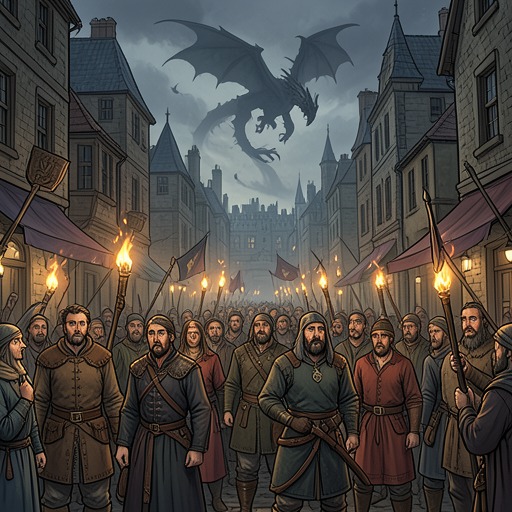
That accumulated fear gives way to the bloody riot in which King’s Landing rises against its rulers. A crowd of dragonslayers moves through streets and alleys toward the Dragonpit, shouting for the dragons to be killed. Some leave the march, but more join it; by the time the crowd reaches the Hill of Rhaenys, its numbers have doubled. The movement of the crowd makes the crisis physical: the city’s people, previously confined by closed gates and rumors of impending attack, now become an armed force moving toward the place where the dragons are kept.
The riot’s consequences reach the royal family directly. Rhaenyra loses both her dragon and her son, and withdraws to her chambers while her counselors conclude that King’s Landing is lost. She leaves at dawn through the Dragon Gate with a small company, including her surviving son, Aegon the Younger. The Mud Gate is in enemy hands, and the ships along the river have been burned or sunk, narrowing the available routes out of the city. King’s Landing, which had been the center of Rhaenyra’s power, becomes a place she can no longer safely hold.
Public order after the war
The city remains a setting for formal political acts after the fighting has ended. Those condemned to die are brought from the dungeons in chains to the Red Keep’s outer ward, where they kneel before Prince Aegon and his court. The scene places punishment before the royal household and its assembled audience, making the capital’s royal precinct a venue for the consequences of the conflict as well as its claims to authority.
The marriage of Prince Aegon and Princess Jaehaera offers a different kind of public spectacle. With the Dragonpit still largely in ruins, the wedding is held outdoors atop Visenya’s Hill, beneath grandstands built to give the nobility a clear view. The date, the seventh day of the seventh moon of 131 AC, is treated as auspicious. The High Septon performs the rites, and tens of thousands of smallfolk cheer when the couple are declared joined. They accompany the prince and princess in an open litter to the Red Keep, where Aegon is crowned king with a plain circlet of yellow gold. The damaged Dragonpit remains part of the setting even when the ceremony avoids it: the ruined structure helps explain why the wedding takes place outside, while the crowds give the dynastic union a public reception absent from a private court rite.
By the end of 131 AC, a subdued calm has settled over King’s Landing and the crownlands. Aegon III sits the Iron Throne when required but is otherwise rarely seen. The work of protecting the realm falls to Lord Protector Leowyn Corbray, while Tyland Lannister, serving as Hand, manages the daily business of rule. Tyland’s appearance, altered by the queen’s torturers, becomes a source of rumor: he wears a silken hood at formal occasions, and the smallfolk begin to imagine him as a sinister masked sorcerer in the Red Keep. The episode shows how little control the court has over the stories that circulate in the city, even when the king’s council controls the formal instruments of government.
Epidemic, finance, and the city’s crowds
King’s Landing’s busy riverside trades also expose the city to danger. During the Winter Fever, the first fatal flush appears among sailors, ferrymen, fishmongers, dockers, stevedores, and sex workers along the Blackwater Rush. The illness spreads from there into every part of the city, affecting rich and poor alike. Grand Maester Munkun examines some of the afflicted, then avoids returning to the castle because of his close contact with the sick. Instead, he sends an urgent letter to the Hand. Tyland responds by ordering the gold cloaks to close the city and prevent anyone from entering or leaving. As in wartime, the gates become instruments of emergency government; this time, their purpose is to contain disease rather than an invading army.
The capital also concentrates the financial consequences of events elsewhere. After the fall of House Rogare becomes known in Westeros, lords and merchants realize that money entrusted to the family has been lost. In King’s Landing, Lotho Rogare is arrested as he tries to depart, and his letters, ledgers, and the remaining gold and silver in the vaults atop Visenya’s Hill are seized. Ser Marston Waters and other Kingsguard members raid the Mermaid, sending its patrons into the street, while Lord Roggerio is marched through a jeering crowd. The city’s authorities act on the collapse of a distant financial house by arresting its members and taking control of its assets in the capital.
King’s Landing repeatedly gathers people for reasons that have little to do with royal pageantry. At the end of 136 AC, lords arrive in response to the king’s summons. The gathering is not formally declared a Great Council, but it is the largest assembly of nobles in the Seven Kingdoms since the council at Harrenhal in 101 AC. Their arrival fills the city, to the benefit of its innkeepers, merchants, and sex workers. Across these episodes, the capital’s significance lies in its concentration of institutions, crowds, and competing claims: it can announce a succession, lose a war, confine a frightened population, impose emergency controls, and host a meeting whose scale recalls an earlier reckoning over royal inheritance.