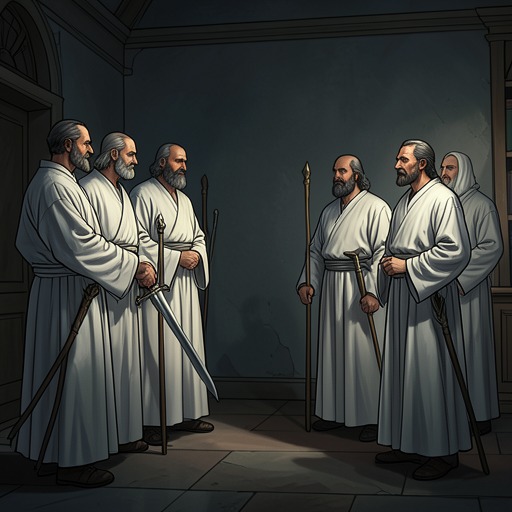
Kingsguard oath of obedience
Fire & BloodThe Kingsguard oath of obedience is presented as a binding duty whose meaning becomes uncertain when the king is a child and the Hand claims to speak in his name. During the secret siege of Maegor’s Holdfast, Aegon III invokes the vows to defend his command, while Ser Marston Waters argues that the same vows require the Kingsguard to obey the Hand until the king comes of age. Their dispute leaves the oath’s authority unsettled and shows how a promise of service can become a struggle over who has the right to command.
The oath and royal authority
The evidence does not provide a formal text for the oath of obedience. Instead, its obligations emerge through the claims made by those bound by it. Aegon III understands obedience as direct service to the king: Ser Amaury, he argues, had been ordered to leave and had refused, despite being warned of the consequence. In the king’s view, a Kingsguard’s vows include following his command, not merely offering him physical protection.
Ser Marston presents a different account of the chain of command. He accepts that the Kingsguard are sworn to obey the king, and says that when Aegon is grown he and his brothers would obey even an order to fall upon their swords. But while Aegon remains a child, Marston says, their oath requires them to obey the King’s Hand, whose voice stands for the king’s. His argument makes obedience conditional not on the king’s wishes alone, but on his capacity to rule without a regent.
Royal ceremonies elsewhere in the history make the stakes of this dispute visible without resolving it. Aegon the Conqueror’s coronation at Oldtown established the royal titles of King of the Seven Kingdoms and Protector of the Realm; centuries later, Criston Cole placed the Conqueror’s crown on Aegon II at his coronation. Such ceremonies publicly identify the king and his authority. The secret siege, by contrast, asks how that authority operates when the crowned king is still a child and the officers around him disagree about who speaks for him.
The dispute at Maegor’s Holdfast
The conflict came into the open after Ser Marston and his men demanded that Aegon leave his sanctuary in Maegor’s Holdfast. Aegon rejected the Lord Commander’s appeal to trust him, insisting that Sandoq was no beast but an obedient servant, and that Ser Amaury had died after disobeying a warning. Marston answered by drawing a distinction between the king’s authority as an adult and the regent’s authority during his minority. He then knelt and swore that none would harm Aegon while he stood beside him.
Aegon did not accept either Marston’s argument or his pledge. He recalled that Marston had stood beside him when a dragon ate his mother and had only watched. His refusal was therefore not simply a legal objection: it was also a judgment on whether the Lord Commander’s promise of protection had meant anything when it mattered to him. Aegon left the battlements and would not return in response to Marston’s appeals over the following days.
Marston next challenged Aegon’s insistence that Lord Thaddeus Rowan was his Hand. He accused Thaddeus of selling the realm to Lys and declared that he would serve as Hand until Thaddeus’s guilt or innocence was established. The claim joined two forms of authority: the office of Lord Commander, which gave Marston command of the Kingsguard, and the office of Hand, which he asserted for himself. Aegon’s insistence that Thaddeus remained his Hand stood against that attempted substitution.
Obedience under pressure
Marston did not attempt to take Maegor’s Holdfast by force, although he had enough men to assault it and might eventually have overcome Sandoq and the other Lyseni defenders. The account suggests that he hesitated because he was unwilling to dishonor the white cloak by attacking the king he had sworn to protect. He continued to seek an end to the siege through words, perhaps also relying on the dwindling supplies inside the holdfast, rather than using ladders, grapnels, or a direct assault.
That restraint shows the oath working in more than one direction. Marston invoked obedience to the Hand as a reason to demand that Aegon surrender, yet the duty to protect the king made him reluctant to storm the place where Aegon was sheltering. His own sworn obligations thus constrained his ability to enforce his interpretation of them. The narrative also presents his hesitation alongside his rise from a bastard-born knight of modest standing to Lord Commander and the most powerful man in the realm until Aegon came of age. His position was formidable, but neither rank nor an asserted regency made the conflict disappear.
Meaning and limits
The oath is not shown as a simple rule that automatically settles disputes. Aegon treats personal command as its central obligation; Marston argues that obedience passes through the Hand while the king is under age. Both men appeal to service, but their competing interpretations produce opposing demands: the king orders the Lord Commander away, while the Lord Commander claims authority to direct the king. The narrative does not present a neutral judgment that definitively resolves which interpretation governs.
The episode gives the oath both institutional force and human cost. Marston’s white cloak restrains him from attacking the king, but his earlier inaction has left Aegon distrustful of his protection. Aegon’s appeal to obedience is inseparable from his memory of being failed; Marston’s appeal to delegated authority is inseparable from his responsibility for the king’s safety. In the secret siege, the oath promises loyalty but cannot by itself decide who holds the king’s voice.