Maegor I Targaryen
Fire & BloodMaegor I Targaryen was a claimant who made force the foundation of his kingship. Rejecting the succession rights of his nephew, he took the Iron Throne and fought the Faith Militant, while his rule became associated with executions, reprisals, and fear. He died after six years and sixty-six days, without an heir of his body; neither the manner of his death nor the means by which he met it was ever settled.
Claim to the Iron Throne
Maegor claimed the crown after the death of his father, Aenys I Targaryen. Queen Visenya Targaryen returned to Dragonstone with him, and he took the iron crown set with blood-red rubies that had belonged to their father, rather than the ornate golden crown Aenys had worn. Before the gathered lords and knights, Maegor proclaimed himself king. Queen Alyssa and her children, including Aenys’s son Aegon, were absent: Alyssa had taken them to Driftmark Island after the funeral.
Grand Maester Gawen challenged the claim on grounds of inheritance. He argued that the Iron Throne should pass to Aegon, Aenys’s son, in accordance with laws the Conqueror had affirmed. Maegor rejected the argument and asserted that strength would decide who held the throne; he then killed Gawen with Blackfyre. The episode established the terms of Maegor’s accession: he possessed a crown, a royal declaration, and the ability to command, but his claim displaced the succession that the Grand Maester considered lawful.
Maegor quickly asserted his authority beyond Dragonstone. He dictated letters to lords throughout the realm, and the next day crossed Blackwater Bay on Balerion with Visenya following on Vhagar. Their dragons’ return to King’s Landing provoked unrest, while the Warrior’s Sons held positions in the city, including the Sept of Remembrance on Rhaenys’s Hill. Visenya publicly advanced her son’s claim and called on those who disputed it to answer by force. The conflict over succession was therefore visible in the city itself: rival claims were backed by armed followers, and Maegor’s immediate answer to resistance was the prospect of combat.
War Against the Faith Militant
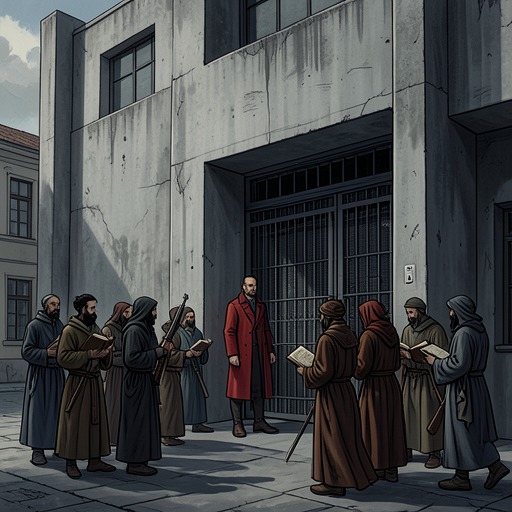
Maegor’s conflict with the Faith Militant became the defining war of his reign. He ordered the Poor Fellows gathering near King’s Landing to lay down their weapons, threatening proscription and death if they refused. When the command failed, he called on loyal lords to disperse them by force. The High Septon, in turn, urged the Faith’s followers to take up arms against the rule of the Targaryens. The struggle was not a single clash but a continuing contest between royal commands and an armed religious movement.
At the fortified Sept of Remembrance, Maegor mounted Balerion and attacked the Warrior’s Sons assembled there. Seven hundred of the order were killed, and the attack sharply reduced its strength. Other chapters remained in Oldtown, Lannisport, Gulltown, and Stoney Sept, but the order would never again approach its former power. Maegor’s victory against the sept’s defenders did not end the war; it demonstrated the destructive force he was willing to employ against opposition, while leaving the wider conflict unresolved.
The fighting also brought defeat to the Poor Fellows in the Reach. At Stonebridge, nine thousand followers under Wat the Hewer attempted to cross the Mander and were caught between six lordly forces. Their army was divided by the river and cut apart by the attack. Wat was captured and brought to King’s Landing in chains. The battle gave its name to Bitterbridge and showed the gulf between the poorly equipped religious host and the mounted forces raised by the lords. Maegor’s government met organized resistance through royal decrees, noble levies, and overwhelming military force.
Household, Heir, and Dynastic Failure
Maegor’s marriages and declarations of succession exposed the uncertainty behind his attempt to secure a dynasty. He named his niece, Aerea Targaryen, the lawful heir until the gods granted him a son, while sending her twin, Rhaella Targaryen, to Oldtown to be raised as a septa. In the same decree, he disinherited his nephew Jaehaerys, whom the existing laws of succession favored. The arrangements extended beyond the royal family: the sons of his queens were sent to other noble households or placed in the care of wards and guardians.
For a time, the prospect of children appeared to offer a way out of the succession problem. Queen Jeyne Westerling became pregnant, and Maegor later announced that Queen Elinor Costayne was pregnant as well. He rewarded both queens and their relatives with gifts, honors, lands, and offices. Jeyne’s pregnancy ended in a stillbirth, and she died soon afterward. Maegor blamed Tyanna of the Tower, who confessed to poisoning Jeyne’s child and claimed she had done the same to Alys Harroway’s pregnancy. Tyanna also threatened that Elinor’s child would suffer the same fate. Elinor subsequently gave birth to a stillborn child. These losses left Maegor without the living son he had repeatedly made the condition of his succession plans.
His relationship with Rhaena Targaryen combined a grant of power with sharp recrimination. He had given her Dragonstone, but later blamed her for bringing a woman he regarded as a thief there. When he considered the recovery of stolen dragon eggs, he threatened to demand their return from wherever they had gone and to use force if necessary. He also distinguished Rhaena from another sister, saying she had no part in the theft and would not be put at risk. The exchange showed the severity of his response to the loss of royal property, while also making clear that his threats did not fall equally on every member of his family.
Buildings, Reprisals, and Rule by Fear
Maegor’s rule left its mark on the Red Keep as well as on those who opposed him. When construction of the castle ended in 45 AC, he feasted the builders and workmen for three days, supplying wine, food, and entertainment. After the celebration, his knights killed the workers so they could not reveal the castle’s secrets; their remains were buried beneath the building they had constructed. The episode turned a royal building project into an instrument of secrecy and intimidation.
After the Red Keep’s completion, Maegor ordered the ruins of the Sept of Remembrance cleared from Rhaenys’s Hill and decreed that a great stone home for dragons be built there. This became the Dragonpit. Finding laborers proved difficult, and men fled from the work; Maegor ultimately used prisoners from the city’s dungeons, supervised by builders brought from Myr and Volantis. The project joined his conflict with the Faith to the physical transformation of the city: a site associated with the destruction of the Warrior’s Sons was cleared for a royal dragon lair.
Maegor’s reprisals also fell on House Harroway. Alys Harroway was subjected to prolonged torment by Tyanna in Maegor’s presence and died after nearly a fortnight. Her remains were publicly displayed at the city gates. Maegor then marched on Harrenhal and Lord Harroway’s Town, ordering the deaths of those he found with Harroway blood. The destruction extended beyond punishment of a single opponent; it erased a family and its wider kin from the places where they had lived. In the aftermath, Harrenhal’s reputation as a cursed seat was reinforced, and Maegor awarded it to Ser Walton Towers after the king’s men fought for the prize. Towers died of his wounds within a fortnight, leaving the lordship to his son.
Death and Historical Reputation
Maegor’s death came after a failing war council in the Red Keep. The lesser lords he had summoned commanded fewer than four thousand men between them, and many were discouraged by the absence of the great lords. Lord Hayford urged Maegor to abdicate and take the black; Maegor had him executed and continued the council with Hayford’s head displayed behind the Iron Throne. The lords departed late at night. Maegor remained alone in the throne room, and Queen Elinor found him dead there at dawn.
The circumstances could not be conclusively explained. Some believed that the Iron Throne’s blades had killed him, noting that Maegor had been alive when the last lords left and that the guards said no one had entered before Elinor. Other accounts proposed that Elinor had killed him, that members of the Kingsguard had acted together, or that an unknown person had used a secret passage. Another possibility was that Maegor had taken his own life rather than face defeat. The accounts preserve uncertainty rather than resolving it: the Red Keep itself, whose secrets Maegor had sought to protect, became the setting for a death whose agency remained unknown.
Maegor’s reign lasted six years and sixty-six days. His body was burned in the yard of the Red Keep, and his ashes were buried on Dragonstone beside those of Visenya. He left no child and no heir of his body; in 48 AC, his nephew Jaehaerys I Targaryen ascended the Iron Throne. Maegor’s reign thus ended without securing the dynasty he had tried to control. Remembered as Maegor the Cruel, he represents a kingship able to seize institutions, command armies, and impose obedience, but unable to turn coercion into a settled succession or lasting peace.