Maegor’s Usurpation
Fire & BloodMaegor’s Usurpation was a seizure of the Iron Throne that turned a royal death into a crisis of succession. On Dragonstone, Maegor claimed the crown before Aenys I’s eldest son could inherit it, and made his claim unmistakable by rejecting the laws of inheritance and executing the Grand Maester who invoked them. The episode set hereditary right against the power to take and hold the throne, while the crown itself became a visible claim to legitimacy.
Background and succession
Aenys I was still on Dragonstone at the beginning of the new year, gravely ill and reportedly weakened by fear and indecision. His condition seemed to improve for a time after Alyssa Targaryen took charge of his care, but he collapsed when news arrived that thousands of Poor Fellows had surrounded Crakehall, where his children Aegon and Rhaena were reluctant guests. He died three days later. The account connects the news to his collapse but does not establish a medical cause of death.
The immediate inheritance question was clear to Grand Maester Gawen: Aenys’s son Aegon should succeed under the laws of inheritance that the Conqueror had affirmed after his conquest. Maegor’s claim, by contrast, would rest not on that succession but on possession and force. His accession thus began with an open disagreement over whether the Iron Throne passed by established law or could be claimed by the person strong enough to seize it.
Death, funeral, and departure
Like his father, Aenys was given to the flames in the yard at Dragonstone. His sons Viserys and Jaehaerys, aged twelve and seven, attended with their five-year-old sister Alysanne. Alyssa sang a dirge, and Aenys’s dragon Quicksilver lit the pyre; Vermithor and Silverwing were also recorded as adding their fire. The funeral gathered the royal children around their father, but it did not settle who would rule in his place.
Visenya was absent. Within an hour of Aenys’s death, she mounted Vhagar and flew across the sea. When she returned, Maegor was with her, riding Balerion. The narrative records this abrupt departure and return without explaining what passed during Visenya’s absence. Its timing nevertheless frames the claim that followed: Maegor arrived at Dragonstone after the king’s death and moved directly to claim the crown.
Alyssa and her children did not witness the coronation. Within hours of Aenys’s funeral, she had taken them from Dragonstone to her father’s nearby castle on Driftmark. Maegor responded to their absence with a shrug, then withdrew to the Chamber of the Painted Table with a maester to dictate letters to lords throughout the realm. His first actions therefore combined a public assertion of kingship with an attempt to notify the political community, while the branch of the family whose succession rights were at issue had already left the island.
The coronation and the challenge of law
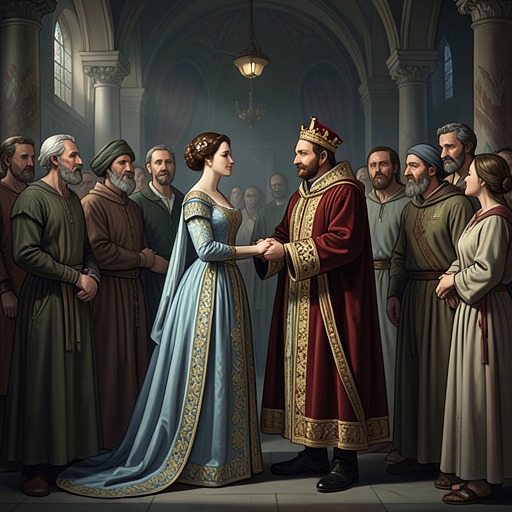
Maegor claimed the crown, but not the ornate golden crown Aenys had worn, which bore images of the Seven. Instead, he chose the iron crown of their father, set with blood-red rubies. Visenya placed it on his head, and the gathered lords and knights knelt as he proclaimed himself king. The choice linked his kingship to the Conqueror’s rule through a recognizable royal object; it did not resolve the question of whether he had the right to inherit.
Gawen alone dared to object. He invoked the laws of inheritance and named Aegon as the rightful successor. Maegor answered that the throne would go to whoever had the strength to seize it, then ordered Gawen’s immediate execution and carried it out himself with Blackfyre. The confrontation made the usurpation more than a disputed ceremony: the claim of legal succession was stated aloud, rejected by the new king, and suppressed through royal violence. Gawen’s objection remains the clearest account of the competing claim at the moment Maegor took the crown.
Legitimacy and the wider history of the crown
The episode belongs to a longer history in which royal ceremony could proclaim a claim but could not, by itself, make rival claims disappear. Aegon Targaryen’s first coronation at the Aegonfort presented a new high king to Westerosi lords through a dragon banner, a circlet, and public acclamation; his later anointing by the High Septon at the Starry Sept gave his kingship a separate religious confirmation. Maegor’s coronation on Dragonstone likewise used a crown and the submission of assembled lords, but the succession challenge and Gawen’s execution exposed the difference between possessing these signs of rule and inheriting lawfully.
Later disputes continued to make that difference consequential. At the Great Council of 101 AC, the lords chose Viserys over Laenor by an overwhelming margin; the decision was subsequently treated as a precedent excluding women, and their male descendants through them, from the Iron Throne. During the Dance of the Dragons, Aegon II and Rhaenyra were each crowned, with distinct crowns and participants marking their rival claims. These later events do not settle Maegor’s succession, but they show how enduringly the realm returned to the problem his accession made stark: a crown could be claimed and displayed, while inheritance, recognition, and force continued to compete as sources of royal authority.