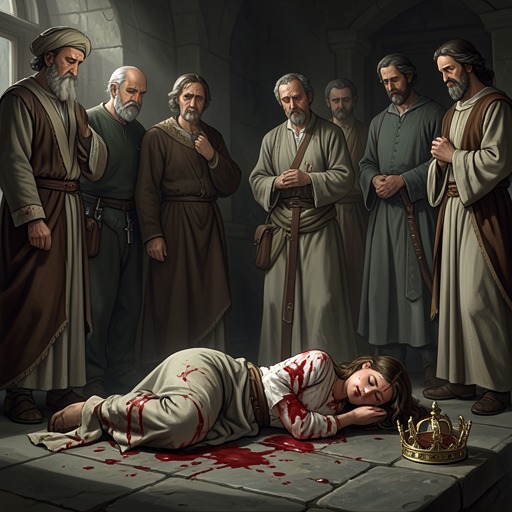
Maiden's Day Ball for the Queen's Selection
Fire & BloodThe Maiden’s Day Ball was meant to let Aegon III choose a new queen after Jaehaera Targaryen’s death. Instead, the selection exposed the struggle between the king’s Hand, Unwin Peake, and the regents, and ended with Aegon choosing Daenaera Velaryon rather than the bride Unwin had been arranging for him. What was announced as a celebration became a carefully managed public contest over who could shape the young king’s future and, through marriage, the succession.
Background and Political Stakes
Seven days after Jaehaera’s body had been consigned to the flames, Unwin Peake visited the grieving king with Grand Maester Munkun, Septon Bernard, and Marston Waters of the Kingsguard. They told Aegon that he must end his mourning and marry again for the good of the realm, and Unwin declared that the new queen had already been chosen. His candidate was his only surviving child, Myrielle Peake. The proposal joined a matter of dynastic concern—the need for a future heir—to the Hand’s effort to place his own family close to the throne.
Aegon questioned whether he had to marry someone he did not like. Unwin answered that the king need only wed her, bed her, and father a son, comparing the obligation to Aegon’s willingness to eat turnips when his cooks served them. The comparison escaped the private exchange and fixed the nickname Lady Turnips to Myrielle. Its circulation made visible how the Hand’s blunt effort to direct the king could be turned into public mockery, while the child he meant to advance bore the embarrassment.
The proposed match also drew objections from within the government. Thaddeus Rowan and Manfryd Mooton were angered that Unwin had acted without consulting the regents, while Lady Arryn, Kermit Tully, and Ben Blackwood raised objections of their own. Their concerns included the haste of the plan and the king’s need for time to mourn. Grand Maester Munkun, initially among those accompanying the Hand, also began to question how the arrangement would appear. Unwin remained intent on marrying Myrielle to Aegon, but could no longer simply impose the choice.
He therefore announced a Maiden’s Day ball at which the king would choose his own bride. The language of personal choice softened the appearance of a decision made by the Hand, and Unwin publicly described a queen’s expected place beside the king: she would share his life and labors, bear children, and comfort him. Yet the selection was not a neutral undertaking. Even before announcing it, Unwin had summoned Myrielle to court, hoping she could befriend and beguile Aegon before the other candidates arrived.
A Contest Without a Ball
The invitation stirred interest far beyond the Red Keep. Unwin restricted the candidates to maidens of noble birth under thirty, but more than a thousand nevertheless gathered in King’s Landing. They came from across the Seven Kingdoms and from overseas: the Prince of Pentos sent a daughter, the Archon of Tyrosh sent a sister, and candidates also set out from Myr and Old Volantis. None of the Volantene girls reached the city; corsairs from the Basilisk Isles carried them off during the voyage. The scale of the gathering exceeded the Hand’s attempt to limit it and made the selection a spectacle involving families and powers well beyond the regency.
Despite its name, the event offered neither dancing nor wine nor a chance for the candidates to converse with the king. Aegon sat on the Iron Throne, dressed in black, with a golden circlet and a gold chain. A herald announced each maiden’s name and lineage; she curtsied, Aegon nodded, and the next candidate was brought forward. One by one, the girls passed before him in a presentation whose formal order emphasized the king’s position while leaving little room for personal exchange. The sheer number made individual notice difficult: by the time the tenth girl appeared, the earlier candidates risked blurring together.
A few tried to distinguish themselves by speaking. Their approaches ranged from asking about a gown to recounting a difficult journey. Barba Bolton, from the Dreadfort, asked that if she were sent home, she be sent with food, because the snows were deep and her people were starving. Her appeal introduced a different claim upon the king’s attention into a ceremony concerned with marriage: the realm’s hardship stood beside the noble families’ hopes for royal favor.
Myrielle’s place in the procession showed how carefully Unwin had prepared her candidacy. A few days beforehand Aegon had given her one of Jaehaera’s dolls, a small gesture Myrielle understood as affection. She carried it when she appeared before him. Unwin had arranged for her to be presented late enough not to seem specially favored, but early enough that Aegon might still remember her. The king greeted her by name and referred to the doll, encouraging her father to believe his plan had succeeded. The scene briefly seemed to reward the Hand’s private management of a contest advertised as the king’s own decision.
The Twins Present Daenaera
With fewer than a dozen candidates left, Baela Targaryen and Rhaena Targaryen arrived together, mounted on black chargers and dressed in black velvet with rubies and the three-headed dragon of House Targaryen on their cloaks. Baela was pregnant; Rhaena was still recovering from a miscarriage. Their entrance interrupted the prepared sequence and asserted their standing as Aegon’s half-sisters. When Marston Waters demanded that they dismount, Baela used her riding crop to make clear that the king, not the Kingsguard, could command her. At the Iron Throne, the twins addressed Aegon directly and announced that they had brought his new queen.
The girl they presented was Daenaera Velaryon, six years old and an orphan. Her mother had died during the Winter Fever, and her father, Daeron Velaryon, had died in the Stepstones while fighting for Alyn Velaryon. Daenaera was a ward of Baela and Alyn, and the herald formally named her family and guardians before the court. Her presence made the choice more than an interruption: the twins had brought forward a candidate whose claim to the king’s attention rested on their own intervention rather than on Unwin’s arrangements.
Aegon smiled at Daenaera and told her she looked pretty. His response made it plain that he wanted to end the procession. The remaining candidates were hurried forward, and one, Henrietta Woodhull, wept as she curtsied. Aegon then gave his cupbearer, Gaemon Palehair, the honor of announcing the choice: he would marry Daenaera. The king’s decision displaced Myrielle’s carefully prepared appearance and defeated the Hand’s attempt to secure the marriage for his daughter.
The Decision and Its Aftermath
Unwin accepted the announcement publicly, but objected at the next council meeting. He argued that a bride of six could not soon bear an heir and that the king’s choice therefore left the succession uncertain. He urged the regents to set the decision aside and select a marriageable woman instead. Thaddeus Rowan answered by asking whether Unwin meant his own daughter, and the other regents did not support the Hand. The betrothal was announced the following day. The council’s refusal to reverse the result demonstrated that Unwin could not convert his office into control over the king’s marriage when the other regents stood against him.
Aegon III married Daenaera on the last day of the 133rd year since Aegon’s Conquest. The public reception was smaller than the crowds that had greeted Aegon and Jaehaera: the Winter Fever had killed almost a fifth of King’s Landing’s population, and the wedding took place amid bitter winds and snow flurries. Those who came nevertheless welcomed the new queen. Baela and Rhaena, riding behind the royal litter, also received cheers; Unwin, farther back, was observed with a grim expression. The marriage that followed the selection thus carried both a dynastic consequence and a political one: Daenaera became queen, while the Hand’s intended match—and his effort to determine it—came to nothing.