Myrielle Peake
Fire & BloodMyrielle Peake, widely known as Lady Turnips, was the only surviving child of Unwin Peake and the bride her father sought to secure for Aegon Targaryen the Younger. Her proposed marriage joined dynastic ambition to a courtly spectacle: Unwin presented Myrielle as a suitable queen, arranged her access to the king, and brought her to Maiden’s Day with careful timing. But her prospects depended on a contest she did not control, and the twins Baela Velaryon and Rhaena Corbray disrupted the plan before the king could choose.
Family Background and the Hand’s Ambition
Unwin had married three times and fathered seven children, but death had successively removed his other heirs. His firstborn son died in infancy; both daughters by his second wife also died young. An eldest daughter survived long enough to marry, but died in childbirth at twelve. A second son, fostered on the Arbor and serving Lord Redwyne as a page and squire, drowned in a sailing mishap at twelve. Ser Titus, Unwin’s heir at Starpike, was knighted for valor after the Battle of the Honeywine by Bold Jon Roxton, then died six days later in a skirmish with broken men he encountered while scouting. Myrielle was left as the Hand’s sole surviving child and the only remaining prospect for his line.
That family history helps explain why Unwin’s plans for Myrielle carried more than the ordinary weight of a lord arranging a daughter’s marriage. A queen’s position would put his last child beside the king and place House Peake close to the center of rule. Unwin described Myrielle as an ideal match: a highborn girl educated by septas to read, write, and do sums, and, he argued, likely to bear sons. He presented her as the king’s contemporary, although the account later gives her age as four-and-ten, one year older than Aegon. The tension between the public case for a suitable queen and the family stakes behind it is central to her story.
A Marriage Arranged for the Realm
The proposed match belonged to a wider political world in which marriage was used to bind houses and regions together. Under Aegon I, former enemies were brought to court, and royal marriages linked noble families from distant parts of the realm. His queens arranged matches among houses with different interests, including a double wedding intended to make peace between House Blackwood and House Bracken. Aenys’s marriage to Alyssa Velaryon likewise joined the royal family to a prominent house descended from Valyrian stock. These examples establish marriage as a public instrument as well as a family arrangement.
Myrielle’s proposed marriage followed that political logic, but the decision became contentious because Aegon had only recently lost Jaehaera. Seven days after Jaehaera’s body was consigned to the flames, Unwin visited the grieving king with Grand Maester Munkun, Septon Bernard, and Marston Waters of the Kingsguard. They told Aegon that he should marry again for the good of the realm, and Unwin had already chosen his daughter as the bride. Other regents and lords objected that a decision of such consequence belonged to the council and that Aegon should have time to mourn. Their resistance shows that Myrielle’s match was not simply a private proposal: it exposed a struggle over who could direct the young king’s household and future.
Courtship and the Doll
Before the public selection, Unwin summoned Myrielle from Starpike to King’s Landing, although Maiden’s Day was still three moons away. He wanted her at court early enough to become familiar to Aegon. She arrived almost a moon before the ball, and her father ensured that she spent part of each day in the king’s company. During the fortnight before Maiden’s Day, she shared half a dozen suppers with him. Mushroom, who entertained at these awkward meals, describes Aegon as saying little; he seemed more at ease with Myrielle than he had been with Jaehaera, though not truly comfortable.
Three days before the ball, Aegon gave Myrielle one of Jaehaera’s dolls. He thrust it toward her with a brief offer, and she accepted it as a token of affection. Unwin, in turn, was pleased by what he took as evidence that his arrangements were working. The doll carried the weight of the recently ended marriage and mourning into the proposed new one: it had belonged to the dead queen, but Myrielle brought it forward as a sign of her connection to the king. The account records her interpretation and her father’s satisfaction, not any deeper assurance of Aegon’s feelings.
Maiden’s Day and the Failed Match
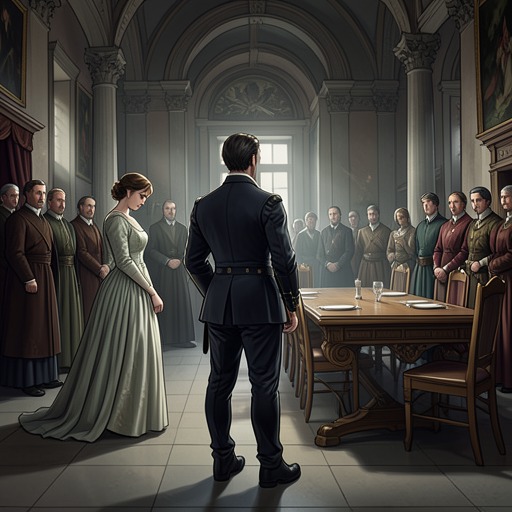
Myrielle carried the doll to the ball and cradled it in her arms as if it were a baby. Her place in the order of presentation had also been managed: she appeared during the first hour, late enough to avoid the appearance that her father had granted her special precedence, but early enough that Aegon would not yet be exhausted. The king greeted her by name, said he was glad she had come, and noted that she liked the doll. Unwin took heart from this exchange, believing his careful preparation had brought his daughter close to the crown.
The moment was overturned when fewer than a dozen maidens remained. Baela and Rhaena entered together on black horses, wearing black velvet, rubies, and the three-headed dragon of House Targaryen. Baela was pregnant; Rhaena was wan after a miscarriage. When Marston Waters blocked their way and demanded that they dismount, Baela struck him with her riding crop and asserted that only her brother could command her. The twins rode to the foot of the Iron Throne and disregarded Unwin’s demand for an explanation. Rhaena then told Aegon that they had brought his new queen. The narrative makes the reversal decisive: Myrielle would never be Queen Turnips.
Significance and Limits of the Record
Myrielle’s story is defined by how others arrange, describe, and present her. Her father’s argument for her suitability emphasizes birth, education, age, and the expectation that she would provide heirs; the court assesses her through her potential place in a royal marriage. Even her brief encounter with Aegon is mediated by Unwin’s strategy and the story’s account of the doll. At Maiden’s Day, she appears publicly as a possible bride, carefully positioned in the procession and holding an object associated with the former queen.
The record gives Myrielle few actions beyond accepting the doll and appearing at the ball, and it does not establish what she thought about her father’s ambitions or the sudden intervention of the twins. Her eventual failure to become queen is clear, but the evidence here does not give a further account of her life. Her narrative significance lies instead in the exposure of the marriage contest around Aegon: a king’s consort could be treated as a matter of state, and a daughter’s place in that contest could be shaped by her father’s losses, ambitions, and access to power.