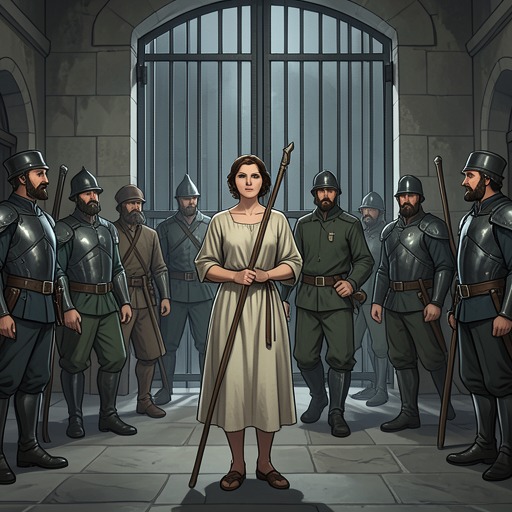
Regis Groves
Fire & BloodRegis Groves was a knight of the Kingsguard entrusted with reclaiming Harrenhal from the armed company gathered under Alys Rivers. His expedition ended in a swift defeat: after he demanded the castle’s surrender and rejected Rivers’s claim for her son, Groves was killed, and the king’s force was routed. His death made the danger at Harrenhal harder for the regents to dismiss, but the account preserves uncertainty about how he died and leaves his replacement unresolved.
Identity and Mission
Groves appears in the account as a serving knight of the Kingsguard, not as a ruler or independent claimant. His importance arises from the commission he received from Ser Tyland Lannister: to recover Harrenhal for the Crown. The assignment placed a royal knight at the center of a contest over a ruined castle whose inhabitants were increasingly described as a political and military threat.
Harrenhal had become a refuge for outlaws, robber knights, and broken men, who preyed on travelers, fisherfolk, and farmers. Their numbers had grown over the preceding year, and stories reaching King’s Landing attributed their rule to a powerful sorceress. In response, Tyland chose Groves to lead the effort to take the castle. The account says he set out from the city with fifty seasoned men. At Castle Darry, Damon Darry joined him with a comparable force, bringing the expedition to roughly a hundred. Groves assumed that this would suffice against what he understood to be a small group of squatters; the scale of the resistance would expose that estimate as a serious miscalculation.
The Approach to Harrenhal
The expedition met a very different situation at the castle. Its gates were shut, and hundreds of armed defenders stood on the battlements. At least six hundred people were inside, with about a third of them of fighting age. These figures reveal why the force Groves had brought was inadequate: his men were not confronting a handful of trespassers but a substantial community capable of organized resistance.
Groves demanded to speak with the lord of Harrenhal. Alys Rivers came out to treat with him, accompanied by a child. The feared “witch queen” was identified as the baseborn wet nurse who had been Prince Aemond Targaryen’s prisoner and later his paramour; she now claimed to be his widow. Rivers said the boy was Aemond’s son and asserted that he was both trueborn and heir, with a right to rule Westeros. She ordered Groves to kneel and swear his sword to the child. He refused, rejecting her claim and the child’s status in terms that made the encounter an open confrontation rather than a negotiation.
Death and Defeat
The account explicitly leaves the manner of Groves’s death disputed. One version says Rivers raised a hand and that Groves died as if by sorcery. Other accounts say the gesture signaled a crossbowman, whose bolt struck him through the eye. Mushroom, who was far away, proposed a third possible explanation: a skilled slinger might have caused the effect the king’s men attributed to magic. The narrative offers no final adjudication among these explanations. What it establishes is that Groves died almost immediately after the confrontation began to turn violent.
The castle gates then opened, and riders charged out. A bloody fight followed, ending in the rout of the royal force. Damon Darry was among the few to escape; his horsemanship, armor, and training are given as reasons he survived, while the attackers pursued him through the night before giving up. Of the hundred men who had set out, only about thirty-two returned to Castle Darry. Groves’s command therefore ended not simply with the loss of its leader but with the destruction of most of the expedition’s strength.
Aftermath and Narrative Significance
The failed mission produced a further warning. A captured man who had been forced to witness the deaths of other prisoners was released to carry Rivers’s message that those approaching the walls should submit rather than return to fight. He claimed she had cursed him and that Harrenhal held a dragon. When one of Lord Darry’s men laughed, the messenger died soon afterward; the account says people believed marks on his skin resembled a woman’s fingers. These reports deepen the atmosphere of fear surrounding the castle, but they do not prove that Groves was killed by supernatural means. His death remains part of the same unresolved dispute between apparent sorcery and ordinary violence.
For Ser Tyland, the death of a Kingsguard knight was deeply troubling. Unwin Peake dismissed Damon Darry’s reports of sorcery and a dragon, attributing the deaths to outlaws, and the other regents agreed that a stronger force would be needed to root out the defenders. By the end of the year, they had concluded that Harrenhal could not be recovered with the force already sent. Before Tyland could arrange another assault or consider who might take Groves’s place in Aegon’s Seven, Winter Fever reached King’s Landing on the third day of 133 AC. The account thus leaves Groves’s commission unfinished: his death exposes the cost of underestimating Harrenhal, while the next crisis displaces the question of his replacement.