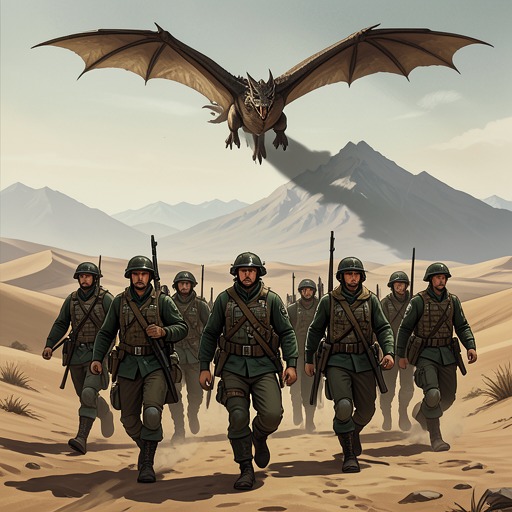
Rhaenys’s mission to Sunspear
Fire & BloodRhaenys’s mission to Sunspear tested whether the Targaryens could win Dorne’s submission without first defeating it in battle. Flying from the Prince’s Pass toward the heart of the principality, Rhaenys found the castles and settlements along her route largely emptied of their lords and defenders. At Sunspear, however, she encountered Meria Martell in person. Their exchange made the choice facing Dorne unmistakable: accept the new power’s authority, or reject it despite the threat of renewed violence.
The approach to Sunspear
Rhaenys had crossed the Red Mountains by flying above the guarded Prince’s Pass rather than engaging the Dornish spearmen stationed there. She descended on Vaith to demand its submission, but found the castle abandoned. In the town below, women, children, and old men remained; asked where their lords had gone, they answered only that they were away. Rhaenys then followed the river downstream to Godsgrace, the seat of House Allyrion, and found it deserted as well.
At the mouth of the Greenblood, she reached the Planky Town, a floating city formed from poleboats, fishing skiffs, barges, houseboats, and hulks lashed together with ropes, chains, and planks. There, too, few people appeared: old women and small children looked up as Meraxes circled overhead. The repeated absence of the lords at Vaith, Godsgrace, and the Planky Town gives the mission its unsettling pattern. Rhaenys could arrive wherever she chose, but arrival did not bring the submission she sought; the settlements offered no opposing army, yet their emptiness did not amount to surrender.
Meria Martell’s refusal
The flight ended at Sunspear, the ancient seat of House Martell, where Princess Meria was waiting in her abandoned castle. The account places her at eighty years of age and says that she had ruled the Dornishmen for sixty years. She was blind and physically frail, but age and blindness had not dulled her wits. Her presence therefore contrasted with the empty seats of power Rhaenys had encountered on the way: at Sunspear, the ruler herself met the envoy.
Meria rejected both parts of the demand implicit in Rhaenys’s arrival. She would neither fight the queen nor kneel to her, and insisted that Dorne had no king. Her answer did not offer a battlefield challenge or a negotiated concession. Instead, it denied the premise that Dorne should recognize the authority Rhaenys represented. The refusal was direct, and it came from the princess who had governed the principality for decades.
A warning answered by a motto
Rhaenys accepted that she would carry Meria’s answer back, but warned that the Targaryens would come again and bring fire and blood. The exchange turned a meeting that had begun as a demand for submission into a declaration of what might follow: the prospect of further violence was stated plainly, but it produced no immediate capitulation.
Meria answered the threat by invoking Dorne’s words, Unbowed, Unbent, Unbroken. She acknowledged that Rhaenys might burn the Dornish, while denying that destruction could make them bend, break, or bow. The distinction matters to the scene: Meria does not claim that Dorne could not be harmed. She asserts instead that damage would not equal consent. Her final warning that Rhaenys was not wanted there, and should return at her peril, sent the queen away with the refusal intact.
Outcome and significance
The princess and the queen parted, and Dorne remained unconquered. Rhaenys’s mission thus ended without either a battle at Sunspear or the submission she had come to demand. The sequence separates physical access from political control: the queen had flown past the guarded pass, visited deserted strongholds, and reached Dorne’s principal seat, but none of those arrivals secured recognition of Targaryen rule.
The encounter also gives the Dornish motto a specific force. It is not merely a statement of pride detached from events; Meria uses it as her answer to a concrete threat of fire and blood. The mission closes on that contrast between the power to inflict destruction and the inability, in this encounter, to compel a bow. Its immediate consequence is explicit: the queens part, and Dorne remains outside the conquest.