Royal financial crisis under Rhaenyra
Fire & BloodRoyal financial crisis under Rhaenyra was the struggle to fund her rule of King’s Landing after the treasury had been depleted and much of the remaining royal wealth placed beyond her control. Her master of coin, Bartimos Celtigar, answered the shortfall with a sweeping system of taxes, fees, seizures, and paid public access to executions. The measures replenished the Crown’s coffers, but they burdened trade and ordinary city life so heavily that they helped transform the popular welcome Rhaenyra had received into resentment.
Origins of the Shortfall
The crisis had roots in the Dance of the Dragons and in the transfer of the royal treasury during the change of rulers. When Rhaenyra took King’s Landing, the Crown had possessed abundant gold at the death of Viserys Targaryen. Aegon II had seized the treasury along with the crown, but the wealth left in the capital had since been spent. His master of coin, Tyland Lannister, had also sent three-quarters of the late king’s riches away, ostensibly for safekeeping. The remainder had been entrusted to the Hightowers of Oldtown, the Lannisters of Casterly Rock, and the Iron Bank of Braavos, leaving Rhaenyra unable to draw on it.
The problem of raising money had already proved politically dangerous under Jaehaerys Targaryen. Maegor’s wars had exhausted the treasury; taxes imposed by his master of coin raised less than expected and further alienated the lords. During the later regency, Edwell Celtigar again tried to close the gap by taxing people and commerce in King’s Landing. The Crown tripled port fees, taxed certain goods on both entry and exit, and imposed levies on innkeepers and builders. The result was not a full treasury: construction stalled, inns emptied, and merchants diverted their ships to Driftmark, Duskendale, and Maidenpool in the Riverlands. That precedent showed how quickly aggressive collection could undermine the activity from which revenue was meant to come.
Bartimos Celtigar’s Tax Measures
Rhaenyra appointed Bartimos Celtigar, Lord of Claw Isle, as treasurer and master of coin. He was considered steadfast, incorruptible, resourceful, and wealthy, qualities that seemed to fit the Crown’s urgent need. Yet he revived the old regency levies and added new ones. Taxes on wine and ale doubled, port fees tripled, and every shopkeeper in the city faced a charge simply to keep a shop open. Innkeepers owed a silver stag for each bed. Entry and exit fees on goods, previously imposed by Rego Draz, returned at three times their former level. A property tax applied to rich merchants in manses and poor residents in hovels alike, according to the area of land they occupied.
Merchants and traders bore much of the burden. With the Velaryon fleet closing the Gullet, many ships were trapped at King’s Landing. Before allowing them to sail, Celtigar demanded heavy additional payments, even from captains who produced documents showing that they had already paid duties and tariffs. He treated payments made to Aegon II’s government as no discharge of what was owed to Rhaenyra. Captains who could not or would not pay lost their ships and cargoes, which were seized and sold. The policy thus drew money from commerce while placing further costs and risks on those trying to move goods through the city.
Celtigar also made the Crown’s justice system a source of income. He ordered that executions of traitors, rebels, and murderers take place in the Dragonpit, where spectators could pay three pennies at the gates to watch. The policy joined punishment to public display and revenue: even the government’s response to political and criminal offenses was made to yield coin.
Revenue and Political Cost
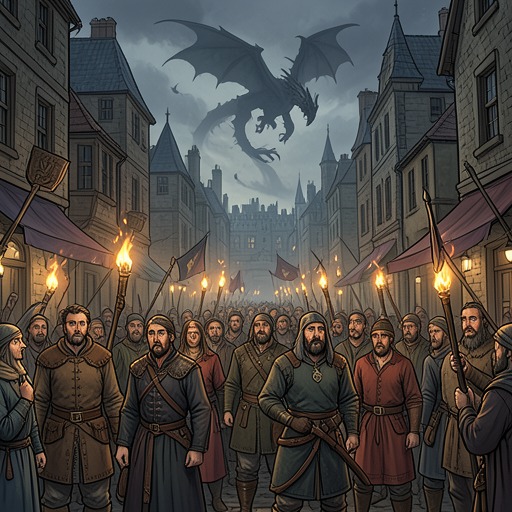
The taxes did replenish Rhaenyra’s coffers, but the benefit came at a steep political price. Many inhabitants had welcomed her return because Aegon II and Aemond Targaryen had not been popular in the city. As taxes mounted and severed heads appeared on spikes above the gates, that welcome ebbed. The account presents the reversal as a change in how the queen was regarded: the girl once celebrated as the Realm’s Delight came to be described by city residents as grasping and vindictive. One mocking epithet likened her to Maegor, and the resulting curse endured among Kingslanders for a century.
The contrast with the earlier tax experiments is pointed. Under Jaehaerys’s regency, Celtigar’s predecessor had driven trade elsewhere and halted building; under Rhaenyra, the revived fees and expanded exactions again made merchants, shopkeepers, innkeepers, and property holders bear the cost of royal need. In both cases the attempt to secure revenue through readily accessible urban sources damaged the commercial life of the capital. Under Rhaenyra, the effect was especially consequential because revenue collection unfolded alongside executions and visible displays of punishment, making fiscal pressure part of the experience of her rule.
Reversal and Aftermath
After Rhaenyra’s fall, Tyland Lannister set about restoring trade and rebuilding the kingdom. He abolished the taxes imposed by Rhaenyra and Bartimos Celtigar, a decision welcomed by both great lords and smallfolk. With the Crown’s gold once again secure, he allocated a million golden dragons in loans to lords whose lands had been destroyed during the Dance. The loans helped reconstruction but also caused a rift between the Iron Throne and the Iron Bank of Braavos.
Tyland’s other recovery measures show how fiscal policy shifted from extracting immediate payments to organizing supplies and labor. He ordered three large fortified granaries built in King’s Landing, Lannisport, and Gulltown, and arranged to fill them with grain. That purchase drove up grain prices, benefiting sellers while angering innkeepers, tavern owners, and the poor. He also put builders to work repairing the Dragonpit and strengthened the city gates. The reversal did not make every policy painless, but it marked a clear departure from Rhaenyra’s reliance on multiplying taxes and fees: the crisis had made the cost of revenue collection a matter of political survival as well as accounting.