Sowing of the Dragonseeds
Fire & BloodThe Sowing of the Dragonseeds turned Dragonstone’s unclaimed dragons into a desperate military resource for Rhaenyra Targaryen’s cause. At Prince Jacaerys Velaryon’s urging, men and women came forward to attempt what was no mere matter of horsemanship: dragons could reject or attack those who approached them. The effort yielded four new riders, among them men whose parentage and place in the royal family remained contested, but it also killed sixteen people and left many others burned or maimed. Its triumph and cost were inseparable: the prince found the dragonriders he needed by exposing hopeful claimants to creatures that could not be commanded by royal promise alone.
Origins and Call for Riders
House Targaryen had ruled Dragonstone for more than two centuries before the Sowing, and the island’s history had produced a population with claims, genuine or supposed, to dragon blood. Children fathered by Targaryen men among the island’s smallfolk were known as born of dragonseed; their descendants were called seeds. The old first-night privilege had helped create this ancestry, and the custom of Targaryen men taking partners among the island’s inhabitants continued even after that privilege ended. The resulting descendants were numerous, but descent alone did not make a dragon accept a rider.
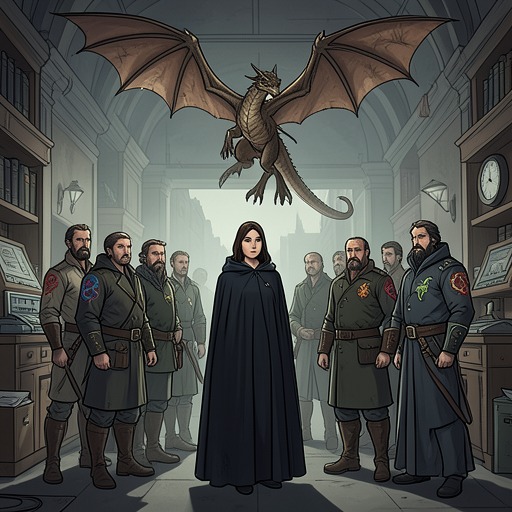
Jacaerys offered more than the chance to fight beside the Prince of Dragonstone. A man who mastered a dragon could expect lands, wealth, and knighthood; his sons would be ennobled and his daughters married to lords. The rewards made the call a path to status as well as a military summons. Yet the answer was not limited to people known as seeds: members of the queen’s household, including Ser Steffon Darklyn, the Lord Commander of her Queensguard, also volunteered, alongside squires, servants, sailors, men-at-arms, performers, and two maids. The breadth of those who came forward showed how far the danger and promise of the dragons reached beyond the established noble families.
Attempts and Losses
The episode’s name and its alternative, the Red Sowing, frame the effort as both a recruitment drive and a bloodletting. Mushroom, himself an unlikely candidate, attempted to mount Silverwing, considered the most docile of the unclaimed dragons. His account turns the failure into a comic interlude: he fled with his clothing on fire and jumped into a well to put it out. That anecdote offers a moment of levity, but it sits within an enterprise in which failure could mean death.
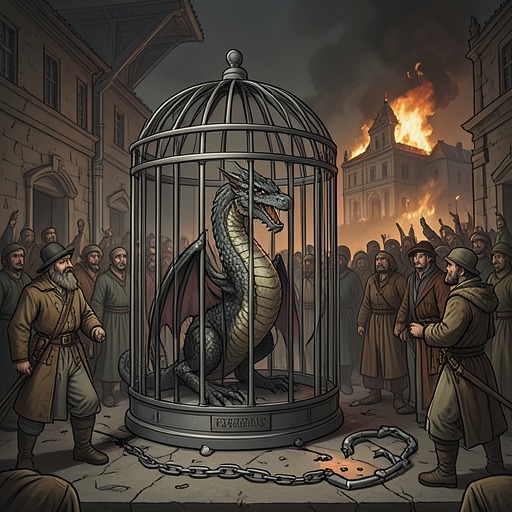
The tally attributed to Grand Maester Munkun’s True Telling is sixteen dead and three times as many burned or maimed. Steffon Darklyn died trying to mount Seasmoke, and Lord Gormon Massey died approaching Vermithor. Silver Denys, whose appearance supported his claim of descent from a bastard son of Maegor the Cruel, lost an arm to Sheepstealer. When his sons tried to stop the bleeding, the Cannibal drove Sheepstealer away and devoured all three. The episode makes the cost of the call concrete: bloodline, courage, and royal reward offered no protection when a dragon answered an approach with violence.
Four New Riders
The dragons that had already carried riders proved more receptive than the wild ones. Seasmoke, Vermithor, and Silverwing had experience of men and were accustomed to their presence. Vermithor, once ridden by Jaehaerys Targaryen, accepted Hugh the Hammer, a blacksmith’s bastard and a towering man. Silverwing, formerly the beloved dragon of Alysanne Targaryen, accepted Ulf the White, a pale-haired man-at-arms also called Ulf the Sot. Seasmoke, once ridden by Laenor Velaryon, accepted Addam of Hull, a boy of fifteen. These successful claims were not interchangeable: they connected new riders to dragons with distinct histories and made the riders’ own origins consequential to the politics of the conflict.
Addam and his younger brother Alyn had grown up around their mother Marilda’s shipyards and at sea. Although their silver hair and purple eyes marked them as dragonseeds, Marilda had not named their father. She claimed they were the natural sons of Laenor Velaryon only when Jacaerys called for new riders. Laenor had visited the shipyards, but his known lack of interest in women made the claim doubtful to many. Nevertheless, his father, Corlys Velaryon, brought the boys to Jacaerys and accepted them as newfound grandsons. When Addam mounted Seasmoke, the feat seemed to support Marilda’s account, though it could not settle the question of his paternity.
The chroniclers preserve that uncertainty rather than resolving it. Grand Maester Munkun and Septon Eustace affirm Laenor’s parentage; Mushroom instead suggests that Corlys, whose business regularly brought him to the shipyards, fathered the boys. The account further says Corlys kept them away from court during Princess Rhaenys’s lifetime and brought them forward after her death. The narrative judges Mushroom’s explanation more likely, while acknowledging that people at Queen Rhaenyra’s court may have suspected as much without saying so. Corlys later asked Rhaenyra to remove the stain of bastardy from Addam and Alyn; with Jacaerys supporting the petition, she did so. Addam became Addam Velaryon and heir to Driftmark. In this way, a successful claim to a dragon altered not only the balance of riders but also the public standing and inheritance of the rider’s family.
The Wild Dragons and Nettles
The three wild dragons on Dragonstone presented a more dangerous challenge. Sheepstealer, a mud-brown dragon with a taste for mutton, preyed on flocks from Driftmark to the Wendwater and could attack those who interfered. Grey Ghost lived in a smoking vent high on the eastern Dragonmont and was so elusive that those seeking him could not find him. The Cannibal, the largest and oldest, was feared for feeding on dead dragons and raiding the island’s hatcheries for hatchlings and eggs; the lair attributed to him was littered with the bones of would-be riders. The differences among the three shaped the attempts to claim them: one was difficult to locate, one too dangerous to approach, and Sheepstealer could be found but resisted would-be tamers.
Alyn of Hull tried for Sheepstealer after failing to find Grey Ghost. The dragon drove him from its lair with his cloak aflame; Addam intervened, using his own cloak to beat out the fire while Seasmoke drove Sheepstealer away. Alyn survived, but carried scars on his back and legs for the rest of his life. Other seekers were killed by Sheepstealer. The episode therefore places Addam’s successful claim to Seasmoke beside a different kind of courage: saving his brother did not make Alyn a rider, but it kept him alive when the same wild dragon defeated his attempt.
Sheepstealer was eventually tamed not by force but by Nettles, a small brown girl of sixteen. Each morning she brought him a freshly slaughtered sheep until he learned to accept and expect her. Munkun records her name as Nettles; Mushroom describes her as a bastard of uncertain birth known as Netty, born to a dockside sex worker. By either account, she became Sheepstealer’s first and last rider. Her method stands apart from the failed assaults: patience and repeated feeding established an acceptance that lineage and daring alone had not secured.
Outcome and Significance
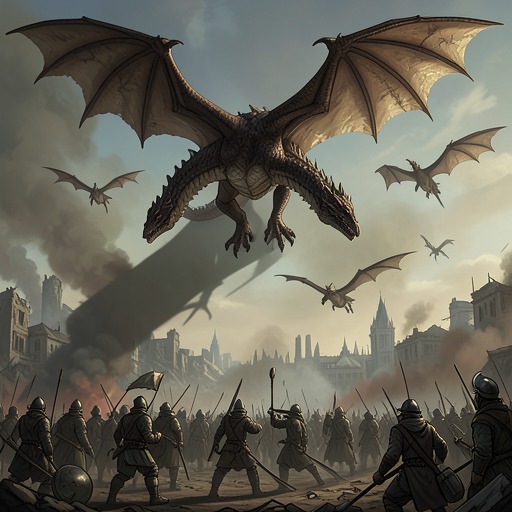
The Sowing achieved Jacaerys’s immediate purpose despite the deaths, injuries, and bereavement it caused. The four successful riders were Hugh the Hammer, Ulf the White, Addam of Hull, and Nettles. Their acquisition of dragons gave Rhaenyra’s side new riders at a moment when Jacaerys was preparing an attack on King’s Landing; as 129 AC ended, he selected the first full moon of the new year for the assault. The Sowing thus ends not in a settled victory but in the preparation for a larger conflict.
Its consequences also exceed the battlefield. The call made dragonriding a route by which people outside the established royal line could gain power, titles, and a claim to noble status, while the dispute over Addam and Alyn’s father showed how readily that power could reopen questions of legitimacy. The outcome depended on different forms of access: inherited or alleged blood, the history of a dragon’s prior riders, Corlys’s political recognition, and Nettles’s daily persistence. The Sowing’s central reversal is that the dragons needed to strengthen the ruling cause could not be treated as weapons waiting to be assigned. Their willingness—or refusal—to accept a rider determined who survived, who rose, and whose ancestry became politically useful.