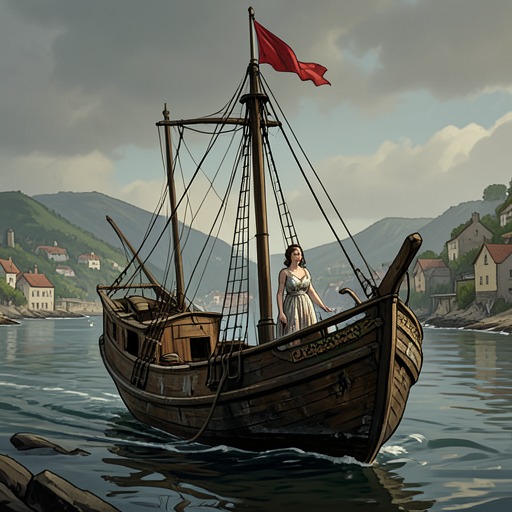
Tess
Fire & BloodTess was a salt wife of Dalton Greyjoy whose killing of him at Faircastle in 133 AC helped bring his campaign against Fair Isle to an abrupt end. The histories preserve almost nothing about her beyond her name and her final actions; even the circumstances that might explain them remain uncertain.
Identity and Historical Record
Dalton had two-and-twenty salt wives. Four were on Pyke, and two of those had borne him children; the others included women taken during his conquests in the west, among them daughters of Lord Farman and a Lannister of Lannisport, as well as women of humbler birth. Tess is identified as one of this latter group, but the account does not establish where or when Dalton took her, or how long she had been among his wives.
The record cannot say whether Tess was young or old, a widow or a virgin, or what she felt toward Dalton. Accounts of her differ so markedly that her life before the night at Faircastle remains unknowable. Her name survives where nearly everything else about her does not.
Dalton Greyjoy’s Death
On a rainy night at Faircastle, while Dalton’s longships gathered below, he spent the night with Tess. After he fell asleep, she took his dagger and killed him. She then entered the sea and died there. The account presents no confirmed explanation for her actions: hatred, jealousy, or any other motive remains speculation rather than established fact.
Dalton’s death was strikingly unlike the battle he had anticipated. The Red Kraken perished not in combat against an opposing force, but at the hand of one of his own wives, using his own weapon. Tess’s brief appearance in the record therefore marks the sudden collapse of a campaign whose outcome had seemed to depend on fleets and battle.
Consequences and Narrative Significance
News of Dalton’s death dispersed the fleet he had assembled to face Alyn Velaryon. Captains turned for home, recognizing that succession on the Iron Islands would be contested. Dalton had no rock wife; under the law, the Seastone Chair passed to his eldest salt son, Toron, who was not yet six. His mother’s status as a salt wife left her without the regency a rock wife might have held. Tess’s action thus ended Dalton’s command at the very moment his absence made the future of his rule uncertain.
On Fair Isle, smallfolk and the knights who remained rose against the ironborn. Over three days, hundreds of reavers were killed and their ships burned, until Faircastle was the last ironborn stronghold on the island. When Alyn Velaryon arrived, the longships had fled and the fighting was over. The account does not attribute the uprising solely to Tess, but her killing of Dalton preceded the fleet’s withdrawal and helped create the opening in which the islanders reclaimed Fair Isle.
The history sets Tess against the usual subjects of chronicles—kings, lords, knights, and maesters—as an ordinary woman whose single act altered the course of events. Yet it does not give her a full voice or a recoverable motive: her significance is clear, while the person behind the name remains beyond the record.