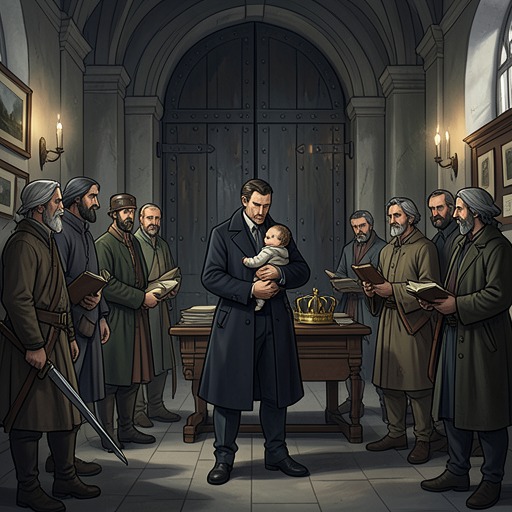
The assassination of Dalton Greyjoy
Fire & BloodThe assassination of Dalton Greyjoy in 133 AC abruptly ended the Red Kraken’s power in the west: he died at Faircastle at the hands of Tess, one of his own salt wives, on the eve of the battle he had prepared against Alyn Oakenfist. His death dispersed the ironborn fleet, unsettled the succession on the Seastone Chair, and helped turn the planned relief of Fair Isle into an arrival after the fighting was already over.
Background and Stakes
Dalton had been warned that Alyn Oakenfist was coming. Longships gathered in the waters south of Fair Isle and off Feastfires, Kayce, and Lannisport, while Oakenfist’s force sailed north from Oldtown. Dalton intended to meet that expedition and then carry his power outward: he spoke of returning by Oakenfist’s route, raising his banner over the Shield Islands, sacking Oldtown and Sunspear, and claiming Driftmark. These were announced ambitions, not completed conquests; the fleet assembling to carry them out would soon lose its purpose.
His talk of taking Baela Targaryen as a salt wife also placed the threat of further personal seizure alongside his military plans. Dalton already had two-and-twenty salt wives. Four were on Pyke, and two of those had borne him children; the others included women taken in his western conquests. They ranged from daughters of Lord Farman to the widow of the Knight of Kayce and a Lannister of Lannisport, as well as women from less powerful families. The account makes clear that Dalton’s household and his conquests were intertwined, though it cannot establish what any particular wife felt about him.
Tess and the Limits of the Record
Tess is known by name, but scarcely otherwise. The historical accounts disagree so sharply that her age, appearance, origins, and time among Dalton’s wives remain unknown. The account cannot say whether she hated him, loved him, or acted from jealousy; none of those explanations can be treated as established motive. Her obscurity is part of the episode’s substance: the surviving record identifies her decisive act but does not give her a recoverable life story or a reliable account of her reasons.
That uncertainty contrasts with the precision of the circumstances that are reported. On a rainy night at Faircastle, with longships gathered below, Dalton was with Tess. Afterward, while he slept, she took his dagger and killed him, then threw herself into the sea. The account provides this sequence but does not resolve the questions surrounding her identity or motive. It therefore presents the assassination as certain while leaving its personal explanation beyond the reach of the record.
The Killing and Its Immediate Effect
Dalton died not in the battle he expected, but before it, killed with his own dagger by a member of his household. The reversal was decisive: the fleet gathered to receive Oakenfist had been assembled under Dalton’s authority, and his death deprived it of its leader before the opposing forces met. The narrative emphasizes that this was not a victory won by an enemy in the field. The threat to Oakenfist’s expedition came to an end through an act within Dalton’s own household.
As news spread, captains began slipping away for home and the assembled fleet dissolved. The assassination thus changed the military situation at once, without a battle between Dalton’s forces and Oakenfist’s. Dalton’s projected campaigns against the Shield Islands, Oldtown, Sunspear, and Driftmark did not follow his death; his conquests themselves did not long survive him.
Succession and the Ending of the Campaign
Dalton had never taken a rock wife. His heirs were consequently two young sons born to salt wives, three sisters, and several cousins, each described as ambitious. By law, the Seastone Chair passed to the eldest salt son, Toron, who was not yet six. His mother could not expect to serve as regent in the way a rock wife might have done. The death therefore left a legal heir but no settled adult authority, making a struggle for power inevitable in the eyes of the ironborn captains.
Meanwhile, Fair Isle’s smallfolk and the knights still there rose in rebellion. Ironmen left behind were killed, their ships seized and burned, and hundreds of reavers died over three days. Only Faircastle remained in ironborn hands. Its garrison, led by Alester Wynch and Gunthor Goodbrother, continued to hold out; the two men later fell into a quarrel over Lysa, one of Lord Farman’s salt widows, and Gunthor killed Alester. By the time Oakenfist arrived, Fair Isle was free, the longships had fled, and the fighting was over. His expedition had set out to deliver the west from the ironmen, but Tess’s act and the rebellion had already altered the outcome.
Narrative Significance
The episode turns the scale of history inside out. The account first sets out the plans of lords and commanders, then makes the fate of those plans depend on Tess, a woman whose background and motives it admits it cannot recover. Her intervention is not presented as the opening of another campaign or as a known political design; its consequence is nevertheless immediate and far-reaching. Dalton’s death dissolves his fleet, exposes the weakness of his succession, and helps free Fair Isle before Oakenfist reaches it. The assassination’s significance lies both in that chain of consequences and in the disparity between Tess’s scant place in the record and the magnitude of what her act changed.