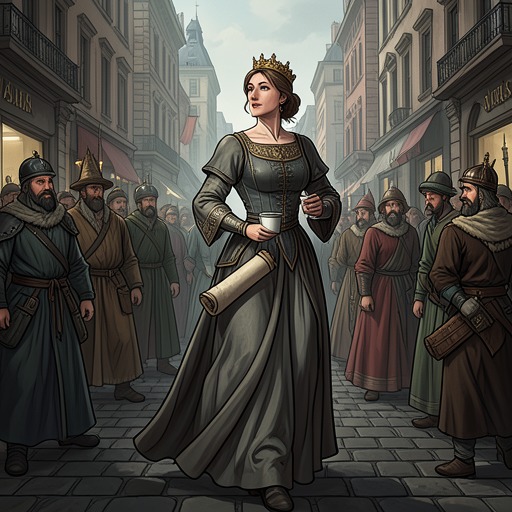
Theomore Manderly
Fire & BloodTheomore Manderly is the formidable Lord of White Harbor, a renowned warrior in his youth and a shrewd ruler under whom the city prospered. His family’s southern origins set them apart among the great houses of the North, but his loyalty to the Starks and his generous reception of Queen Alysanne Targaryen made him an important intermediary between northern custom and royal politics. In Alysanne’s eyes, the scale of his family offered not merely hospitality but an opportunity to draw the North closer to the Iron Throne through marriage.
Lord of White Harbor and His Heritage
The Manderlys had come from the Reach centuries earlier, after rivals drove them from their rich lands along the Mander. They found refuge near the mouth of the White Knife and, despite their southern origins, became fiercely loyal bannermen of the Starks of Winterfell. They retained their own southern gods, worshipping the Seven, and preserved the traditions of knighthood. Theomore’s house thus occupied a distinctive position in the North: politically bound to Winterfell, but marked by religious and cultural practices unusual among its great houses.
Theomore himself had won renown as a warrior when young. In later life, he was known as a capable lord whose rule brought considerable prosperity to White Harbor. His standing combined martial reputation and practical governance, qualities that made his household an attractive partner for the crown’s diplomatic ambitions. He had also outlived four wives; by the time a royal marriage was proposed for him, he remained a doughty fighter but had grown very stout.
Alysanne’s Reception at White Harbor
When Alysanne’s northern journey began at White Harbor, tens of thousands of northerners gathered to cheer her and look upon Silverwing. For many, it was their first sight of a dragon, and their awe was mixed with fear. The immense crowd surprised even Theomore, who had not realized how many smallfolk lived in his city. The scene presents White Harbor as both a thriving urban center under his rule and a place where the queen’s arrival could gather a public far beyond the expectations of its lord.
Theomore entertained Alysanne lavishly. At the welcoming feast, an entire aurochs was roasted, while his daughter Jessamyn served as the queen’s cupbearer. She filled Alysanne’s tankard with strong northern ale, which the queen praised above any wine she had tasted. He also arranged a small tourney in her honor to display the prowess of his household’s knights. Among the fighters was a woman, a wildling girl captured by rangers north of the Wall and fostered by one of Theomore’s household knights. Alysanne delighted in the girl’s daring and summoned her sworn shield, Jonquil Darke, to meet her in a spear-against-sword duel. The northmen roared their approval.
A few days later, Alysanne held her women’s court in Theomore’s hall, a gathering previously unheard of in the North. More than two hundred women and girls came to share their thoughts, concerns, and grievances with the queen. The event extended the visit beyond feasting and spectacle: Theomore’s hall became a venue for a form of royal access that brought women’s concerns before the queen in a region where such a court had not been held before.
His View of Winterfell
Theomore’s account of Alaric Stark helps establish the contrast between White Harbor’s welcome and the reception awaiting Alysanne at Winterfell. Though Theomore was Alaric’s bannerman, he did not dispute the Stark lord’s reputation as stern and hard. He described Alaric as respected in the North but not loved, a judgment that accords with the queen’s chilly greeting at the castle. Theomore’s assessment is therefore more than passing characterization: it offers the perspective of a powerful northern lord who recognizes the authority of Winterfell without confusing respect with affection.
The contrast also sharpens Theomore’s role in Alysanne’s progress. At White Harbor, the queen encountered a large crowd, lavish entertainment, and an open hall for women’s petitions; at Winterfell, Alaric questioned her clothing, refused to admit Silverwing within his walls, and warned that his household could not feed a thousand men for long. Theomore’s earlier warmth was the exception that made the later reserve visible. His presence in the account links the North’s varied responses to royal visitation rather than presenting it as a single, uniform culture.
Marriage as Royal Policy
Alysanne remembered the welcome Theomore had given her on her first visit to the North. In 86 AC, she announced that her fifteen-year-old daughter Viserra would be betrothed to him. Jaehaerys Targaryen presented the match as a means of uniting one of the North’s great houses with the Iron Throne and drawing the region closer to the realm’s center. Theomore’s reputation as a prosperous and capable lord made the proposal politically credible; Alysanne’s personal affection for him, grounded in his hospitality, also informed her support.
The match was not presented as a choice Viserra welcomed. She recoiled from the prospect of marrying a much older man who had outlived four wives and had grown stout, while her ambitions pointed elsewhere. Alysanne believed Viserra sought marriage to Baelon Targaryen, not from love but because she wanted to become queen. The queen instead defended Theomore’s character and the value of the match, while Jaehaerys likewise emphasized its political importance and left marriage arrangements to Alysanne. The episode reveals the limits of Theomore’s place in the royal design: he could be valued as a good man, a capable lord, and a means of binding the North to the crown, while Viserra’s own desires remained in conflict with that plan.