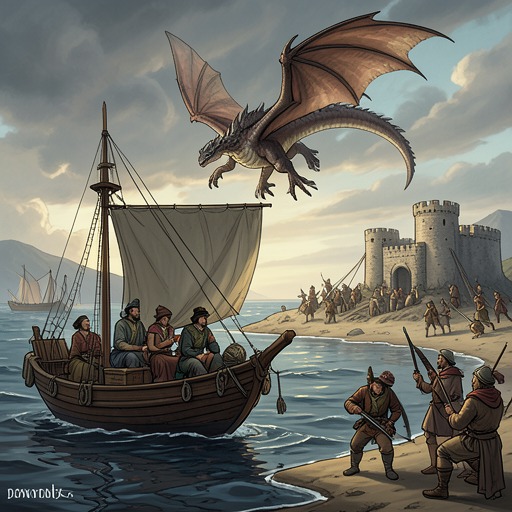
Torrhen Stark’s Submission
Fire & BloodTorrhen Stark’s Submission, remembered as the moment the King Who Knelt surrendered the crown of the Kings of Winter, brought the North into Aegon Targaryen’s realm without a battle on the Trident. Confronted by a larger host and the prospect of dragonfire, Torrhen chose submission over a potentially ruinous fight. He remained Lord of Winterfell and became Warden of the North, but was a king no longer.
The Northward March
At Highgarden, Aegon had intended to continue south and secure the submission of Oldtown, the Arbor, and Dorne. That plan changed when word arrived that Torrhen Stark had crossed the Neck into the riverlands with thirty thousand northmen. Aegon immediately turned north, flying ahead of his army on Balerion, the Black Dread, and sent word to his queens and to the lords who had already submitted after Harrenhal and the Field of Fire.
By the time Torrhen reached the Trident, a host assembled south of the river awaited him. It was half again the size of his own and included riverlords, westermen, stormlanders, and men of the Reach. Above the camp, Balerion, Meraxes, and Vhagar circled in widening sweeps. The size of the opposing force and the dragons overhead made the choice before Torrhen more than a contest of numbers: a forced crossing could bring the destruction already visited upon other armies.
Counsel and the Crossing
Torrhen’s scouts had seen the still-smoldering ruins of Harrenhal, and accounts of the Field of Fire had reached him. His bannermen disagreed over what to do. Some urged an attack, trusting northern valor to prevail; others advised retreat to Moat Cailin, where the North could make its stand on its own ground. Torrhen’s bastard brother, Brandon Snow, offered to cross the Trident under cover of darkness and kill the dragons while they slept.
Torrhen did send Brandon across the river, but not on that mission. Brandon went with three maesters to treat, and messages passed between the two sides throughout the night. The next morning Torrhen crossed the Trident himself. The secret crossing thus led not to an attempt against the dragons but to negotiations—and to the North’s surrender without a battle.
The Surrender and Its Terms
On the south bank, Torrhen knelt before Aegon, laid the ancient crown of the Kings of Winter at his feet, and swore fealty. He rose as Lord of Winterfell and Warden of the North, his former royal authority replaced by a lordship within Aegon’s realm. The submission preserved his position over the North while ending its independence from the conquering king.
The surrender was not followed by a northern battlefield strewn with burned remains. No northmen left their burned bones beside the Trident, and the swords Aegon collected from Torrhen and his vassals were neither twisted, melted, nor bent. The condition of those swords marks the difference between this submission and a victory won by dragonfire: Torrhen yielded before the threatened destruction became a battle’s aftermath.
A Name Remembered
From then on, Torrhen was remembered as the King Who Knelt. The name records both the visible act of surrender and the transformation it sealed: the King in the North became a lord under Aegon, while the North entered the new realm without suffering the fate Torrhen had reason to fear. His decision did not make the submission costless—the crown was relinquished—but it spared his people a contest against a larger host backed by three dragons.