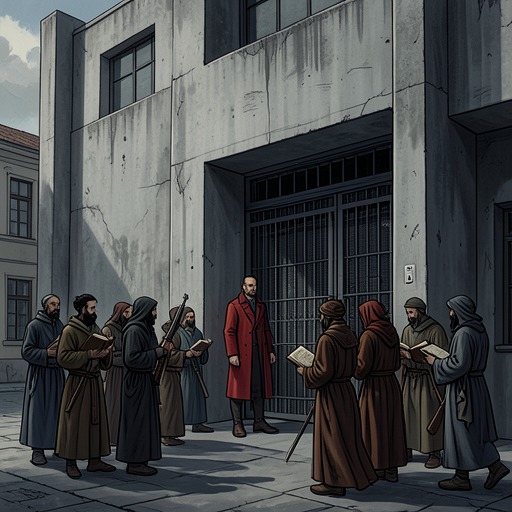
Trial of Seven
Fire & BloodThe Trial of Seven was a public combat between Maegor Targaryen and champions of the Warrior’s Sons, staged in King’s Landing to decide whether Maegor’s contested claim to the Iron Throne could be resisted by force. Its immediate result was a victory that brought the armed order to submission, but the scene also exposed the precariousness of Maegor’s kingship: at the start, the newly crowned king could find only one man willing to stand beside him, and victory left him unconscious and near death for weeks.
Background and Stakes
Maegor’s claim followed the death of his brother, King Aenys. Grand Maester Gawen had objected that the laws of inheritance, affirmed by Aegon the Conqueror, made Aenys’s son Aegon the rightful heir. Maegor rejected that argument and had Gawen executed. Queen Alyssa and her children had already left Dragonstone for Driftmark, while Maegor sent letters to lords across the realm. His succession was thus contested not only by a rival claimant but by the question of whether inheritance or possession of power would determine who ruled.
Maegor’s arrival in King’s Landing made that dispute impossible to ignore. He crossed Blackwater Bay on Balerion, accompanied by Dowager Queen Visenya on Vhagar. The dragons’ return set off riots as people tried to flee the city and found its gates closed. The Warrior’s Sons held the walls, the building sites and pits of what would become the Red Keep, and the Sept of Remembrance on the Hill of Rhaenys. Maegor’s supporters raised their standards on Visenya’s Hill and called for loyal men to join them. Visenya publicly asserted her son’s right and challenged anyone who disputed it to prove the claim through combat. The Warrior’s Sons accepted.
The Champions Gather
The order’s seven hundred knights came down from the Hill of Rhaenys under Ser Damon Morrigen, its grand captain, known as Damon the Devout. Maegor proposed that swords settle the question. Damon invoked the precedent of seven champions on each side, but Maegor had no Kingsguard with him: Aenys had taken them to Dragonstone, and the king stood alone. The challenge therefore became a test of whether his authority could attract defenders as well as command a dragon.
At first the crowd offered no answer. Many turned away or pretended not to hear, fearful of the Warrior’s Sons’ reputation. Dick Bean, a man-at-arms rather than a knight, was the first to volunteer. His decision stirred the others: Bernarr Brune, the squire who had killed Harren the Red and been knighted by Aenys, rebuked the knights for letting a common soldier shame them. Four more then offered their service. Maegor’s six companions were Dick Bean, Bernarr Brune, Ser Bramm of Blackhull, Ser Rayford Rosby, Ser Guy Lothston, called Guy the Glutton, and Ser Lucifer Massey, Lord of Stonedance.
The seven champions of the Warrior’s Sons were Damon Morrigen; Ser Lyle Bracken; Ser Harys Horpe, called Death’s Head Harry; Ser Aegon Ambrose; Ser Dickon Flowers, the Bastard of Beesbury; Ser Willam the Wanderer; and Ser Garibald of the Seven Stars, a septon knight. Damon prayed for strength for their arms, and Visenya gave the signal to begin. The match set the king’s claim against an order that presented its own armed resistance as bound to religious authority and oath.
The Combat and Its Uneven Record
Dick Bean was the first to die, almost immediately after the combat began. Beyond that, the surviving accounts diverge. Chroniclers disagree about the deeds of particular champions and even about whether the fighting lasted hours or ended within moments. Their conflicting versions resist a tidy heroic account: the record preserves striking episodes, but does not offer a single reliable sequence for every fall or blow.
They agree on the eventual position. Maegor remained standing against Damon Morrigen and Willam the Wanderer, both of whom were badly weakened. Although Maegor still held Blackfyre, the outcome was not assured. As Willam fell, he struck Maegor’s helmet with enough force to leave the king unconscious. For a time those watching thought Maegor dead; Visenya had his broken helmet removed and confirmed that he was still alive. The victory went to Maegor, but its immediate cost made the triumph look perilously close to defeat.
Submission and the Unsettled Succession
Seven of the Warrior’s Sons’ champions, including their commander, had died, while more than seven hundred armed members of the order remained around the hilltop. Visenya ordered that Maegor be carried to the maesters. As the bearers took him down, the Swords of the Faith knelt in submission. She then ordered them to return to their fortified sept on the Hill of Rhaenys. The combat had therefore achieved a decisive public result: the armed men who had answered Visenya’s challenge yielded, even though their larger force had not been destroyed.
Maegor did not recover quickly. For twenty-seven days he remained close to death while maesters treated him and septons prayed over him. The Warrior’s Sons continued to debate their obligations inside the Sept of Remembrance. Some argued that the order had to accept Maegor because the gods had granted him victory; others maintained that they remained bound to obey the High Septon and continue fighting. Submission at the end of the combat did not, in itself, erase the dispute over what loyalty required.
Nor did the trial eliminate the rival claim. Queen Alyssa proclaimed her son Aegon the true king on Driftmark, though few answered her appeal. Aegon was far away at Crakehall, surrounded by Poor Fellows and pious peasants who regarded him as an abomination. Meanwhile, the Kingsguard arrived from Dragonstone and, at Visenya’s request, took charge of Maegor’s loyalists and surrounded the Hill of Rhaenys. The archmaesters convened at the Citadel to debate the succession and select a new Grand Maester, while thousands of Poor Fellows moved toward King’s Landing. The trial settled the immediate confrontation with the Warrior’s Sons, not the realm’s competing claims to the crown.
A Contest Between Crown and Legitimacy
The episode belongs to a larger history in which royal authority is made visible through public acts as well as asserted by blood and law. Aegon the Conqueror’s first crowning at the Aegonfort was followed by a second coronation at the Starry Sept, where the High Septon anointed him before a much larger company; that later ceremony became the accepted beginning of his reign. In Maegor’s crisis, however, ritual could not secure uncontested obedience. He turned instead to a trial whose outcome could be read as a judgment from the gods, even as opponents continued to argue from inheritance, oath, and religious authority.
Later coronations during the Dance of the Dragons likewise show how a crown, a title, and public recognition could become stakes in a succession struggle: Aegon II was crowned in the Dragonpit, and Rhaenyra was crowned on Dragonstone after Ser Steffon Darklyn brought her the stolen crown of Jaehaerys. These later events are not part of Maegor’s trial, but they echo its central problem. Possession of a crown or victory in a contest might compel submission in a particular place and moment; neither necessarily ended disagreement over who had the right to rule. The Trial of Seven made Maegor king in the eyes of the men who knelt, while leaving that larger question unsettled.