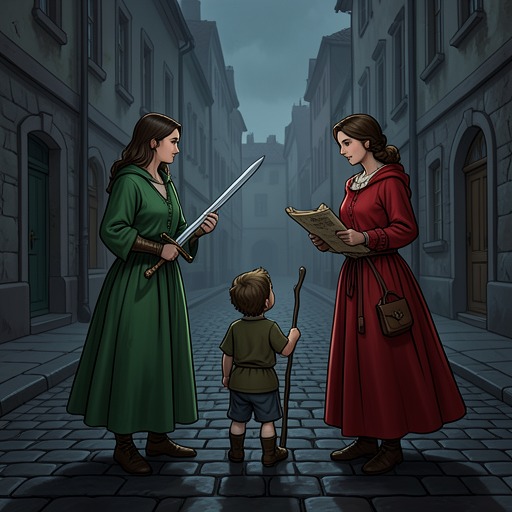
Viserys Targaryen and Alicent Hightower
Fire & BloodThe marriage of Viserys Targaryen and Alicent Hightower became both a royal household and a source of political division. Viserys chose Alicent after the death of his first wife, rejecting a proposed match with Laena Velaryon that might have repaired relations with House Velaryon. Alicent’s children gave her a powerful place in the succession dispute, yet Viserys did not replace Rhaenyra Targaryen as his acknowledged heir. His continued attempts to balance affection for his wife and daughter against the claims advanced by their respective supporters preserved a fragile peace, not a settlement.
The king’s choice and the marriage
After Queen Aemma’s death, Grand Maester Runciter urged Viserys to remarry and proposed Laena Velaryon, then twelve. A marriage to Laena, daughter of Corlys Velaryon and Rhaenys Targaryen, might have healed the growing rift between the Iron Throne and Driftmark. It would also have brought the king into closer alliance with one of the realm’s most powerful seafaring houses. Viserys chose a different course: he announced that he would marry Alicent Hightower, the eighteen-year-old daughter of Otto Hightower, his Hand. Alicent had read to the dying Jaehaerys Targaryen, and the account presents Viserys’s choice as a personal preference rather than a state arrangement.
Alicent’s lineage offered no formal impediment to the match. House Hightower was ancient and noble, and her marriage to the king was celebrated in 106 AC. Still, the decision carried consequences beyond the couple. Some courtiers suspected that Otto had brought Alicent to court with the marriage in mind, while allegations about her conduct before the wedding circulated without proof. The absence of House Velaryon from the wedding made the political cost visible: Corlys had seen his house passed over again, after earlier disappointments involving Laena, Laenor Velaryon, and Rhaenys. At the feast, Rhaenyra poured wine for her new stepmother; Alicent kissed her and called her daughter. The welcome within the Red Keep stood in sharp contrast to the gathering across Blackwater Bay, where Corlys received Daemon Targaryen for a war council.
A growing royal household
Alicent’s marriage soon made her the mother of a succession of royal children. In 107 AC she gave birth to Aegon Targaryen. Two years later came Helaena Targaryen, and in 110 AC she bore Aemond Targaryen. The births secured Viserys’s line with sons as well as a daughter, but they did not alter his public recognition of Rhaenyra as heir. The king had already brought Rhaenyra to court when he held audiences and begun inviting her to meetings of the small council. Even as Alicent’s children arrived, the princess remained at the center of his stated succession plan.
The family’s marriages continued to be shaped by dynastic custom. In 122 AC, Viserys married his eldest son, Aegon, to his daughter Helaena, following the Targaryen tradition of marriage within the family. Helaena was thirteen and Aegon fifteen. Their twin children, Jaehaerys and Jaehaera, were born the following year, and a second son, Maelor, followed in 127 AC. These births created another branch of potential heirs within Alicent’s household. They increased the number of royal claimants without resolving the competing principles at court: Viserys’s designation of Rhaenyra, and the expectation among Alicent’s supporters that the king’s sons should inherit.
The succession and the divided court
The tension between the queen’s interests and the princess’s position developed while Viserys continued to hold Rhaenyra’s succession in place. Alicent’s father, Otto, was among the strongest advocates for his grandsons’ rights. In 109 AC, after the question of succession had been pressed too far, Viserys removed Otto as Hand and appointed Lyonel Strong. The dismissal checked Otto’s immediate influence at court, but it did not dissolve the group of lords favorable to Alicent and her sons. When Otto later returned to Oldtown, a queen’s party remained, set against the party of the princess.
Viserys’s response was to try to preserve the balance rather than force a settlement. He loved both his wife and his daughter, disliked dissension, and sought to please both with gifts, gold, and honors. His approach kept the feasts and tourneys going and maintained peace across the realm during his lifetime, while the court’s opposing factions remained evident. The succession question was not merely a quarrel between relatives: it linked personal loyalties, the king’s public designation, and the expectations created by the birth of Alicent’s sons. Viserys’s refusal to revisit the matter left those forces in place beneath the surface of court life.
Public signs and political legacy
At a great tourney in King’s Landing in 111 AC, held on the fifth anniversary of Viserys and Alicent’s wedding, the court’s division acquired its familiar colors. Alicent wore green; Rhaenyra appeared in Targaryen red and black. The contrast gave the two parties their names: the greens for the queen’s supporters and the blacks for the princess’s. In the tourney, Criston Cole, wearing Rhaenyra’s favor, defeated the queen’s champions, including two of her cousins and her youngest brother, Gwayne Hightower. The event turned household alignments into a public spectacle, but it did not create the underlying dispute: that had grown from the king’s marriage, the birth of his sons, and his continuing recognition of Rhaenyra.
The marriage therefore carried two outcomes at once. It established Alicent as queen and made her children a dynastic center of their own, while the king’s choice had failed to draw House Velaryon into closer alliance with the Crown. Viserys’s efforts to keep peace allowed the competing parties to coexist, but his deference to Rhaenyra’s established position did not extinguish the claims associated with Alicent’s sons. The household he formed with Alicent became inseparable from the unresolved question of who would follow him.