Vulture King’s Revolt
Fire & BloodThe Vulture King’s Revolt was a major uprising along the Dornish Marches that challenged Targaryen authority and drew a vast but uneven rebel host into battle. Its defeat came through the divided force’s failures at Stonehelm and in the west, where marcher lords caught the rebels between converging armies. The revolt’s end is often counted as the end of the Second Dornish War, though the name obscures a central distinction: the Vulture King led the rebellion, while Princess Deria Martell publicly disavowed him and no Dornish lords took the field.
Origins and Growing Rebellion
The revolt emerged amid several threats to the young Targaryen regime. When King Aenys returned to King’s Landing, news from the Vale and Iron Islands had already worsened: Jonos Arryn had imprisoned his brother Ronnel Arryn and proclaimed himself King of Mountain and Vale, while a priest claiming to be Lodos the Twice-Drowned had appeared among the Ironborn. In the Red Mountains, another pretender called the Vulture King summoned Dornishmen to avenge the wrongs done to Dorne by the Targaryens. The crises were distinct, but together they made the realm’s unsettled loyalties plain.
Deria Martell denounced the rebel and declared that she and her loyal Dornish subjects wanted peace. Her stance did not prevent the uprising from gathering strength. Thousands flocked to the Vulture King’s banners, coming down from the hills and up from the sands, and moving by mountain tracks into the Reach. Lord Harmon Dondarrion dismissed the rebels in a letter to the king as undisciplined and conspicuous. The rebellion soon answered that contempt in action: its forces stormed Blackhaven, seized Dondarrion’s castle, and burned it before departing. The Vulture King personally inflicted a severe punishment on Dondarrion, who survived to become a commander against the revolt.
The rebellion became the largest and most threatening of the disturbances along the Dornish Marches. Its army grew to more than thirty thousand, including hundreds of Dornish knights and several thousand seasoned spearmen. Deria continued to condemn the Vulture King from Sunspear, but some suspected that her public opposition concealed support, alleging that she supplied the rebels with men, money, and provisions. The account leaves that suspicion unresolved; the alleged assistance is not established as fact, and Deria did not lead an army against the rebels.
The Divided Campaign
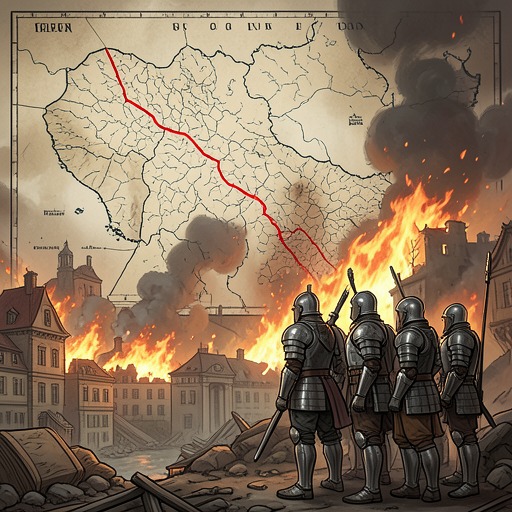
The size of the rebel host encouraged the Vulture King to divide it. He took half west to attack Nightsong and Horn Hill, while the other half marched east to besiege Stonehelm, the seat of House Swann. The eastern army was commanded by Lord Wyl, son of the man known as the Widow-lover. The division placed the two forces on separate campaigns and exposed them to different opponents.
At Stonehelm, Orys Baratheon rode out from Storm’s End for one final campaign. Known as Orys One-Hand, he defeated the Dornish force beneath the castle walls and took Lord Wyl captive, wounded but alive. Orys’s reprisal was deliberately framed as repayment for the loss his own hand had suffered at Lord Wyl’s father’s hands. He imposed a severe mutilating punishment on the captive, calling it usury. Orys himself had been wounded in the battle, and he died on the march back to Storm’s End. His son later recalled him as dying content, a recollection that set the old lord’s sense of vengeance beside the cost of the victory.
The western campaign also turned against the Vulture King. Unable to take Nightsong, he abandoned the siege and marched west. Lady Caron came out in pursuit and joined a force of marcher lords led by Harmon Dondarrion, now the mutilated lord of Blackhaven. Lord Samwell Tarly of Horn Hill then appeared across the Dornish line of march with several thousand knights and archers. The rebel host greatly outnumbered these three forces combined, but much of it lacked training and discipline. Faced by armored opponents at both front and rear, its ranks broke. The Dornish threw down their weapons and fled toward the distant mountains; the marcher lords pursued and killed many of them. The rout became known as the Vulture Hunt.
Capture, Death, and the War’s End
The Vulture King did not escape with the retreating rebels. Samwell Tarly took him alive and held him exposed between two posts. The singers’ version of his death made the vultures that gave him his name the agents of his destruction. The account rejects that tale: he died from thirst and exposure, and the birds arrived only after his death. This contrast between the celebrated story and the stated account gives the rebel leader a death less like the legend attached to his title and more like the outcome of his defeat and capture.
His death is generally treated as the end of the Second Dornish War, but the account qualifies that designation. No Dornish lords took the field, and Deria continued to denounce the Vulture King until the end of his campaigns. The revolt therefore cannot simply be equated with an official Dornish war directed by Sunspear. Its scale, the uncertain allegations about Deria’s aid, and the difference between her declared policy and the rebels’ cause remain part of its political record. The name Vulture King also outlasted this particular claimant: later men adopted it, though whether any shared his blood is unknown.