the Shepherd
Fire & BloodThe Shepherd was an itinerant preacher whose warnings against dragons and the Targaryens gave shape to the terror gripping King’s Landing. As fear of an approaching attack spread, his preaching in Cobbler’s Square drew a crowd that grew from listeners into thousands. He urged the people to destroy the dragons in the Dragonpit; the resulting assault overwhelmed its guards and ended with the dragons dead. Captured after the uprising, he was executed by Aegon II, while the thoroughfare linking his square to the Dragonpit took the name Shepherd’s Way.
Identity and uncertain origins
The Shepherd appears in the account as a wandering brother, dressed in a hair shirt and roughspun breeches, with a begging bowl hung around his neck. He had once been a thief, and one hand was missing. His identity and origins remain unknown: Grand Maester Munkun suggests that he may have been a Poor Fellow, although that order had long been outlawed and wandering Stars still traveled the Seven Kingdoms. The account gives no name beyond the title by which his listeners knew him.
The name the Dead Shepherd comes from Mushroom, whose description emphasizes how the man appeared to him. It is one of several signs that the surviving accounts do not offer a secure biography. Rather than explaining how the Shepherd came to preach in the capital, they present him as an obscure figure who entered the narrative at a moment of public fear. His missing hand is a concrete part of that identification; the evidence does not establish its cause or describe his life with a disability beyond it.
Preaching in a fearful city
The Shepherd emerged in Cobbler’s Square while stories of the slaughter at Tumbleton were spreading through King’s Landing. Many inhabitants feared that dragons would soon attack the city. The gates were kept shut to people trying to flee, and residents sought shelter or consolation in cellars, taverns, brothels, and septs. In this atmosphere of alarm, the Shepherd preached through the night and into the following day, denouncing Queen Rhaenyra and predicting destruction.
His preaching connected the dragons to the ancient sorceries of Valyria, which he portrayed as a source of moral corruption and catastrophe. He claimed that the Targaryens had escaped the Doom by fleeing to Dragonstone, but that a second doom was approaching. In his account, the dragons and their masters threatened not merely their enemies but the survival of Westeros; destroying them became the means by which the city might avoid sharing Valyria’s fate. The argument transformed fear of an expected attack into a demand for action against the dragons already housed in the capital.
The crowd around him grew from a dozen listeners to scores, then hundreds, and by dawn thousands had gathered. Some carried torches. Attempts to silence the preacher met with violence from the crowd, and forty gold cloaks who tried to clear the square were driven off. These details mark a shift in his role: he was not only a preacher addressing a fearful audience but the center of a gathering that could resist the City Watch.
From prophecy to assault
During the later riot, the Shepherd returned to Cobbler’s Square and interpreted the disorder as confirmation of his warnings. He blamed Rhaenyra for the city’s peril and presented the Stranger as a coming force of punishment. When a septa pleaded for him to save the city, he answered that rescue required divine mercy, which the people had lost through their conduct. He then directed the crowd’s attention toward the Dragonpit, declaring that the dragons had to be destroyed if the city was to be cleansed of them.
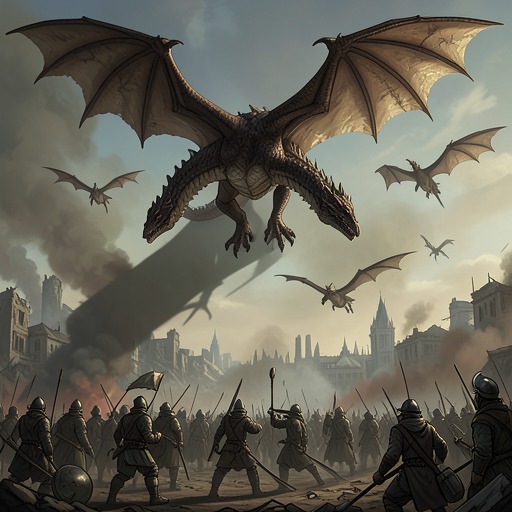
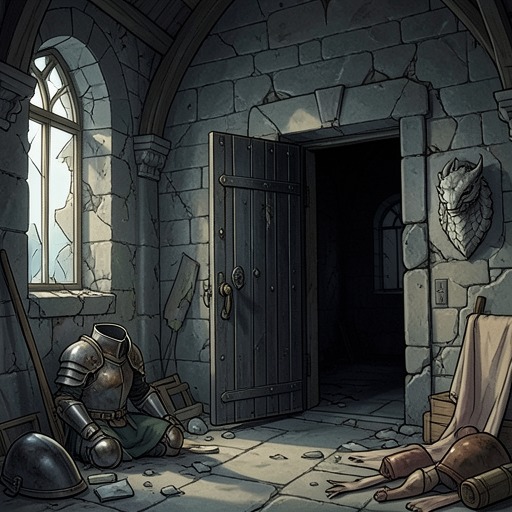
The response was a mass movement toward Rhaenys’s Hill. The crowd’s numbers doubled on the way, and its members carried torches, swords, knives, and other weapons. Gold cloaks sent to defend the hill could not cut through the gathering. At the Dragonpit, fewer than fifty Dragonkeepers were on watch from a total force of seventy-seven. The attackers entered through lesser doors and windows, overwhelmed the guards, and pressed into the building. The four dragons inside were awake by the time the first attackers reached the sands. Trapped within the structure, they could not escape; by the end of the assault, all four had been killed.
The Shepherd’s role in this violence is presented through his preaching and the crowd’s response, not through any account of him personally leading the attack inside the Dragonpit. His repeated insistence that dragon blood was necessary gave the uprising a declared religious purpose, while the fears already circulating in the city supplied its immediate setting. The destruction of the dragons thus followed the course of his public exhortations, even as the crowd’s size and actions exceeded what can be attributed to him alone.
Capture and execution
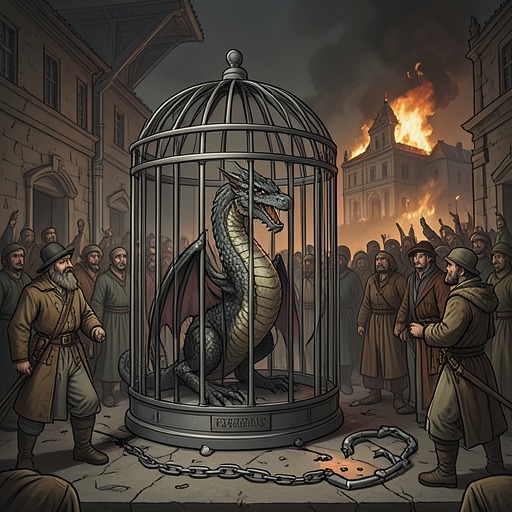
After Aegon II’s forces returned to King’s Landing, the Shepherd called his followers to defend the hill and the Dragonpit ruins. Fewer than three hundred answered, and many fled when Lord Borros and Ser Perkin the Flea led their forces up the hill from opposite directions. The victors found the Shepherd among the deteriorating dragon heads, still preaching. They took him alive and carried him to the Red Keep in chains.
Brought before the Iron Throne, he refused to repent or admit treason. Aegon II ordered his tongue removed with hot pincers and condemned him and his followers to death by fire. On the last day of the year, 241 of the most devoted followers were chained along the road from Cobbler’s Square toward the Dragonpit. Aegon proceeded along it in his litter as his knights used torches to light the way. At the top of the hill, supported by two Kingsguard, the king rose from his cushions and set the Shepherd aflame himself. The road was thereafter known as Shepherd’s Way.
Narrative role and aftermath
The Shepherd’s brief appearance links the city’s fear of a military threat to an uprising against the dragons within its walls. His preaching gives that fear a stark explanation and an immediate target; the crowd’s increasing size, its expulsion of the gold cloaks, and its march to the Dragonpit show how quickly that explanation became a collective cause. His downfall then reverses the scene: the preacher who called for the destruction of the queen’s order is captured by the forces restoring Aegon II’s authority and executed before the year ends.
The story does not resolve the Shepherd into a known political or religious identity. Munkun’s suggestion that he might have been a Poor Fellow remains uncertain, and his personal history is otherwise lost. What remains is the public force of his preaching and the name attached to a changed place in the city. Shepherd’s Way preserves the connection between Cobbler’s Square and the Dragonpit, recalling both the route of the uprising and the king’s final procession against the preacher and his followers.