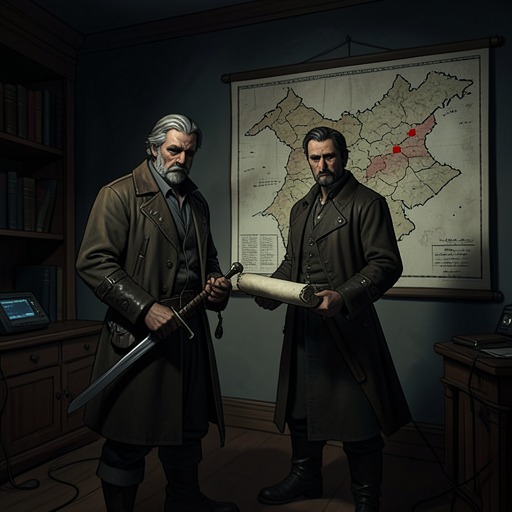
Aegon III and Viserys II's Brotherhood
Fire & BloodAegon III and Viserys II's Brotherhood is defined in the account by a shared stand against the seizure of Viserys’s wife and by their united resistance to a contested change of government. At Maegor’s Holdfast, the thirteen-year-old Viserys confronts armed men with a battleaxe rather than allow them to take his wife; Aegon then joins him, insisting that the king’s authority and the brothers’ own judgment cannot simply be set aside. Their solidarity gives visible force to a family bond within a struggle over who may rule in Aegon’s name.
Brothers at Maegor’s Holdfast
Viserys’s defiance begins when Ser Amaury Peake arrives with a dozen men-at-arms to take his wife for questioning. Viserys, described as a slight boy of thirteen, stands on the drawbridge holding a battleaxe and tells the knight that he will not pass while Viserys remains there. The threat is plainly unequal: Mushroom doubts the boy could even lift the weapon, much less wield it. Its significance lies less in its practical force than in the protection Viserys offers his wife, and in his willingness to place himself between her and the armed men.
The confrontation becomes a joint act of resistance when Aegon III steps out beside his brother. He identifies himself as king and objects that he never appointed Ser Marston Waters as Hand. Amaury replies that Aegon is still a boy and that his regents have authority to choose for him. Viserys supports Aegon’s claim and exposes the circularity of the officials’ argument: the Hand appoints the regent, and the regent appoints the Hand. He warns that the men will not pass or touch his wife. Aegon, in turn, takes Viserys by the shoulder and draws him back into the holdfast’s safety when Amaury orders his men to move the boys aside. The brothers do not merely make parallel objections; each acts to defend the other as the standoff escalates.
Loyalty and the regency dispute
Their opposition is directed at more than the immediate attempt to take Viserys’s wife. Lord Thaddeus Rowan has been removed from the regency, and Ser Marston has become Hand without Aegon’s consent. Aegon’s insistence that Rowan remains his regent shows that he regards the change as an affront to his authority. Viserys reinforces that position at the drawbridge, using the officials’ own institutional logic against them while standing beside the king rather than accepting their claim that the brothers are powerless minors.
Marston later tries to persuade Aegon to come out, pledging that no one will harm him while Marston stands beside him. Aegon rejects the appeal by recalling Marston’s presence when Aegon’s mother died and his failure to protect her. The memory reveals that Aegon’s resistance is rooted not only in the present dispute over appointments, but also in a profound distrust of the man now claiming to safeguard him. Viserys’s earlier intervention and Aegon’s later refusal of Marston’s protection together place the brothers’ loyalty above the assurances of the regency’s officers.
The confession and Aegon’s judgment
The brothers’ solidarity is tested again when Thaddeus Rowan is brought forward in chains and, after being tortured, appears to confess to treason. His account implicates Viserys, Viserys’s wife, and Gaemon Palehair, as well as naming others connected to the alleged plot. Aegon is left speechless at Rowan’s appearance and confession. Viserys answers the charges by asking whether his wife was involved, then challenges the implication that Gaemon was guilty, insisting that Gaemon had done nothing wrong. His words defend those close to him even while Rowan’s coerced statement implicates Viserys himself.
Aegon then declares Rowan innocent of treason and identifies the men who tortured him to obtain the confession as the true traitors. He orders Ser Marston to seize Lord George Graceford, the Lord Confessor. The command resolves the immediate danger to Rowan and his household, but it also shows Aegon acting on his own judgment rather than accepting the regents’ version of events. Viserys’s challenge to the confession and Aegon’s decision to reject it form a shared defense of the accused Hand, extending their alliance beyond protection of Viserys’s wife.
Significance of the bond
The episode gives the brothers’ relationship political consequences. Viserys does not defer to the men surrounding the king when he believes his wife is at risk; he stands beside Aegon and asserts the king’s authority. Aegon reciprocates by protecting Viserys from the armed men and later refusing the protection offered by Marston. Their actions do not erase the danger of the regency struggle, but they make clear that neither brother treats the other as expendable in it.
The account’s decisive image is the pair at the holdfast gate: Viserys armed and refusing to yield, Aegon stepping beside him, and the king finally drawing his brother back from the advancing men. Their alliance is expressed through concrete acts of protection, then renewed when the brothers reject a coerced confession and challenge those who claim to govern for them. In these scenes, brotherhood is both family loyalty and a claim that the king’s choices—and the safety of his brother’s household—cannot be overridden without resistance.