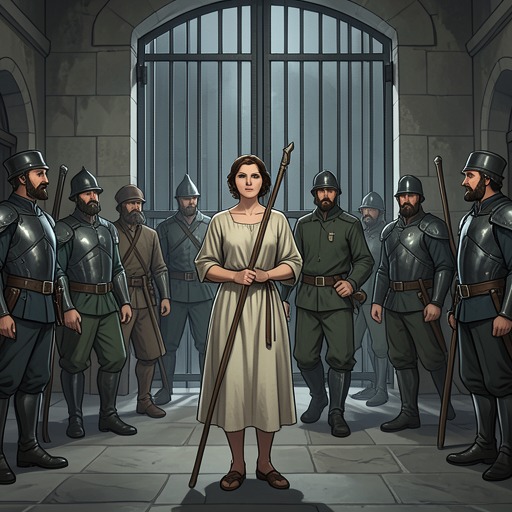
Alys Rivers
Fire & BloodAlys Rivers is a wet nurse whose uncertain parentage, association with Prince Aemond Targaryen, and eventual claim to rule Harrenhal make her one of the most enigmatic figures to emerge from the Dance of the Dragons. The histories alternately describe her as a servant, a captive, a mother, a sorceress, and a self-appointed queen. They establish that she survived the destruction of House Strong and became the center of an armed faction at Harrenhal, but leave the source of her supposed powers unresolved.
Identity and disputed origins
Alys was among the smallfolk captured when Daemon Targaryen took Harrenhal. She was identified as a wet nurse, a role that gave her an intimate place in the castle’s household: although all her own children had been stillborn, her abundant milk had nourished many children born to other women there. The surviving accounts disagree sharply about who she was beyond that work. Munkun calls her a serving woman who practiced potions and spells; Septon Eustace describes a woods witch. Mushroom offers a more sinister account, presenting her as an enchantress who maintained her youth through blood magic. These descriptions are allegations and interpretations, not a settled account of her abilities.
Her parentage is equally uncertain. Her surname suggests that she was born a bastard, but little is known of either parent. Munkun and Septon Eustace say that Lord Lyonel Strong fathered her in his youth, which would make her a natural half-sister to Harwin Strong and Larys Strong. Mushroom disputes that account, insisting that she was much older and may have served as wet nurse to the two brothers and even to their father. The accounts offer no final resolution. What is clear is that Alys was at least forty during the Dance, and that observers agreed she looked younger than her age; they disagreed over whether this was ordinary appearance or evidence of sorcery.
Harrenhal during the war
Alys’s presence at Harrenhal brought her into the orbit of two rival princes. When Daemon captured the castle, its castellan, Ser Simon Strong, surrendered rather than risk the destruction associated with Black Harren. The castle’s wealth and valuable hostages passed into Daemon’s hands, and Alys was among the captives. Although the castle became an important base for Rhaenyra’s supporters, little was reported about Alys while Daemon held it. The histories specifically leave her supposed supernatural influence uncertain and say that Daemon appeared immune to it.
The castle changed hands again after Daemon departed. Aemond took Harrenhal, and Alys became his paramour. She was described as twice his age, or perhaps older still if Mushroom’s account is accepted. The record treats their relationship as part of the aftermath of conquest: Alys was spared when the men and boys of House Strong were killed, while Aemond chose her over the other women in the castle. The sources do not explain what Alys wanted from him or how she understood their relationship; they record the unequal circumstances and the political and personal consequences that followed.
When Harrenhal stood empty after Aemond left, Lady Sabitha Frey seized it and found Alys there, pregnant. Alys claimed that the child was Aemond’s and described the pregnancy as proof of his legacy. Her declaration foreshadowed the more explicit political claim she would make later. At this stage, however, the record confirms only that she asserted she carried his child; it does not establish the child’s status or the truth of her claim.
Visions and the final flight
Daemon returned to Harrenhal after his vigil in the ruined castle, and Aemond arrived with Alys on Vhagar. As the two princes prepared to fight, Aemond credited Alys with finding Daemon: he said that she had seen his uncle in a storm cloud, a mountain pool at dusk, and the fire used to cook their meals. The account presents the claim through Aemond’s words, without independently confirming what Alys saw or how she might have known where Daemon was.
Alys watched from Kingspyre Tower as the dragons rose over the Gods Eye. The duel ended with both dragons and both princes falling into the lake. The narrative gives no account of Alys’s immediate response or subsequent whereabouts at that moment. Her importance to the episode lies partly in the contrast between her position as a watcher on the tower and Aemond’s reliance on her supposed sight: she is not merely a captive or companion in this telling, but the person credited with directing him to his final encounter. Yet the evidence does not make that attribution proof of magic.
The witch queen and her claim
In the years that followed, Harrenhal became a refuge for outlaws, robber knights, and other broken men who preyed on travelers, fishers, and farmers. Reports said that their numbers had grown and that a powerful witch queen ruled them. When the royal government sent Ser Regis Groves to reclaim the castle, expecting to face only a few squatters, he found its gates shut and hundreds of armed people on the walls. At least six hundred people were inside, about a third of them of fighting age.
The woman who came out to negotiate was Alys. A child stood beside her, and she said he was Aemond’s trueborn son and heir, and the rightful king of Westeros. This claim went far beyond her earlier assertion that she was carrying Aemond’s child: she now presented the boy as a legitimate successor and demanded that the king’s knight submit to him. Regis rejected the claim and refused to kneel. The sources identify the child as Aemond’s according to Alys, but do not independently establish either his paternity or legitimacy.
The assault and the limits of the record
What happened to Regis is expressly disputed. Some accounts say that Alys raised a hand and that he died amid an apparent supernatural assault. Others say her gesture signaled a crossbowman, while Mushroom suggests a sling could explain what the witnesses saw. The histories therefore preserve both the impression of sorcery and ordinary possible explanations, without resolving which account is true. They agree that Regis died at the encounter’s outset, after which Alys’s riders charged from Harrenhal and routed the royal force.
Ser Damon Darry escaped with about thirty-two other men from the hundred who had set out. The next day, another survivor arrived: a captive released after being made to watch the others die under torture, and sent to deliver Alys’s warning that no one should approach her walls unless prepared to yield. He also reported that she had cursed him and that Harrenhal possessed a dragon. When one of Lord Darry’s men laughed, the messenger began to choke and died. The account says that marks resembling a woman’s fingers were seen on his skin, but does not establish what caused his death. Alys’s power is thus conveyed through testimony, fear, and competing explanations rather than a definitive demonstration.
The regents did not accept the stories of sorcery and a dragon as fact; Unwin Peake dismissed the matter as the work of outlaws, and the others agreed that a stronger force would be needed to retake Harrenhal. The castle and its armed inhabitants remained a problem for the government as the year ended. Alys’s story consequently closes not with her defeat or a confirmed supernatural revelation, but with her continued hold over a ruined stronghold and a claim to kingship that the authorities neither accepted nor immediately overcame.