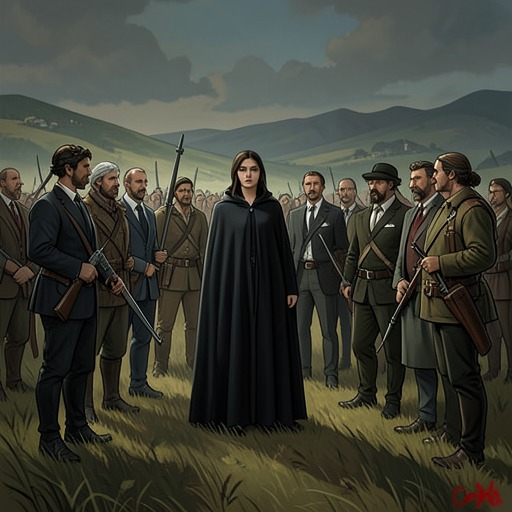
Benjicot Blackwood
Fire & BloodBenjicot Blackwood, called Bloody Ben, inherited the lordship of Raventree as a child and became one of the Riverlands’ most prominent commanders during the Dance of the Dragons. His youth never kept him from taking authority in battle: he led Blackwood forces through costly campaigns, witnessed the devastation they brought, and continued to seek the field. After the war, he helped turn military ties between the Riverlands and the North into lasting settlement, while remaining an influential lord under Aegon III Targaryen.
Boy Lord of Raventree
Benjicot was eleven when he appeared among the fresh riverland levies at the Fishfeed, alongside other lords and commanders. His father, Lord Samwell Blackwood, had been killed by Ser Amos Bracken at the Battle of the Burning Mill, leaving Benjicot to inherit Raventree young. Rather than hand authority to older men, he kept command for himself. That choice placed a boy at the head of a house whose military power mattered to the riverlords, and made his childhood inseparable from a war in which his family had already suffered a personal loss.
At the Fishfeed, the riverland forces attacked the westermen from three sides and drove them back toward the waters of the Gods Eye. The fighting left two thousand dead by nightfall. The Winter Wolves, who had insisted on leading the assault, charged five times into the Lannister spears; more than two-thirds of the men who had ridden south with Lord Dustin were dead or wounded. Benjicot wept at the sight of the heaps of dead. The episode gives a striking counterpoint to his later reputation: he was not untouched by the cost of battle, even as he continued to command in it.
Command in the Dance
By the time Benjicot was twelve, he had already become a seasoned warrior. At Second Tumbleton he commanded the center, and he watched the dragonfight from horseback, about fifty yards away. Vermithor and Seasmoke were locked together in the mud when Tessarion joined the struggle. Years later, Benjicot recounted to Grand Maester Munkun that Vermithor’s greater size and weight seemed likely to overcome Seasmoke. The surviving account records the dragons’ deaths but cannot establish what would have happened had Tessarion not entered the fight.
Tessarion survived until sunset, repeatedly failing to take flight and appearing to suffer. Benjicot summoned his best archer, a longbowman called Billy Burley, and placed him a hundred yards away, beyond the range of the dragon’s fires. Burley shot three arrows into Tessarion’s eye as she lay helpless. The act was a grim command decision made amid a field where dragons and human combatants alike had been brought low. When the riverlords withdrew at moonrise, Benjicot carried the broken body of Ser Addam Velaryon from beside his dragon. Addam’s remains rested at Raventree Hall for eight years; in 138 AC, his brother Alyn returned them to Driftmark for burial at Hull. The tomb’s inscription, “LOYAL,” preserves a public judgment on Addam’s allegiance—and the connection between his death and the young lord who carried him from the field.
Benjicot’s battlefield authority continued after Second Tumbleton. His men helped drive Criston Cole from Harrenhal by hunting down the foragers on whom his force depended. During the Muddy Mess, Benjicot led the flank attack from the woods; the assault broke Lord Baratheon’s stormlanders and won the day. In that engagement, he earned the name Bloody Ben, by which he was known thereafter. The name suggests a fearsome warrior, but the account of his earlier grief complicates any simple portrait of a boy hardened by violence: he could be both an effective commander and a witness to the human cost of his victories.
The boy and the commander
Benjicot was thirteen when he rode with the forces accompanying Aegon III Targaryen from the Trident to the gates of King’s Landing. In court dress, he was described as tall but slight, with a sensitive face and a shy, self-effacing manner. In mail and plate, he seemed entirely different: a young lord who had seen more fighting at thirteen than many men saw in a lifetime. The contrast between the guarded boy at court and the battlefield commander was not merely a difference of appearance. His authority had been formed in a war that repeatedly required him to make decisions among older and more experienced men.
His place in the postwar political order was consequential but not always formal. Benjicot was among the notable figures omitted from the council of regents, though the account distinguishes him from Unwin Peake, the only exclusion said to have truly angered its subject. Later, when Peake pushed forward a betrothal for Aegon III Targaryen, Benjicot questioned its haste and argued that the young king should have been allowed time to mourn Jaehaera Targaryen. His objection put the king’s grief and the pace of a politically important marriage ahead of Peake’s plan, without establishing that Benjicot opposed the match itself on other grounds.
Black Aly and the northern alliance
Benjicot’s aunt Alysanne Blackwood, known as Black Aly, was also a military figure. A huntress, horse-breaker, and exceptional archer, she accompanied her nephew to court and council, where she met Cregan Stark. Benjicot’s household and the northern host became linked through her relationship with the Stark lord. After the royal wedding, more than a thousand Northmen returned to the Riverlands with Alysanne and Benjicot. Their resettlement was part of a broader effort to reconnect communities after the war: hundreds of marriages were made at the Widow Fairs held at Raventree, Riverrun, Stoney Sept, the Twins, and Fairmarket, while Northmen who did not marry entered the service of riverland lords. The newcomers strengthened, in particular, House Tully and the Blackwoods, and helped spread the worship of the old gods south of the Neck.
In 132 AC, Benjicot led a party north along the kingsroad to witness Alysanne’s marriage to Cregan at Winterfell. The journey took three times as long as expected because winter had already settled over the North. Snowstorms and outlaw attacks cost the party horses, provisions, and all the wedding gifts, but the wedding itself was reported to be splendid. Alysanne and Cregan pledged their troth before the heart tree in Winterfell’s godswood. The journey’s hardships show the distance and difficulty involved in making the alliance tangible; Benjicot’s presence connected the Blackwood family to a marriage that helped bind northern and riverland interests beyond the battlefield.
Later campaigns and legacy
Benjicot remained an active military lord after the immediate settlement of the Dance. When spring made the high road through the Mountains of the Moon seem passable, five thousand men set out under Ser Robert Rowan. Levies from Maidenpool, Darry, and Hayford joined them; after they crossed the Trident, six hundred Freys and a thousand Blackwoods under Benjicot brought the force to nine thousand as it entered the mountains. The detail marks the continuing military weight of his house and his own role in assembling forces for a new campaign.
His career is defined by the tension between age and responsibility. Lordship fell to him through his father’s death, and war made him a commander before he had outgrown boyhood. He did not retreat into a merely ceremonial role: he held authority, took part in hard-fought campaigns, and carried a fallen ally from the battlefield. Yet accounts also retain his grief at the Fishfeed and his concern that Aegon III Targaryen be given time to mourn. His later importance lay not only in leading troops, but in helping connect the Riverlands to the North through family, service, and resettlement.