Blacks and Greens
Fire & BloodThe Blacks and Greens were the two principal factions in the struggle for the Iron Throne that followed the death of Viserys I Targaryen. Built around rival claims by his daughter Rhaenyra and his eldest son by Alicent Hightower, Aegon II, they turned a dispute within the royal family into a war that divided the realm and gravely reduced Targaryen power.
Origins of the Rival Claims
The conflict, fought from 129 to 131 AC, arose from the competing claims of Rhaenyra, the only surviving child of Viserys’s first marriage, and Aegon, his eldest son by his second. Succession precedent made the dispute especially combustible: the Great Council of 101 had favored a male claimant over a female by twenty to one, and Otto Hightower had warned that, if that precedent governed, a king’s brother would outrank a king’s daughter. The rival claims therefore invoked different grounds of legitimacy, while the question of who would inherit the Iron Throne remained unresolved at Viserys’s death.
The factions’ names were reflected in the rival councils that organized their causes. Grand Maester Munkun called the meeting held by Alicent’s party the green council; the gathering on Dragonstone that Rhaenyra presided over became the black council. The contrast marked more than competing colors: each faction assembled its own court, declared its own authority, and began preparing for a struggle that neither side expected the other to abandon.
The Green Council and Aegon’s Accession
After Viserys died in the Red Keep, Alicent and her allies met in Maegor’s Holdfast. The council included her father, Otto Hightower, as Hand; Criston Cole, Lord Commander of the Kingsguard; Grand Maester Orwyle; Lyman Beesbury, master of coin; Tyland Lannister, master of ships; Larys Strong, master of whisperers; and Jasper Wylde, master of laws. Orwyle proposed the customary response to a king’s death, including informing Rhaenyra and preparing for her coronation. Otto insisted that those steps wait until the succession was settled. Orwyle warned that passing over the princess would lead to war, while Beesbury objected to the attempt to take her crown and emphasized that she had sworn supporters.
The green council moved to secure the means of rule before announcing Aegon’s accession. Tyland replaced Beesbury as master of coin and divided the royal treasury: one portion went to the Iron Bank of Braavos, another to Casterly Rock, a third to Oldtown, and the remaining funds were reserved for gifts, bribes, and hiring sellswords if necessary. Otto also sought an alliance with Dalton Greyjoy, offering him the admiralty and a seat on the council. Meanwhile, ravens went to lords considered sympathetic to Aegon; the news was not sent to Dragonstone at once. The faction thus treated money, appointments, communications, and prospective military support as parts of the same contest for authority.
Aegon was crowned in the Dragonpit, where Criston placed the iron-and-ruby crown of Aegon the Conqueror on his head. Alicent placed her own crown on Helaena, Aegon’s wife and sister, and knelt before her. The ceremony gave public form to the new king’s claim, but the response in the city was uncertain: accounts differed over the size of the crowd, and reports described many smallfolk as silent or wary, with some calling for Rhaenyra. Even before the coronation, a Kingsguard defection had carried a different royal crown to Dragonstone, making the symbols of succession part of the rivalry itself.
The Black Council and Rhaenyra’s Claim
On Dragonstone, Rhaenyra convened the black council after hearing of Aegon’s accession and suffering the loss of her stillborn daughter. She presided with Daemon Targaryen and Maester Gerardys; her sons Jacaerys, Lucerys, and Joffrey were present, as were Ser Erryk Cargyll and Ser Lorent Marbrand. The island’s garrison consisted of thirty knights, a hundred crossbowmen, and three hundred men-at-arms. Corlys Velaryon and Rhaenys Targaryen also supported Rhaenyra, and a dozen lesser lords with ties to Dragonstone attended. Corlys’s fleets gave her cause an important source of strength at sea.
Rhaenyra was crowned the following day with the crown of Jaehaerys the Conciliator, brought from King’s Landing by Ser Steffon Darklyn and other loyalists. Daemon placed it on her head, named her queen, and claimed the title Protector of the Realm; she named Jacaerys Prince of Dragonstone and heir. Her first declaration branded Otto and Alicent traitors, but she offered to spare her half-brothers and Helaena if they came to Dragonstone and submitted. The offer showed that her claim still invoked kinship as well as authority, even as the rival coronation made accommodation increasingly difficult.
The black council debated how to turn its alliances and dragons into an effective campaign. Some urged an immediate attack on King’s Landing, but Corlys argued that the aim was to rule the city, not destroy it. Rhaenyra also rejected the assumption that her side could simply overwhelm Aegon’s dragons: she was not yet able to fly, the dragons at Dragonstone did not all have riders, and three of the available mounts would be ridden by her sons. The council instead chose a combined strategy. Daemon would attack Harrenhal, the Velaryon fleet would close the Gullet and restrict shipping in Blackwater Bay, and envoys would seek support from Riverrun, the Eyrie, Pyke, and Storm’s End. Jacaerys and Lucerys volunteered to carry those appeals by dragon; Rhaenyra permitted them to go as messengers only, after they swore not to fight.
A Realm Divided
The factions drew in lords, knights, and smallfolk across the Seven Kingdoms, while House Targaryen itself divided as the claimants’ kin and children became involved. Their competition relied on networks of allegiance as well as royal ceremony: the greens secured the treasury and courted distant allies, while the blacks relied on Dragonstone’s supporters, Corlys’s fleet, and diplomatic missions intended to bring other great houses to their side. Earlier Targaryen policy had sought to bind former enemies to the realm through court service and marriages between noble houses. The civil war exposed how fragile that political unity remained when the succession itself was contested.
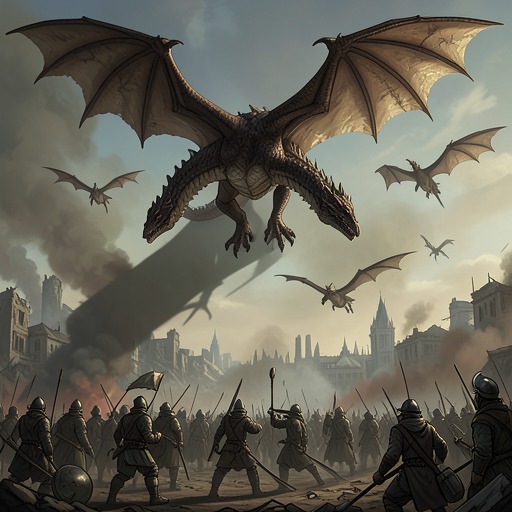
The conflict was not confined to armies meeting in battle. Fighting took place on land and water, and dragons fought in the air; stealth, murder, betrayal, and political maneuvering also shaped the struggle. The rivalry’s violence reached the capital’s streets as well. During the attack on the Dragonpit, a crowd gathered against the royal dragons, while Rhaenyra’s remaining city forces were too few to offer a confident defense. The scene showed how far the struggle had escaped the councils and castles where it began: the competing claims now put the city’s people and the dragons themselves in danger.
Consequences and Significance
The Dance of the Dragons ended with the Targaryen dynasty still on the Iron Throne, but its power was substantially diminished. The great lords, their followers, knights, and smallfolk paid a heavy price, and the world’s last dragons were greatly reduced in number. The names Blacks and Greens consequently stand for more than two claimants or two royal households: they mark the division of a kingdom, the fracture of a dynasty, and the destructive consequences of leaving succession contested.