Cobbler’s Square
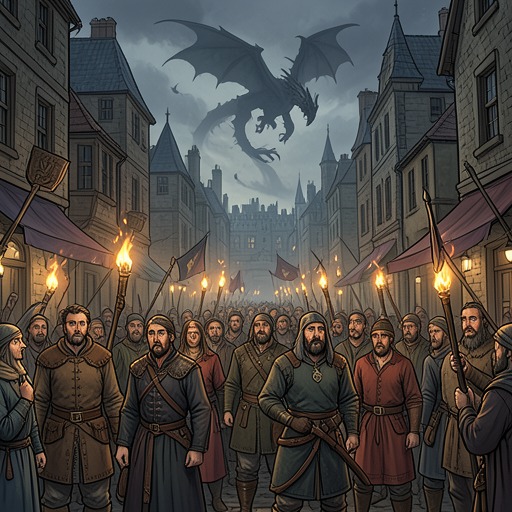
Fire & BloodCobbler’s Square became the focal point of popular resistance to Rhaenyra Targaryen in King’s Landing. A gathering that began around an itinerant preacher grew into a mass assembly, turning the square into a place where fear of an approaching dragon attack could be organized into open hostility toward the queen and her rule.
Setting and the Shepherd’s Arrival
The account places Cobbler’s Square at the heart of a city gripped by fear. Reports of the slaughter at Tumbleton spread through King’s Landing, and many residents expected the conflict to reach the city. Some tried to flee but were turned back at the gates; others sought shelter or consolation elsewhere. Against this atmosphere, the square offered a public platform for a preacher whose message gave the city’s anxieties a target.
The man, known only as the Shepherd, was described as a barefoot, itinerant brother in rough clothing, carrying a begging bowl. He had once been a thief and had lost his right hand. Grand Maester Munkun suggested that he might have belonged to the outlawed Poor Fellows, though the account leaves his origins and identity uncertain. His name was not preserved, and the square became the setting in which his public reputation took shape.
A Crowd Forms Around the Sermons
The Shepherd preached through the night and into the following day, condemning Rhaenyra and presenting dragons as demonic creatures whose presence threatened the realm. His sermons linked the Targaryens’ Valyrian origins and the city’s immediate danger to a coming doom. The square’s crowd grew by stages: a dozen listeners became scores, then a hundred, and by dawn thousands had gathered to hear him.
The assembly became increasingly difficult to control. Many listeners carried torches, and by nightfall the Shepherd stood within a ring of fire. People who tried to silence him were attacked by the crowd. When forty Gold Cloaks attempted to clear the square with spears, they were driven away. Cobbler’s Square had shifted from a venue for preaching into a gathering capable of resisting the city’s authorities.
The Square During the Riot
As riots spread through King’s Landing, their sounds reached Cobbler’s Square from every quarter. The Shepherd treated the disorder as confirmation of his warnings and urged the crowd to see the violence as a sign that judgment was near. A thousand torches illuminated the square as listeners joined his cries. In response, the City Watch later assembled five hundred men there under Ser Luthor Largent. The sight of the force sent hundreds fleeing into nearby streets and alleys, and more ran when Largent ordered an advance.
Renewed Preaching and Political Significance
The Shepherd returned to Cobbler’s Square the next night. The previous night’s dead had been cleared away, but the crowd was reported to be twice as large and three times as fearful. Its members dreaded the arrival of King Aegon’s dragons and no longer trusted the queen to protect them; they looked instead to the Shepherd for deliverance. He directed their attention toward the Dragonpit on Rhaenys’s Hill and urged them to destroy the dragons if they wanted the city to be theirs.
The square’s significance lies in this transformation: a public space became a rallying point where private terror, religious condemnation, and opposition to the queen reinforced one another. The Shepherd’s influence did not depend on a known name or established office. In Cobbler’s Square, the size and intensity of the crowd gave his preaching a political force that the Gold Cloaks could not simply disperse.