Green Council Coup
Fire & BloodThe Green Council Coup turned the death of King Viserys Targaryen into a contest over who could control the succession before the realm learned that he was dead. In the queen’s apartments, Queen Alicent Hightower and the king’s councillors set aside the ordinary public rites and notifications, asserted that the Iron Throne belonged to Aegon, and began preparing his coronation. Lord Lyman Beesbury’s death silenced the council’s only recorded defender of Rhaenyra’s claim; the secrecy and violence of the meeting made the change of ruler not a settled inheritance but the first decisive move in the Dance of the Dragons.
Death and Secrecy
The council met after Alicent went to Viserys’s bedchamber with Criston Cole, the Lord Commander of the Kingsguard, and confirmed that the king was dead. She ordered the chamber sealed and guarded, and the serving man who had found the body was taken into custody to prevent him from spreading the news. Cole returned to White Sword Tower and sent the Kingsguard to rouse the small council. The meeting began at the hour of the owl, while the wider court and the rival claimant remained uninformed.
The secrecy shaped the advantage Alicent’s party sought. No raven was sent to Dragonstone, where Rhaenyra was confined and about to give birth, and no bells rang to announce the king’s death. Servants who knew what had happened were sent to the dungeons. Eustace later argued that the quiet delivery of the news to Alicent alone was no accident, and that the guards and servants had been instructed in advance about what to do when Viserys died. That account presents the silence not as a momentary delay but as a method: control of information could buy the council time to arrange the succession before Rhaenyra could respond.
The Council and the Succession Dispute
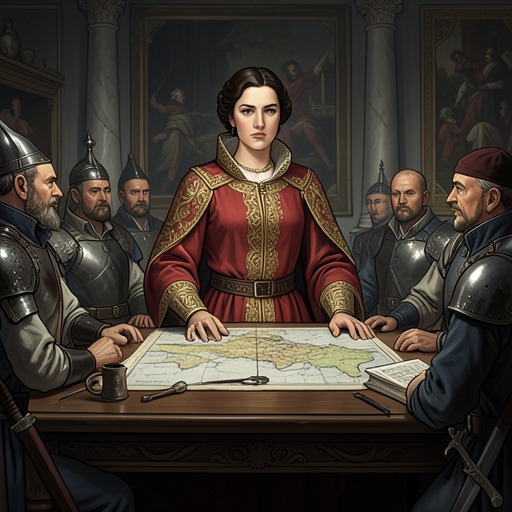
The meeting took place in Alicent’s apartments in Maegor’s Holdfast. Its members were Alicent; her father, Otto Hightower, Hand of the King; Cole; Grand Maester Orwyle; Beesbury, the eighty-year-old master of coin; Tyland Lannister, master of ships; Larys Strong, master of whisperers; and Jasper Wylde, master of laws. Munkun’s later history calls the gathering the green council. Its account of the deliberations depends substantially on Orwyle, who had attended and participated, but who also had reason to present his own conduct favorably. Eustace and Mushroom offer different versions, relying on rumor, hearsay, or family accounts. The surviving narrative therefore records both the political action and uncertainty over some of its details.
Orwyle began by listing the customary duties following a king’s death: summon Eustace to perform the last rites, send a raven to Dragonstone, ring the bells, and begin preparations for Rhaenyra’s coronation. Otto interrupted. He insisted that these steps must wait until the succession was settled, arguing that his authority as Hand allowed him to govern until a new king was crowned. Alicent made the council’s position explicit: she maintained that the throne rightfully passed to Viserys’s eldest trueborn son. The dispute was thus not simply over which ceremony to perform first. The council’s proposed pause in customary procedures created space to act against the succession Viserys had previously established.
Beesbury set out the case for Rhaenyra: she was older than her brothers, Viserys had chosen her as heir and repeatedly refused to change that decision, and lords and landed knights had sworn to defend her rights in 105 AC. He also invoked her greater Targaryen ancestry. These arguments echoed the unresolved force of earlier succession decisions. At the Great Council of 101 AC, the assembled lords had chosen Viserys over Laenor Velaryon by an overwhelming margin; many subsequently treated that choice as a precedent against a woman inheriting the Iron Throne or transmitting a claim to her male descendants. Yet Viserys’s designation of Rhaenyra and the oaths sworn to her provided a competing basis of legitimacy, one the green council chose not to honor.
Dissent and the First Blood
Orwyle warned that displacing Rhaenyra could lead to war: she would not simply stand aside, and she had dragons. Beesbury answered that she also had friends and that men of honor would remember their vows. He rose to leave rather than accept what he described as a plot to take her crown. His departure became the meeting’s point of no return. The chronicles disagree about how he died. Orwyle says Otto ordered him seized and confined in a black cell, where he later died while awaiting trial. Eustace says Cole forced him back into his seat and killed him with a dagger; Mushroom also blames Cole, but says Beesbury was thrown from a window. The accounts do not agree on the manner, but all three identify Beesbury as the first person killed in the Dance of the Dragons.
After his death, no further dissent was recorded. The council turned to the practical work of securing Aegon’s accession: planning a rapid coronation and drawing up lists of potential allies and enemies in case Rhaenyra refused to accept him. Alicent’s party understood that her confinement on Dragonstone and ignorance of her father’s death delayed her ability to act. Cole was assigned to take into custody courtiers thought likely to support her. Otto’s instruction was that those who bent the knee to Aegon should not be harmed; Wylde added that those who refused were traitors and should die. The language of allegiance and treason made submission the test by which the new regime would distinguish a subject from an enemy.
Larys spoke only once during the meeting. He proposed that the conspirators swear first, in case there were traitors among them, and urged a blood oath binding them as brothers. The men cut their palms and clasped hands; Alicent was excused from the oath on account of her womanhood. The ceremony turned private agreement into a mutual pledge, while also exposing a distinction within the council: its male members performed the oath together, but the queen who directed the succession was not required to join it.
Coronations and Consequences
The bells finally rang on the tenth day of the third moon of 129 AC. Orwyle was allowed to send ravens, and riders announced Viserys’s death and Aegon’s accession through King’s Landing. The reports describe divided reactions: some wept, others cheered, and many smallfolk watched in confusion or wariness; occasional voices called for Rhaenyra. The delay had ended, but the announcement did not produce a universally accepted succession.
Aegon’s coronation was held in the Dragonpit, chosen in part because its strong walls, roof, and bronze doors made it defensible. Cole placed the iron-and-ruby crown of Aegon the Conqueror on the new king, while Alicent crowned her daughter Helaena as queen. The ceremony invoked the authority of a conqueror’s crown and the familiar public forms of anointing and proclamation, but the High Septon was absent in Oldtown, so Eustace performed the anointing. Accounts differ sharply over how many people witnessed the crowning: Munkun reports more than a hundred thousand, while Mushroom says the benches were only half full.
The rival coronation on Dragonstone made the division unmistakable. The night before Aegon’s crowning, Steffon Darklyn had escaped King’s Landing with Viserys’s crown, the yellow-gold band set with seven differently colored gems that Viserys and Jaehaerys had worn. On Dragonstone, Daemon Targaryen placed that crown on Rhaenyra and proclaimed her queen; she named Jacaerys her heir and declared Otto and Alicent traitors. The opposed crowns recalled the broader history of Targaryen rule, in which public standards and sacred anointing had helped turn conquest into recognized kingship, but here ceremony could not settle the competing claims. The Green Council Coup secured Aegon’s immediate possession of the capital and the first public coronation, while its concealment, coercion, and rejection of Rhaenyra’s sworn succession ensured that the struggle would continue by force.