Helaena Targaryen
Fire & BloodHelaena Targaryen was a daughter of King Viserys I and Alicent Hightower, a dragonrider, and, through her marriage to her elder brother Aegon II, queen and mother to the heirs of the green faction. Her life became bound to the Dance of the Dragons not through military action but through dynastic ceremony, the murder of her son, and the grief that followed. Her death, under circumstances that remained a matter of dispute, helped turn the people of King’s Landing against Rhaenyra and preceded a popular uprising that destroyed the city’s dragons.
Identity and Dynastic Position
Helaena was one of Alicent Hightower’s children with King Viserys I. Her brothers included Aegon II, Aemond Targaryen, and Daeron Targaryen. When the succession crisis came, her position was layered: she was Aegon’s sister and queen, the mother of his children, and herself a member of the royal house. The royal marriage made her a visible part of the green claim, but the chronicle gives little indication that she directed its political strategy.
In 129 AC, as the small council prepared for Aegon’s accession, Helaena was having breakfast with her children when the Kingsguard came looking for him. Asked where her brother and husband was, she answered with a dry remark that he was not in her bed and that the guards could search beneath the blankets. The exchange offers a rare glimpse of her voice before the public ceremonies and disasters that came to define her story.
Marriage, Children, and Dreamfyre
In 122 AC, Viserys arranged for Helaena, then thirteen, to marry her fifteen-year-old brother Aegon, in keeping with the marriage custom of House Targaryen. The account contrasts Aegon’s laziness and indulgence with Helaena’s pleasant and cheerful disposition, and records the expectation that she would make a good mother. The marriage produced children, but did not restrain Aegon’s conduct: the chronicle reports that he fathered two bastard children in the same year that Helaena gave birth to twins.
In 123 AC, Helaena gave birth to Jaehaerys and Jaehaera. A dragon’s egg was placed in each child’s cradle, and both eggs hatched. The twins’ early lives were marked by differences that the court noticed: Jaehaera was unusually small and slow to develop, while Jaehaerys had six fingers on his left hand and six toes on each foot. Helaena later gave birth to a second son, Maelor Targaryen, in 127 AC.
Helaena was also a dragonrider. She flew Dreamfyre, a she-dragon who had previously carried Rhaena Targaryen. Her brother Aegon rode Sunfyre, and Daeron had Tessarion, while Aemond remained without a dragon in 120 AC. The chronicle’s account of Helaena’s dragon is at first part of the royal family’s abundance: several children had dragons or hatchlings, and the court expected Aemond eventually to claim one. Later, Dreamfyre’s fate would become inseparable from the loss of Helaena herself.
The Dance and the Murder of Prince Jaehaerys
The last recorded visit between Helaena’s children and their grandfather took place on the third day of the third moon of 129 AC. Helaena brought the twins, then six, and two-year-old Maelor to see the ailing Viserys. The king gave Maelor a pearl ring and told the older children a familiar story about their namesake, Jaehaerys, and a journey north to defeat wildlings, giants, and wargs. He sent them away when he grew tired; he died after falling asleep. His death opened the succession struggle in which Helaena’s husband and half-sister Rhaenyra became rival claimants.
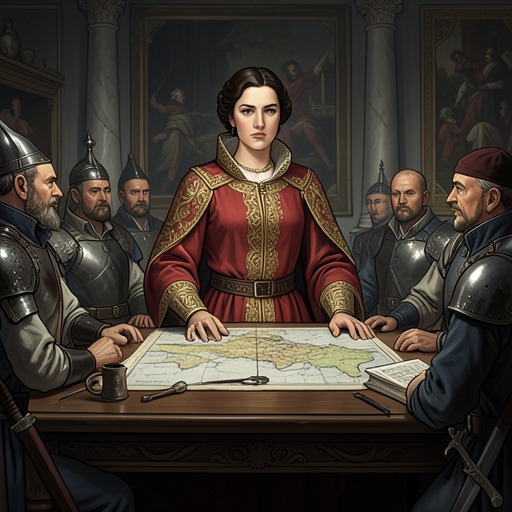
During the green council’s preparations to crown Aegon, Helaena was with her children. After Aegon’s coronation at the Dragonpit on Rhaenys’s Hill, Alicent placed her crown on Helaena and knelt before her, acknowledging her as queen. The ceremony made Helaena’s status unmistakable, but offered no protection from the war that followed.
The decisive personal catastrophe came when Blood and Cheese entered the Red Keep by a hidden passage and waited in Alicent’s chambers for Helaena to bring the children. They seized Maelor and forced Helaena to choose which son would die. She named the younger boy, perhaps believing he would understand less or hoping to spare the elder, who was Aegon’s heir. Instead, the attackers killed Jaehaerys and escaped with his head. Helaena had pleaded to be killed in her son’s place; afterward, the account says, she could no longer bear to look at Maelor because she had named him.
The murder changed Helaena’s life even though she herself survived the attack. She stopped eating, bathing, and leaving her chambers. Aegon took Maelor from her and entrusted him to Alicent to raise as her own. Aegon and Helaena thereafter slept apart, while he raged and drank and she sank further into distress. In the chronicle’s account, the murder is not simply a blow to the green succession: it leaves a mother alive with the knowledge of the choice the attackers forced her to make.
Captivity, Death, and Contested Accounts
When Rhaenyra took King’s Landing, her men found Helaena confined in her bedchamber. Aegon II had escaped with the surviving children, Jaehaera and Maelor, and two Kingsguard; even Alicent did not know where they had gone. Helaena remained in the city under Rhaenyra’s rule. Her captivity, like her earlier withdrawal, is presented as a condition of profound isolation rather than as a return to public life.
After about half a year, Helaena died by falling from a window in Maegor’s Holdfast. The sources disagree about what led to her death. Mushroom offers an account involving sexual abuse and pregnancy, which the chronicle rejects as no more credible than his tale of the Brothel Queens. Grand Maester Munkun suggests that the deaths of two knights may have driven her to act, but the account notes there is no evidence that she knew them or witnessed their deaths. Septon Eustace proposes that Mysaria told Helaena of Maelor’s death and its circumstances that night, while acknowledging that the reason for such an act is unclear. None of these proposed explanations is established as fact.
A different story spread through the city: that Rhaenyra had ordered Helaena killed. The chronicle treats this as a calumny, noting that Helaena posed no threat to Rhaenyra and that Luthor Largent, named in the rumor as the killer, was elsewhere with hundreds of gold cloaks when Helaena died. The speed with which the accusation gained currency nevertheless mattered. Helaena had once been beloved by the smallfolk, while Rhaenyra was hated; memories of Jaehaerys’s murder and Maelor’s death at Bitterbridge intensified the contrast. Helaena’s death thus became both a private loss and a public accusation, whether or not the accusation had any truth.
At the moment Helaena died, Dreamfyre rose with a roar and broke two of the chains binding her. During the later assault on the Dragonpit on Rhaenys’s Hill, Dreamfyre broke her remaining restraints and fought the attacking crowd. She killed many before being wounded and bringing down part of the dome in a final attempt to escape. Her death, following Helaena’s, gives the loss of the queen’s dragon a stark place in the wider destruction of the dragons.
Aftermath and Narrative Significance
Helaena’s death was followed that night by a bloody riot in King’s Landing. The crowd called for justice for the dead princes and their mother, and attacked people and property across the city. The riot forms part of the political consequence of her death: the rumor that Rhaenyra had murdered a queen the people loved turned grief and existing anger into open revolt.
Her remaining daughter, Jaehaera, survived and was later delivered safely to Storm’s End by Willis Fell. Alicent, who had outlived all her children, was eventually confined to her apartments in Maegor’s Holdfast. After the Dance, Alicent’s grief and isolation continued; she died during the Winter Fever after a year spent largely alone. These later events do not undo Helaena’s own ending, but show how her death belonged to a wider destruction of the family around her.
Helaena’s story is shaped by the contrast between the forms of royal continuity she embodied and their collapse. Her marriage produced heirs, her children received dragon eggs, and her coronation publicly confirmed her place beside Aegon. Yet dynastic status could not shield her children from political violence, nor restore her capacity to live after Jaehaerys’s murder. The chronicle leaves the cause of her death unresolved while showing its consequences clearly: a city’s trust breaks, a queen’s reputation becomes a weapon, and Dreamfyre’s loss joins the Dance’s mounting destruction.