House Martell
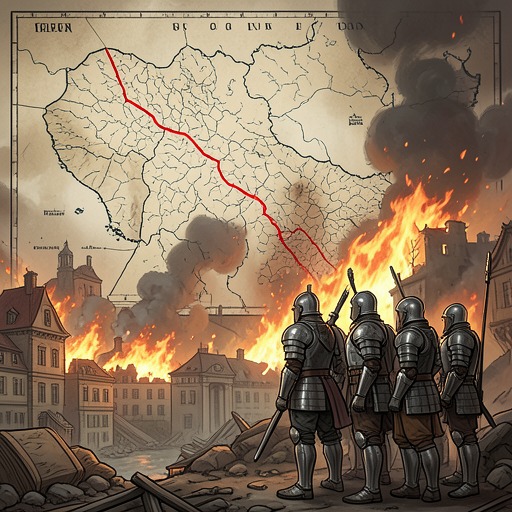
Fire & BloodHouse Martell was the ruling house of Dorne, whose resistance to Aegon Targaryen’s conquest made it the one realm his dragons could not bring to submission. Its defining early achievement was to outlast invasion without surrendering its independence: after years of costly conflict, peace came through negotiation, not victory by the Iron Throne.
Sunspear and Dornish Rule
Sunspear, the ancient seat of House Martell, was the center of Dornish rule. During Aegon’s invasion, Rhaenys Targaryen crossed the Red Mountains and found Vaith and Godsgrace deserted; at the Planky Town, the floating settlement where the Greenblood met the sea, few people remained. The pattern was one of retreat from the invaders rather than a decisive battle at the gateways to Dorne. Rhaenys eventually reached Sunspear, where Meria Martell awaited her in the abandoned castle.
Meria was eighty years old and had ruled the Dornish for sixty years. Blind and in poor health, she nevertheless retained her political judgment. She rejected both battle on the terms offered by the invaders and submission to their king, making clear that Dorne did not recognize a king who could command its obedience. Her refusal was not a declaration of a rival claim to the Iron Throne; it was a defense of Dornish self-rule. Rhaenys warned that the Targaryens would return with fire and blood, while Meria answered by asserting that force could devastate Dorne without making it yield. The queen and princess parted without agreement, and Dorne remained unconquered.
Resistance and the First Dornish War
The refusal at Sunspear became the defining political position of House Martell during the First Dornish War, fought from 4 to 13 AC. The conflict exacted a severe price: by its later years Dorne was described as a land afflicted by famine, plague, and blight. Yet House Martell maintained its resistance. A captured Dornish knight told Queen Visenya that Meria would sooner see her people die than become subjects of House Targaryen, an account that presents the conflict as a struggle over autonomy as well as military power.
The Martell position exposed a limit to the conquest that had brought the other kingdoms under Targaryen rule. Aegon had dragons and armies, but the capture of territory did not secure Dornish allegiance. Meria’s strategy was disparaged by some lords and knights north of the Red Mountains, who treated the Dornish outcome as dishonorable rather than as a successful defense of independence. That reaction also revealed how sharply the meaning of the war divided the victors from the people who had resisted them: what the conquerors called evasion or dishonor, Dorne could regard as survival without submission.
Meria’s Death and the Peace Settlement
Age and illness, rather than an invading army, ended Meria’s rule. She died in 13 AC, and her son Nymor Martell succeeded her as Lord of Sunspear and Prince of Dorne. Sixty years old and already in failing health, Nymor had little appetite for further slaughter. He opened his reign by sending an embassy to King’s Landing, led by his daughter Deria. The delegation returned the skull of Meraxes, the dragon killed in the Dornish conflict, and carried Nymor’s terms for peace.
The proposal met resistance at court. Queen Visenya and her allies opposed making peace without Dornish submission, and other lords urged harsh treatment of Deria. Aegon rejected those proposals and protected the princess as an envoy who had come under a banner of peace. The decision mattered because accepting peace without submission risked making the Iron Throne appear to have failed to impose its rule; the king’s advisers also feared that other subjects might take encouragement from such a settlement. Aegon was close to refusing the terms when Deria delivered a sealed letter from her father.
Aegon read Nymor’s letter in open court while seated on the Iron Throne. He burned it, did not disclose its contents, and that night flew across Blackwater Bay to Dragonstone. On his return the next morning, he accepted Nymor’s terms, and the two sides soon concluded a treaty of eternal peace. The reason for the sudden change remains unknown. Later accounts variously describe the letter as an appeal from one father to another, a reckoning of the war’s dead, or a threat against Aegon’s young heir, Aenys; none establishes what Nymor actually wrote. The uncertainty leaves the settlement’s private cause obscure, but its public consequence is clear: the First Dornish War ended without House Martell acknowledging Targaryen sovereignty.
Later Alliances and Dornish Influence
House Martell’s independence continued to shape its dealings with the wider political world. In 132 AC, Aliandra Martell ruled Dorne and presented herself as a new Nymeria. When Lord Alyn Velaryon brought a large fleet to the waters off Sunspear, the Dornish were alarmed, but Aliandra treated his arrival as a visit rather than an attack. Alyn needed fresh water and provisions for his ships; Aliandra supplied both, along with charts of dangerous whirlpools along Dorne’s southern coast. The meeting thus joined political caution to practical exchange, allowing the fleet to continue toward Oldtown and the Arbor.
The reports differ over the personal character of Aliandra’s reception of Alyn, but agree that her attentions to him displeased Dornish lords and angered her younger siblings, Qyle and Coryanne. The episode shows that the ruler’s choices could have consequences within the Dornish court as well as beyond it. A few years later, House Martell’s reach extended into another powerful network when Drazenko Rogare married Aliandra and became her Prince Consort and Lord of the Stepstones. The marriage coincided with the height of House Rogare’s influence, linking the ruling house of Dorne to Lys and to authority over the Stepstones.
Significance
House Martell’s history in these accounts is marked by the distinction between military defeat and political submission. Meria’s resistance did not spare Dorne the destruction of war, but it denied Aegon the conquest he had achieved elsewhere. Nymor’s diplomacy then converted that endurance into a peace which preserved Dornish independence. Under Aliandra, the house appears not only as the guardian of that settlement but as an active participant in maritime and dynastic politics, negotiating with fleets and joining its ruling family to the Rogare ascendancy. Across these episodes, House Martell’s power rests less on an ability to match the Iron Throne’s dragons than on maintaining its own terms of rule and choosing when to resist, negotiate, or form alliances.