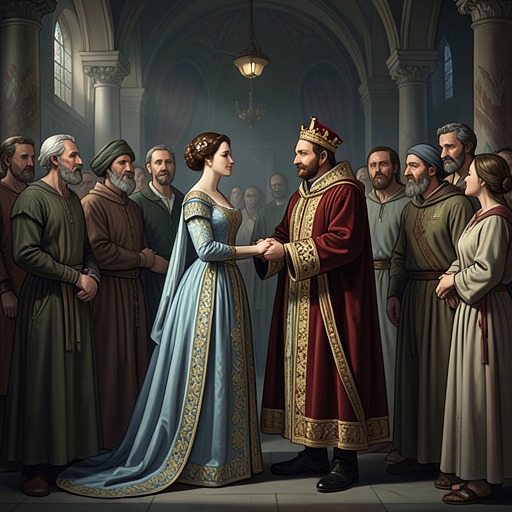
Jaehaerys and Alysanne's Second Quarrel
Fire & BloodJaehaerys and Alysanne's Second Quarrel was a marital and political rupture over the succession to the Iron Throne. When Jaehaerys I Targaryen preferred his son Baelon Targaryen to his granddaughter Rhaenys Targaryen, Alysanne Targaryen challenged the decision as a judgment against women’s capacity to rule. Her departure from King's Landing made a private disagreement visible across the realm, while their eventual reunion did not resolve the question that had divided them.
Background to the Dispute
The conflict followed the death of Prince Aemon, whose daughter was Rhaenys. Jaehaerys chose Aemon’s brother, Baelon, as heir instead. Rhaenys objected directly, speaking to the king with a hand on her pregnant belly and arguing that the decision robbed her son of his birthright. Her husband, Corlys Velaryon, was so angry that he relinquished his admiralty and his place on the small council and took her back to Driftmark. Rhaenys’s mother, Jocelyn Baratheon, and her uncle, Boremund Baratheon, also opposed the choice.
Alysanne became the most prominent dissenter. Having helped Jaehaerys rule for many years, she saw the appointment of Baelon as more than a decision between two members of the royal family: it passed over her granddaughter on account of her sex. She challenged the premise that a woman could not rule, insisting that judgment and integrity—not being male—were what a ruler required.
Departure and Estrangement
Alysanne’s protest became an act of separation. She left King's Landing and flew on her dragon, Silverwing, to Dragonstone. Jaehaerys and Alysanne remained apart for two years, and the histories record this period as the Second Quarrel. Her departure gave the succession dispute a personal cost that a council decision alone could not convey: the king’s choice had divided the royal household as well as the court.
The disagreement unfolded as the question of Rhaenys’s children became clearer. The unborn child whose birth had been part of the dispute proved to be a girl, Laena, born in 93 AC; Rhaenys had a son, Laenor, the following year. By then Baelon was firmly established as heir apparent. House Velaryon and House Baratheon nevertheless continued to regard Laenor as having a stronger claim, while some also maintained the claims of Laena and Rhaenys. The family dispute thus persisted beyond Alysanne’s initial protest and attached itself to the claims of the next generation.
Reconciliation Without Agreement
In 94 AC, their daughter Septa Maegelle helped bring Jaehaerys and Alysanne back together. The reconciliation ended their estrangement, but it did not produce agreement on the succession. Their marriage resumed without settling the principle at stake: whether the Iron Throne could pass through a woman or be inherited by a woman in her own right.
Alysanne held to her view until her death in 100 AC, at sixty-four. She continued to believe that Rhaenys and Rhaenys’s children had been unfairly deprived of their rights. The quarrel therefore ended as a period of separation, not as a resolution of the royal family’s competing claims.
Succession and Legacy
The later Great Council of 101 AC brought the question into a wider political forum. Corlys and Rhaenys arrived at Harrenhal seeking support for their son Laenor, but the lords chose Viserys Targaryen by a reported margin of more than twenty to one. Jaehaerys, who had not attended, accepted the verdict and named Viserys Prince of Dragonstone. The council’s decision was thereafter treated by many as a precedent against a woman inheriting the Iron Throne or transmitting a claim to her male descendants.
The Second Quarrel did not itself establish that precedent, but it records the resistance it would encounter within the royal family. Alysanne’s opposition gives the succession dispute a clear dissenting voice, while the later council shows how decisively the lords settled the question in practice. Their reconciliation restored the king and queen to one another; it could not reconcile their views of who should inherit.