Kingsguard
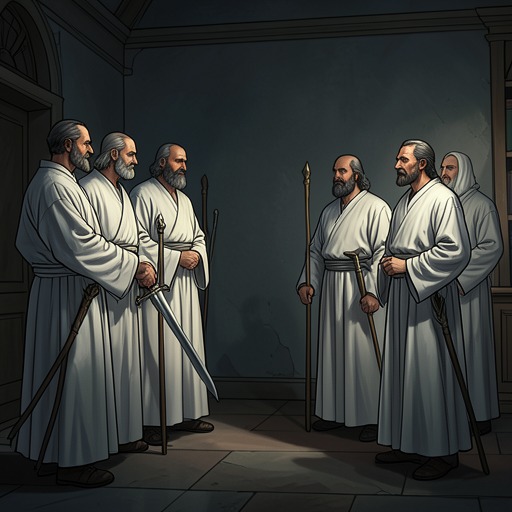
Fire & BloodThe Kingsguard is a brotherhood of seven knights sworn to devote their lives to defending the king and his kin. Its white cloaks signify an ideal of proven prowess and loyalty, but the history of the order repeatedly tests that ideal against political allegiance, personal ambition, and the cost of vows. Its members serve as protectors, royal representatives, and, at moments of crisis, participants in the struggles over who holds the crown.
Composition and Charge
The Kingsguard is described as a sworn brotherhood of seven knights, selected for their loyalty and prowess. Their vows require them to defend the king and his family with their lives. The charge is not simply ceremonial: the knights are expected to stand between the royal household and physical danger, as when Ser Gyles Morrigen warned armed men away from King Jaehaerys and the queen, or when Ser Erryk Cargyll served as Princess Rhaenyra’s sworn shield after she was sent to Dragonstone.
The order’s responsibilities extend beyond a single royal residence. During a journey from King’s Landing to Oldtown, Ser Joffrey Doggett accompanied Queen Alysanne, while Jonquil Darke flew with Jaehaerys. The arrangement balanced the weight carried by the dragons, but it also placed sworn protectors beside both monarchs along the route. In wartime, the same obligation could put members of the brotherhood on opposite sides: the vows were to defend the king and kin, while succession disputes divided the royal family they served.
Rebuilding and Choosing the White Cloaks
After Maegor’s fall, the new reign began with the problem of what to do with the surviving Kingsguard. Five of Maegor’s seven knights remained alive. Ser Olyver Bracken and Ser Raymund Mallery had abandoned the late king and gone over to Jaehaerys, but the boy king treated their change of allegiance as a breach of their sworn duty to defend the king’s life. He sentenced all five survivors to death. At Princess Alysanne’s urging, however, the four who accepted clemency were allowed to exchange their white cloaks for the black of the Night’s Watch and depart for the Wall; Ser Olyver and Ser Raymund were among them.
The fifth survivor, Ser Harrold Langward, demanded trial by battle. Jaehaerys offered to fight him himself, but the Queen Regent prevented the king from entering the contest. Ser Gyles Morrigen, a young knight from the Stormlands, fought as the Crown’s champion and defeated the elderly Kingsguard knight. His victory helped establish his loyalty to the new king, and he was soon appointed Lord Commander.
With only Ser Gyles and Ser Joffrey Doggett appointed to the reconstituted order, Queen Regent Alyssa proposed filling the remaining five places through contests of arms at her wedding, when knights from across the realm would be gathered. Jaehaerys supported the proposal but directed that candidates prove themselves on foot rather than in jousts. The contests became known as the War for the White Cloaks: a public test of arms intended to find protectors whose courage and loyalty could be demonstrated before the realm. The selection process made the order’s renewal visible, linking the king’s security to a spectacle in which potential members had to earn their places.
Service, Discipline, and Succession
The Kingsguard’s authority rested on its vows, and the order’s own members could insist that those vows be honored. Ser Ryam Redwyne discovered that Ser Lucamore Strong had secretly taken three wives and fathered sixteen children, in violation of his white-cloak vows. Ryam brought the matter to the Lord Commander, who reported it to the king. Ser Gyles Morrigen, speaking for the sworn brothers, argued that Lucamore’s conduct had dishonored their common office and sought his death. Jaehaerys connected the violation of Lucamore’s marriage and chastity vows to the question of whether he could be trusted to keep his promise to defend the royal family. The scandal therefore exposed a central anxiety of the institution: if a knight treated one sacred obligation as dispensable, the Crown could not easily rely on his other promises.
The order’s membership also had to be renewed as its knights died. During the Shivers in 59 AC, the Kingsguard lost two members, among them Ser Sam of Sour Hill and Ser Victor the Valiant. Once the epidemic passed, Ser Gyles Morrigen brought forward two knights, and Jaehaerys gave white cloaks to Ser Ryam Redwyne and Ser Robin Shaw. Ryam later became the knight who exposed Lucamore’s secret marriages, showing how a new appointment could shape the order’s internal discipline as well as its numbers. After Ser Willam the Wasp died, Jaehaerys chose Ser Lucamore Strong, victor of the great melee in the Dragonpit, to fill the vacancy; that appointment would later become the source of a major breach of trust.
Division During the Dance
The Dance of the Dragons revealed how a brotherhood sworn to one royal family could be split by rival claims. At the death of King Viserys, only five of the seven white cloaks were in King’s Landing: Ser Criston Cole, Ser Arryk Cargyll, Ser Rickard Thorne, Ser Steffon Darklyn, and Ser Willis Fell. Ser Erryk Cargyll and Ser Lorent Marbrand were with Rhaenyra on Dragonstone and had no part in the first actions taken by the members in the capital. The divided location of the knights became a political divide within the order.
Ser Steffon Darklyn defected from the city with his squire, two stewards, and four guardsmen, escaping through a postern gate to a waiting fishing skiff bound for Dragonstone. He also carried away the crown worn by Viserys and Jaehaerys, a gold band set with seven differently colored gems. Aegon II chose to wear the Conqueror’s iron-and-ruby crown, while Queen Alicent had ordered Viserys’s crown locked away; the steward entrusted with it had instead made off with the older royal emblem. Darklyn’s flight thus joined a personal defection to the transfer of a symbol of royal continuity.
The struggle also turned the sworn brothers against one another directly. After Blood and Cheese killed Aegon II’s heir, Ser Criston Cole proposed sending Ser Arryk Cargyll to Dragonstone in disguise as his twin, Ser Erryk, to take vengeance on Rhaenyra. Arryk entered the castle under that deception, but encountered his brother near the royal apartments. They recognized what the other’s presence meant and fought. The episode brought the institutional conflict into its starkest form: two Kingsguard, each bound to the royal cause he served, met as adversaries within the same family’s stronghold.
The Regency and the Cost of Service
The order remained entangled in royal government after the war. When Aegon III, still ten years old, became king, Ser Willis Fell, the sole survivor of Viserys’s Kingsguard, was made Lord Commander, with Ser Marston Waters as his second. Since both men were regarded as Greens, the remaining places were filled with Blacks. The appointments made the order’s factional composition explicit even as it resumed its protective role around a child monarch.
After Aegon II’s death, Lord Cregan Stark condemned Ser Gyles Belgrave and three other Kingsguard who had been present in the city. Belgrave was held responsible for the king’s death, whether through direct involvement or failure to prevent it; the complicity of the other three could not be proved. Those who were not in the city were judged innocent. Belgrave refused the opportunity to take the black, accepting that a Kingsguard should not outlive a king who had died violently, and Cregan executed him with Ice. The episode placed the order’s strict code of service beside the danger of collective punishment: presence at the king’s death could itself become grounds for judgment, even where guilt remained unproven.
In a later crisis, Ser Marston Waters and the Kingsguard controlled the Red Keep while Ser Lucas Leygood and the gold cloaks held the city. Marston defended the men’s actions to Aegon III by arguing that, while the king was a child, the Kingsguard were bound to obey the Hand, who spoke with the king’s voice. That claim exposed the tension between protecting the monarch and serving the government acting in his name. The conflict ended with revelations of conspiracy against the regency. Ser Mervyn Flowers, a Kingsguard knight, was named among the conspirators; when Ser Marston confronted him, Flowers turned on his sworn brother and was killed while attempting to escape. The white cloak could mark a shared oath, but it could not prevent its bearer from becoming a political enemy.
The order was restored to seven members during Torrhen Manderly’s regency. With the Lord Commander, Manderly appointed Ser Edmund Warrick, Ser Dennis Whitfield, and Ser Agramore Cobb to fill the places left by Marston Waters, Mervyn Flowers, and Amaury Peake. Across these successive changes, the Kingsguard’s continuity depended on repeated selection and replacement. Its history is therefore not only a record of royal defense, but also of the unstable bond between sworn service and the contested authority of the Crown.